
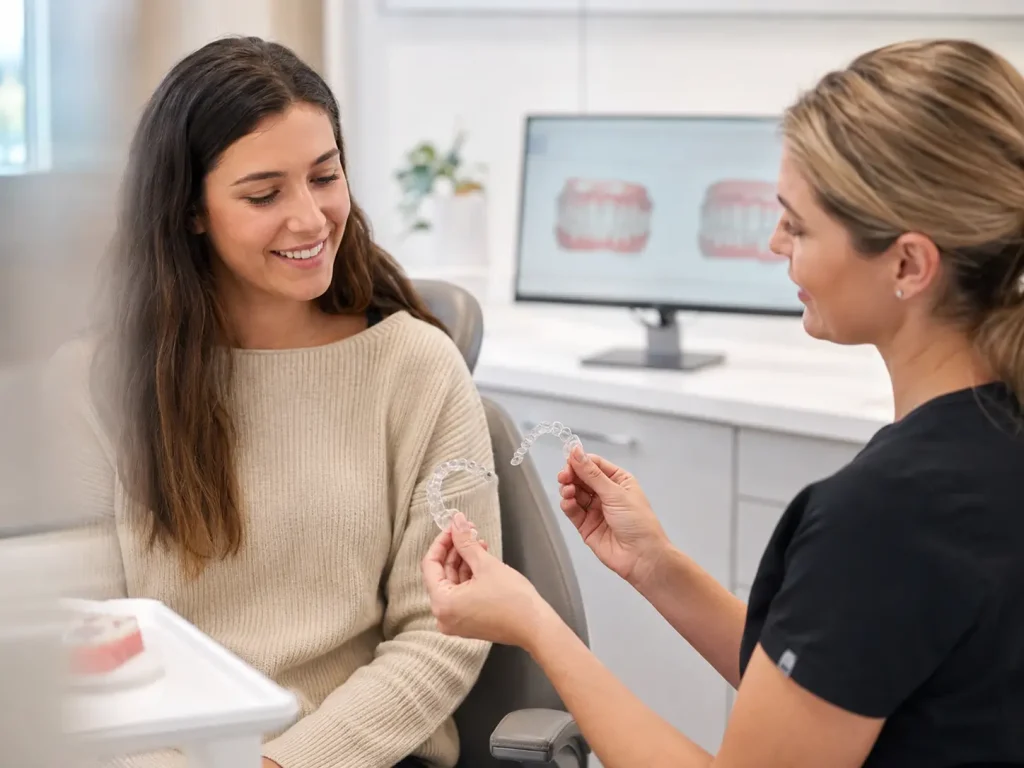
You reached the last tray in your Invisalign series, slipped it in, and started counting down to the finish line. Then, at what you assumed was your final appointment, your orthodontist scanned your teeth and said the words you were not expecting: you need refinements. If your first reaction was a quiet mix of confusion and disappointment, that is completely understandable. Most people hear “more aligners” and immediately wonder whether something went wrong.
Here is the reassuring reality: refinements are not a setback, and they are certainly not a sign of failure. In fact, they are one of the most common and expected parts of clear aligner treatment. Throughout this guide, we will explain exactly what refinements are, why the research shows nearly everyone needs them, what happens at your refinement appointment, and how you can lower your own chances of needing extra rounds.
First, the Reassuring Truth: Refinements Are Normal
Let us settle the anxiety before we go any further. Needing refinements does not mean your aligners failed, your orthodontist made a mistake, or your teeth are somehow uncooperative. Rather, it means your treatment is being fine-tuned to reach the exact result your orthodontist planned from the start, instead of stopping at “close enough.”
In practice, experienced orthodontists anticipate refinements from day one. Because they are so predictable, most treatment plans build them in as an expected phase rather than an unwelcome surprise. So, while the word might sound like a correction, it is really just the detailing stage of a well-run process.
What Exactly Are Invisalign Refinements?
Invisalign refinements are additional sets of custom aligners, ordered near the end of your treatment (or sometimes partway through), that fine-tune movements the first series did not fully complete. Think of them as the finishing touches on a detailed project. Your initial aligners handle the bulk of the work, guiding your teeth along the path mapped out in your digital treatment plan, much like the process we describe in our article on how aligners straighten teeth. Refinements then close the small gap between where your teeth landed and where they were designed to finish.
To create them, your orthodontist takes a fresh 3D scan of your teeth in their current position, compares that reality against the original goal, and orders a new, shorter series of trays that targets only the movements still remaining. You then wear those refinement aligners on the same schedule as your originals.
How Common Are Refinements, Really?
This is where the honest data matters, because the numbers tell a very different story from the marketing you may have seen. A retrospective study published in the American Journal of Orthodontics and Dentofacial Orthopedics analyzed how often Invisalign patients needed additional scans, and the findings were striking.
| What the research shows According to that study, only 6% of patients completed their Invisalign treatment without a single refinement scan. Just 22.4% finished after only one. On average, patients should be prepared to receive 2 to 3 refinement scans over the course of treatment. |
In other words, finishing Invisalign with no refinements at all is the exception, not the rule. If you need a second round, you are firmly in the majority. Far from being a red flag, refinements are simply how clear aligner treatment reaches a precise, stable result for the overwhelming majority of patients.
Why Does Your Smile Need a Second Round?
Understanding the reasons behind refinements takes the mystery, and most of the worry, out of the process. Several factors explain why even a carefully planned treatment often needs fine-tuning.
Teeth Are Living Tissue and Don’t Always Track to Plan
Your treatment plan is built from a digital prediction of how your teeth should move. Biology, however, does not always follow the software exactly. Teeth sit in living bone that remodels at its own pace, so the real movement almost always differs slightly from the on-screen simulation.
Research bears this out clearly. In a prospective study, also published in the American Journal of Orthodontics and Dentofacial Orthopedics, researchers measured how closely actual tooth movement matched the predicted movement. The results explain refinements better than anything else:
| Type of tooth movement | Accuracy achieved | Predictability |
| Buccal-lingual crown tip (tilting) | 56% | Highest |
| Average across all movements | 50% | Moderate |
| Rotation (turning a tooth) | 46% | Lowest |
As the table shows, aligners achieved an average of 50% of the predicted movement across all tooth types. Certain movements, especially rotating a tooth, proved harder to accomplish than others. When roughly half of the planned movement is expressed per series, a second round to complete the rest is not a flaw in the system. Instead, it is a built-in feature of how the technology works.
Some Teeth Are Simply Harder to Move
Building on that data, certain teeth and certain movements are inherently more difficult for aligners to achieve. Rounded or pointed teeth, such as canines, offer less surface for the aligner to grip. Rotations, molar movements, and closing large gaps all tend to lag behind simpler movements. These trickier cases are among the most common reasons a refinement round is needed to finish the job precisely.
Wear Time Below the 20 to 22 Hour Target
Here is the one factor you genuinely control. Aligners only work while they are on your teeth, and the standard prescription is 20 to 22 hours per day. Whenever wear time slips below that threshold, teeth fall behind the schedule, and the gap between planned and actual position widens. Much like the consistency required with rubber bands and orthodontic elastics, steady daily wear is what keeps your movements on track and can meaningfully reduce how much refinement you need.
A Loose Attachment or a Tray That Stopped Tracking
Finally, the small tooth-colored bumps bonded to your teeth, known as attachments, give your aligners the grip they need for complex movements. If one chips off or a tray stops seating fully, tooth movement in that area can quietly stall. This is closely tied to why your Invisalign might feel loose or stop trackingand catching it early is one of the best ways to keep refinements to a minimum.
What Happens at Your Refinement Appointment?
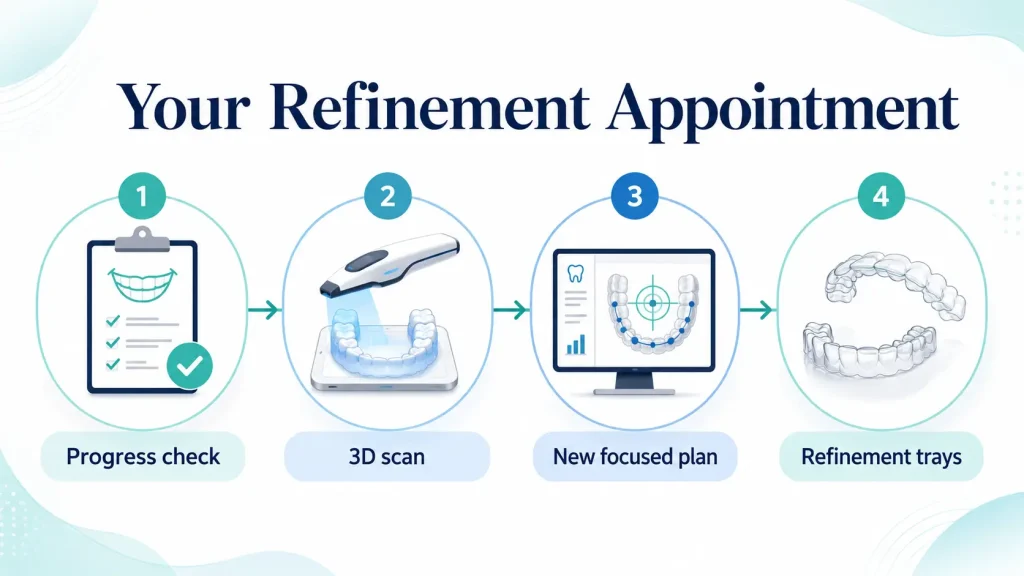
The refinement process is refreshingly straightforward, and it looks a lot like the very beginning of your treatment. Here is what to expect, step by step:
• Progress review. Your orthodontist compares where your teeth are now against where the original plan intended them to be.
• A fresh digital scan. A new 3D scan captures the current position of your teeth. There are no messy impressions involved.
• A new, focused plan. Using that scan, your orthodontist designs a shorter series of aligners that targets only the movements still remaining.
• Small adjustments if needed. Attachments may be added, moved, or replaced, and in some cases light elastics or minor enamel polishing between teeth help achieve the final details.
• Your refinement trays. You receive the new aligners and wear them on the same 20 to 22 hour schedule, progressing through the series as directed.
How Long Do Refinements Add to Your Treatment?
Understandably, this is the question most patients ask next. The honest answer is that it depends entirely on how much movement remains. Because each refinement aligner is typically worn for one to two weeks, a case that needs only two or three extra trays may wrap up within a couple of months. A larger gap between planned and actual position will naturally require more trays and a bit more time.
What matters is that your orthodontist can give you a realistic timeline after the refinement scan, rather than a guess based on averages. If you want a broader sense of how aligner timelines work overall, our guide on how long Invisalign takes breaks down the factors that shape the total treatment window.
Will Refinements Cost You More?
For most patients, the answer is reassuring. Many Invisalign treatment plans include at least one round of refinements at no additional charge, precisely because they are so expected. That said, refinement policies vary from one practice to another, so the smartest move is to ask about it before you begin treatment. Knowing exactly what your fee covers, including refinements and final retainers, prevents any surprises later on.
How to Reduce Your Chances of Needing Extra Trays
While no one can guarantee a refinement-free treatment, and the research suggests almost everyone needs at least one round, you can absolutely minimize how many you need. A few consistent habits make the biggest difference:
• Wear your aligners 20 to 22 hours every day. This is the single most powerful factor within your control.
• Seat each tray fully. Use the chewies your orthodontist provides to press the aligners snugly against your teeth, especially at night.
• Do not switch to a new tray early. Advancing before your teeth are ready is a common cause of tracking problems.
• Protect your attachments. Avoid the hard and sticky foods that can pop them off, and keep your trays clean and cared for, so they seat properly.
• Report problems early. If an attachment falls off or a tray suddenly feels loose, call your orthodontist rather than waiting for your next visit.
Refinements at Freedman & Haas: Planned, Not Improvised
At Freedman & Haas Orthodontics, refinements are never an afterthought. Our board-certified orthodontistsplan for the detailing phase from the very start, because achieving a precise, stable, and healthy bite matters more than simply finishing on the original date. When we tell you that you need a refinement round, it is a sign of our commitment to getting your result exactly right, not a sign that anything went wrong.
With more than 30 years of experience and over 30,000 smiles completed across West Palm Beach and Wellington, our team has guided countless patients through the refinement phase with clear communication and realistic timelines every step of the way.
Frequently Asked Questions
Are Invisalign refinements a sign my treatment failed?
Not at all. Research shows that only about 6% of patients finish Invisalign without any refinements, so needing them puts you in the vast majority. Refinements are the normal, expected detailing stage of clear aligner treatment, not a sign of failure.
How many refinement rounds will I need?
On average, patients should be prepared for 2 to 3 refinement scans over the course of treatment, though some need only one and others need a few more. The exact number depends on how closely your teeth tracked to the original plan and how consistently you wore your aligners.
Do refinements hurt?
Each new refinement tray may feel snug or create mild pressure for a day or two, exactly like your original aligners did when you switched sets. That sensation is simply a sign the trays are working, and it typically fades quickly as your teeth adjust.
Can I avoid refinements altogether?
Possibly, but it is uncommon. Because aligners express only about half of the predicted movement per series on average, most patients need at least one refinement round. Wearing your aligners the full 20 to 22 hours a day, seating them properly, and protecting your attachments give you the best chance of keeping refinements to a minimum.
Have Questions About Your Refinement Phase?
Refinements are proof that your orthodontist is committed to the details, not evidence that something went off track. If you are approaching the end of your aligner series and want to understand what comes next, or if you are considering Invisalign and want a clear picture of the full journey, we are here to help.
Schedule a consultation at Freedman & Haas Orthodontics in West Palm Beach or Wellington, and let our board-certified team walk you through exactly what your treatment, refinements included, will look like from start to finished smile.