
The little rubber rings an orthodontist wedges between your back teeth are easy to dismiss. They are not braces. They are not Invisalign. They are the small, slightly annoying errand you run a week or two before the real treatment begins. What almost no one mentions is that those unassuming spacers are among the most studied objects in all of orthodontics. When researchers want to measure, precisely, how much orthodontic treatment hurts, or whether a particular painkiller actually works, the separator is the tool they reach for. The thing sitting between your molars right now is, in effect, a scientific instrument.
That turns out to matter to you for a very practical reason. Because separators have been placed, timed, and measured in study after study, we know a surprising amount about exactly what they do, when the soreness shows up, how long it lasts, and which remedies hold up under scrutiny and which are simply folklore. So instead of telling you that spacers feel like a little pressure and leaving it there, we are going to walk through what the research genuinely shows, including a couple of findings that run against instinct. Let us start with the small job these rings are quietly doing.
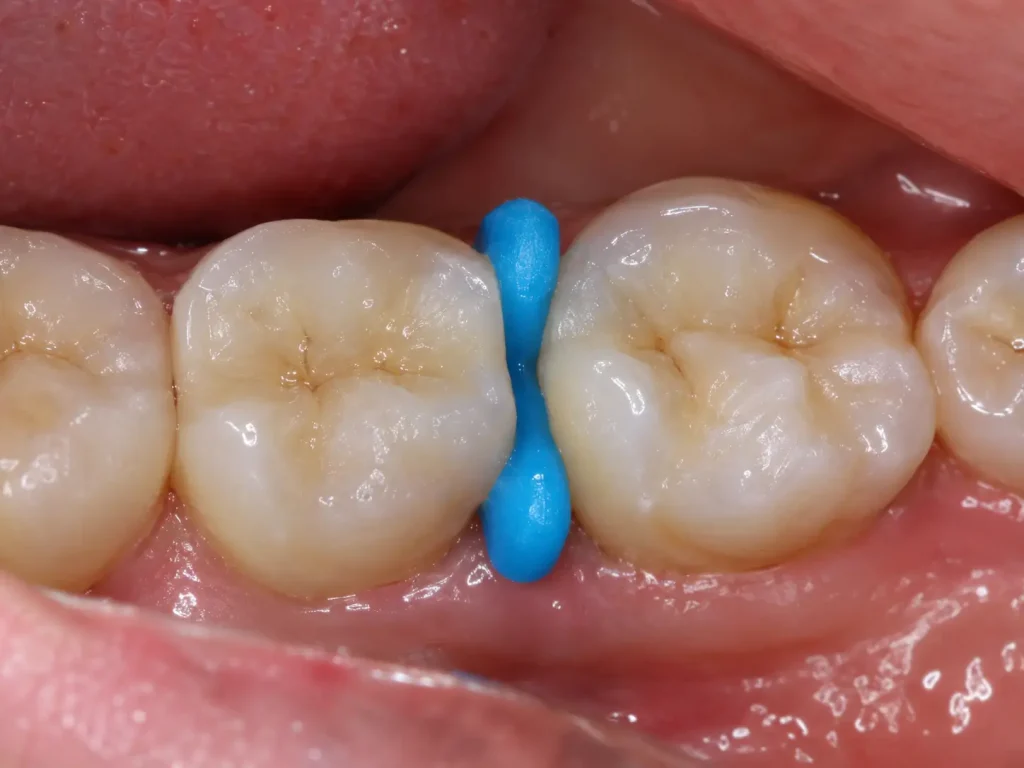
What Spacers Are, and the Small Job They Quietly Do
A spacer, which an orthodontist is more likely to call a separator, is usually a small elastic ring slipped between two back teeth that sit tightly against each other. Most often they go in on either side of the first molars, the large teeth you rely on to grind food. Their purpose is narrow and specific. Certain kinds of braces need a metal band wrapped all the way around a molar, and there is simply no room to slide that band into place when neighboring teeth are pressed flush together. The separator spends a week or two gently nudging those teeth a fraction of a millimeter apart, opening just enough room for the band to seat cleanly on the day you come back.
It helps to know that a separator moves your tooth using the very same biology that will move your teeth for the rest of treatment. The ring applies steady, gentle pressure, the bone and ligament around the tooth respond by remodeling, and the tooth drifts. If you understand how teeth move during braces, you already understand how a separator works. It is orthodontics in miniature, which is exactly why it makes such a useful stand-in for the real thing in research.
So, Do Spacers Hurt? And When?
Here is the honest answer, and the part that surprises most people. Spacers can be sore, but usually not at the moment they go in. The placement itself takes a few minutes and feels like pressure or a bit of tightness, nothing most people would call pain. The soreness arrives later.
Study after study using separators finds the same shape to it. Discomfort builds over the first several hours and peaks around the next day, roughly 24 hours after placement, rather than right away. In one trial that followed adolescents for a full week, average pain on the first two days sat in the moderate range, then dropped off noticeably after the second day and faded to almost nothing by day seven. The most consistent finding across all of this work is that the soreness is worst when you bite down and chew. At rest, with your teeth apart, it is far milder, much like the tenderness that shows up later when teeth feel loose during braces.
So why the delay? When the separator wedges the teeth apart, it compresses the periodontal ligament, the thin cushion of fibers that suspends each tooth in its socket. That compression sets off a slow inflammatory response, and signaling molecules with names like prostaglandin E2 and substance P gradually accumulate in the tissue around the tooth. Researchers have measured those exact molecules rising in the fluid around separated teeth, and their levels track closely with how much the patient reports hurting. Because that chemical build-up takes hours to develop, the pain peaks the following day rather than in the chair. Knowing this is quietly reassuring. The ache on day one is not a signal that something went wrong. It is the expected, well-documented middle of a curve that is already on its way back down.
The Painkiller That Actually Holds Up
If you plan to reach for something in the medicine cabinet, the research points clearly in one direction. For orthodontic soreness, ibuprofen has the strongest evidence behind it. In a carefully designed crossover study at the University of Florida, where adults had separators placed and then tracked their pain, ibuprofen was the only medication that significantly outperformed a placebo. Acetaminophen, the active ingredient in Tylenol, did not reliably beat the placebo for this particular kind of pain.
There is a clean reason for that gap. The soreness is driven largely by prostaglandins, the same inflammatory molecules building up around the tooth, and ibuprofen and its fellow anti-inflammatories work by shutting down prostaglandin production at the source. Acetaminophen quiets pain through a different route and does little about the inflammation itself. The practical tip that falls out of this is one most people miss entirely. Taking ibuprofen a little before the soreness sets in, rather than waiting until it is already bad, gives noticeably better control, because you are heading off the chemical cascade instead of chasing it after the fact.
Two honest caveats belong here. First, ibuprofen is not the right choice for everyone, and anyone who cannot take anti-inflammatories for medical reasons can reasonably reach for acetaminophen instead, even if the evidence for it is weaker. Second, there used to be a worry that anti-inflammatories might slow tooth movement, since they blunt the very inflammation that drives it. For the short, low-dose course that separators call for, a day or two at most, studies have not found a meaningful effect, so there is no reason to suffer through the soreness on that account. It is always worth a quick word with your orthodontist about what is right for you.
The Trick Most People Get Backward
Here is the counterintuitive one. When teeth are sore, the natural instinct is to protect them, to chew as little as possible and keep everything still. The research suggests that instinct is partly backward, because gentle chewing actually helps.
In a randomized trial, patients who chewed sugar-free gum after their separators went in reported clearly less pain than those who did not, and the gap held through the tender first two days. At bedtime on the first day, right when soreness tends to be at its worst, the gum chewers rated their pain nearly two points lower on a ten-point scale. The leading explanation is mechanical. Rhythmic chewing briefly loosens the compressed ligament, restores blood flow to the squeezed tissue, and helps flush out the very metabolites that are irritating the nerve endings. Sitting perfectly still lets those metabolites pool, while gentle movement keeps them moving along.
This does not mean you should go after a bag of nuts. There is a real line between gentle, rhythmic chewing, which helps, and biting into something hard or sticky, which does not. Hard foods drive pressure straight into already sore teeth, and sticky foods can grab a separator and pull it out before it has finished its job. Soft foods for the first day or two, paired with some gentle chewing rather than total stillness, is the sweet spot. If you want to try gum, keep it sugar-free and check with your orthodontist first.
What Is Normal, and When to Call
A separator occasionally falls out on its own, and that tends to worry people more than it should. If it slips free in the last day or two before your next appointment, it has very likely already done its job and created the space it was meant to. If one comes out early, in the first few days, call the office, because the gap can close again and may need to be reopened. A simple, honest rule of thumb is that the soreness should be improving by the third or fourth day, not getting worse. Pain that climbs rather than fades, along with swelling or a sense that something is genuinely wrong, is not the expected pattern and is worth a phone call.
One small practical habit saves a lot of second-guessing. Note how many separators you started with, since losing track is common, and knowing whether one has gone missing is far easier than trying to reconstruct it later.
Eating and Cleaning Around Your Spacers
Day-to-day life with separators is mostly ordinary, with a few minor adjustments. Lean on softer foods for the first couple of days while the soreness is at its peak, and steer clear of the usual troublemakers, which are the hard, crunchy, chewy, and sticky foods that either hurt going in or lift the rings out. Caramel, taffy, ordinary chewing gum that is not part of a deliberate pain-relief plan, and crunching on ice are the most common offenders.
Cleaning deserves one specific note. You can and absolutely should keep brushing as normal, but be gentle with floss in the two or three spots where the separators sit. Pulling floss straight down between a pair of separated teeth can lift the ring right out, which undoes the progress, so it is fine to simply brush those areas thoroughly and save the careful flossing for everywhere else until the separators come out.
What Comes After Spacers
Spacers are a short chapter, not the whole story. In a week or two you will come back, the orthodontist will slip the separators out, which is quick and usually a small relief, and the molar bands or the next stage of your braces will go on. If you are curious how the rest unfolds from there, it helps to have a sense of how long braces usually take, so that the small early steps make sense within the larger picture.
Questions About Your Treatment? Talk to Freedman & Haas
At Freedman & Haas Orthodontics, our board-certified team has guided more than 30,000 patients across West Palm Beach and Wellington through every stage of treatment, starting with the small ones like this. If you have spacers in right now and something does not feel right, or you simply have a question, call us. We would always rather hear from you than have you sit at home wondering. Schedule a visit or reach out any time, and we will walk you through exactly what comes next.
Frequently Asked Questions
Do spacers hurt more than braces?
For most people the soreness is a similar kind of pressure, and often milder and shorter than the first few days in braces. It tends to peak about a day after placement, feels worst when you chew, and settles over the following days. If anything, spacers are a gentle preview of the sensation braces create, not something sharper or worse.
How long does it take for spacers to stop hurting?
The discomfort is usually at its worst on the first and second day, eases noticeably after the second day, and is mostly gone by about a week. If your soreness is still climbing after the third or fourth day rather than fading, that is not the usual pattern and is worth calling your orthodontist about.
Should I take ibuprofen or Tylenol for spacer pain?
The evidence favors ibuprofen, because the soreness is driven by inflammation and ibuprofen works directly on it, while acetaminophen has not reliably outperformed a placebo for this kind of pain. Taking it shortly before the soreness sets in works better than waiting. If you cannot take anti-inflammatories, acetaminophen is a reasonable fallback. Check with your orthodontist about what suits you.
What can I eat with spacers in?
Soft foods are easiest for the first day or two, and it is smart to avoid hard, crunchy, chewy, and sticky foods that either hurt or can pull a separator out. Gentle chewing is actually fine and may even ease the ache, so you do not need to keep your teeth completely still, just away from the tough and sticky stuff.
Is it normal for a spacer to fall out?
Sometimes, yes. If a separator falls out in the last day or two before your appointment, it has probably already opened the space it needed to and done its job. If one comes out in the first few days, call the office, since the space can close again and the separator may need to be replaced.