
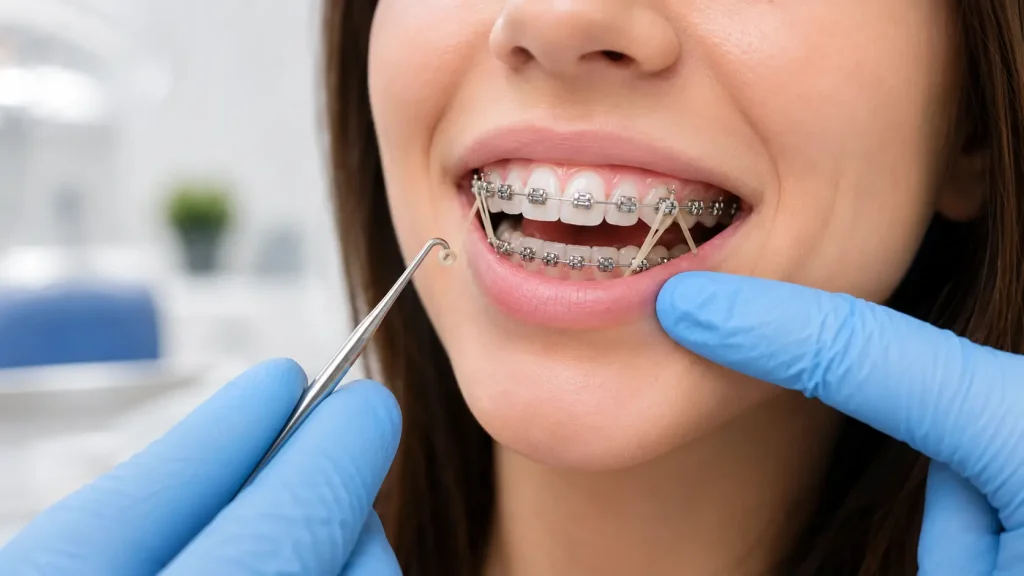
You finally got used to your braces, the brackets, the wires, the new cleaning routine, and then, at your last adjustment, your orthodontist handed you a small bag of rubber bands and a whole new set of instructions. If you walked out of the office wondering how something so tiny could possibly matter, you are not alone. The truth is that those little elastics often determine whether your treatment finishes on schedule or drags on for extra months.
In this guide, we will explain exactly what orthodontic rubber bands do, why your orthodontist prescribed them, how to put them on correctly step by step, and, just as importantly, what happens when you skip them. By the end, you will know how to make these small elastics work hard for your smile instead of against your timeline.
What Are Orthodontic Rubber Bands (Elastics)?
Orthodontic rubber bands, also called elastics, are small, stretchy rings that connect a hook on your upper braces to a hook on your lower braces. Unlike the colorful ligatures that hold the archwire to each bracket, elastics span between your two arches and apply a steady, gentle force in a very specific direction.
That direction is the key. Your braces are excellent at straightening individual teeth, if you want a refresher on the mechanics, take a look at our article on how teeth move with braces, but they cannot, on their own, change the way your upper and lower jaws meet. Elastics supply that missing force, guiding your bite into proper alignment while the brackets and wires handle the alignment of each tooth.
Modern orthodontic elastics are made from medical-grade latex because of its strength and consistent stretch. If you have a latex allergy, don’t worry: synthetic, latex-free versions are readily available, so simply let your orthodontist know.
Why Do Orthodontists Prescribe Rubber Bands?
Not every patient needs elastics. They are prescribed when your bite, the way your upper and lower teeth come together, needs correction in addition to straightening. Here are the most common reasons.
Fixing Overbites and Underbites
When the upper teeth sit too far forward (an overbite) or the lower teeth jut out ahead of the upper teeth (an underbite), elastics worn at an angle between the arches gradually pull the jaws into better harmony. As we explained in our article on whether braces can correct overbites and underbites, bite correction is one of the most valuable health benefits of orthodontic treatment, and elastics are frequently the tool that makes it possible.
Closing Gaps and Correcting Midlines
Elastics can also close stubborn spaces between teeth and shift your dental midline, the imaginary vertical line between your two front teeth, so that your upper and lower midlines match. These fine-tuning movements are often what separates a good result from a truly excellent one.
Types of Orthodontic Elastics
Elastics come in different sizes, strengths, and configurations, and each setup has a specific job. Your orthodontist will choose the exact type and placement based on your treatment plan, but it helps to understand the most common patterns:
| Type of elastic | What it corrects | How it is worn |
| Class II elastics | Overbite (upper teeth sit too far forward) | From an upper front hook down to a lower back hook, pulling the upper teeth back and the lower teeth forward |
| Class III elastics | Underbite (lower teeth sit too far forward) | From a lower front hook up to an upper back hook, the reverse of Class II |
| Vertical elastics | Open bite (front teeth do not touch when biting down) | Straight up and down between opposing teeth to bring them together |
| Crossbite elastics | Crossbite (upper and lower teeth overlap in the wrong direction) | Diagonally, often from the inside of one arch to the outside of the other |
| Triangle / box elastics | Fine-tuning how upper and lower teeth fit together | Connecting three or four hooks at once in a triangle or box pattern |
Elastics also vary in diameter and force level. Never swap the elastics you were given for a different size, and never double them up, more force is not faster. In fact, excessive pressure can damage the roots of your teeth and actually slow tooth movement.
How to Put Rubber Bands on Braces: Step-by-Step Guide
Placing your elastics may feel awkward the first few times, but most patients can do it in seconds after a day or two of practice. Follow these steps:
- Wash your hands thoroughly before touching your braces or elastics.
- Stand in front of a mirror with good lighting so you can clearly see your brackets.
- Identify the correct hooks. Your orthodontist will show you exactly which bracket hooks to use, usually a canine (the pointed tooth) in the front and a molar hook toward the back. Follow the diagram or photos from your appointment.
- Hook one end of the elastic onto the first attachment point, holding the band between your thumb and index finger.
- Gently stretch the band to the opposite hook and secure it. Bite down lightly while placing it, this shortens the distance and makes stretching easier.
- Check the fit in the mirror. The elastic should match the exact pattern your orthodontist showed you.
- Repeat on the other side if you were instructed to wear elastics on both sides.
If your fingers struggle with the placement, ask our team for a small plastic elastic placer. This inexpensive tool hooks the band for you and makes the whole process much easier, especially for younger patients.
How Many Hours a Day Should You Wear Rubber Bands?
In most cases, elastics are meant to be worn 22 to 24 hours per day, essentially full time, including while you sleep. Light, continuous force is what moves teeth efficiently; intermittent force simply does not work the same way. That said, there are a few moments when you should take them out:
| Situation | What to do with your elastics |
| Eating a meal | Remove them, then put on a fresh pair right after |
| Brushing and flossing | Remove them, then replace with a new pair |
| Playing sports or an instrument | Ask your orthodontist; in most cases you can keep them in |
| Sleeping | Keep them in, nighttime wear counts toward your daily total |
| An elastic snaps or falls off | Replace it immediately with a fresh one |
One more golden rule: change your elastics several times a day, typically after each meal and before bed. Rubber bands lose their stretch within hours, and a fatigued elastic delivers far less force than a fresh one, even if it looks perfectly fine.
What Happens If You Skip Wearing Your Elastics?
This is the question patients rarely ask out loud but always want answered. Here is the honest truth: skipping your elastics is the single most common reason orthodontic treatment runs past its estimated finish date.
When you wear your elastics inconsistently, your teeth begin to drift back toward their previous positions between wears. Every restart means re-doing movement you had already achieved, which is also why your teeth feel sore again after a skipped day. In practical terms:
- Skipping a few days repeatedly can add weeks or months to your total treatment time.
- Wearing elastics only at night, when full-time wear was prescribed, can stall bite correction entirely.
- Doubling up on elastics to “catch up” after missed days does not speed anything up, it applies excessive force that can harm the roots of your teeth.
If you are looking for legitimate ways to stay on schedule, or even finish early, consistency with elastics tops the list. We cover this and other proven strategies in our guide on how to help your orthodontic treatment go faster.
Common Mistakes and How to Avoid Them
Even motivated patients fall into a few predictable traps. Watch out for these:
- Reusing old elastics. Once a band has been worn or removed, its tension is gone. Always use a fresh one.
- Wearing them in the wrong position. Hooking the wrong teeth applies force in the wrong direction and can move teeth where you don’t want them. When in doubt, call our office and we will walk you through it.
- Taking them out whenever they feel tight. Mild soreness for the first few days is normal and means the elastics are working. It typically fades quickly.
- Running out of rubber bands. Keep a bag at home, one in your backpack or purse, and one in the car. If your supply runs low, contact us, we are happy to provide more at no charge.
- Stopping early because your bite “looks fixed.” Teeth need time to stabilize. Only your orthodontist can confirm when the correction is truly complete.
Tips to Make Wearing Rubber Bands Easier
A few small habits make full-time elastic wear much more manageable:
- Tie it to a routine. Change your elastics after each meal and right before bed, just like brushing. Within a week it becomes automatic.
- Set phone reminders for the first couple of weeks until the habit sticks.
- Carry spares everywhere. A small bag of elastics weighs nothing and saves the day after lunch at school or work.
- Use over-the-counter pain relief or a soft-food day if your teeth feel tender when you first start, the discomfort fades as your mouth adjusts.
- Track your progress with weekly selfies. Watching your bite change is the best motivation to keep going.
Frequently Asked Questions
Can I reuse rubber bands?
No. Elastics lose their elasticity within hours of being stretched. Reusing them means your teeth receive too little force to keep moving, so always replace each band with a fresh one.
Do rubber bands hurt?
You may feel pressure or mild soreness for the first two or three days, similar to how your mouth felt after getting your braces on. This is a sign the elastics are working, and it fades as your teeth adjust. If you are curious about what discomfort is normal at each stage of treatment, our article on whether getting your braces off hurts covers the end of the journey, too.
Where can I get more elastics?
Simply call or visit our office, we provide replacement elastics to our patients free of charge. Many pharmacies also carry orthodontic elastics but make sure they match the exact size and force level you were prescribed.
Will skipping rubber bands extend my treatment time?
Almost certainly, yes. Inconsistent wear is the leading cause of delayed orthodontic results. Each day of full-time wear builds on the last; each skipped day lets your teeth drift backward. Consistency is genuinely the fastest route to getting your braces off.
Questions About Your Elastics? We’re Here to Help
Rubber bands may be the smallest part of your orthodontic treatment, but they carry some of the biggest responsibility and using them correctly is the surest way to keep your smile on schedule. At Freedman & Haas Orthodontics, our board-certified orthodontists have guided more than 30,000 patients across West Palm Beach and Wellington through every stage of treatment, elastics included.
If you are ever unsure about your rubber band placement, run out of elastics, or simply want us to double-check your technique, contact Freedman & Haas Orthodontics today. A quick question now can save months of treatment time later, schedule your visit at our West Palm Beach or Wellington office and keep your new smile right on track.