
Among all the teeth in your mouth, the canines rarely get much attention. They are not the front teeth people notice in photos, nor the molars that shoulder the heavy work of chewing. And yet when one of them fails to come in the way it should, it can quietly set off a chain of problems that an orthodontist takes very seriously. An impacted canine is one of those situations where what you cannot see ends up mattering far more than what you can.
If a dentist has mentioned that your child, or perhaps you, has an impacted canine, it is natural to feel a little uneasy about what that means and what comes next. The reassuring news is that this is a well-understood problem with a high rate of success when it is caught and managed in good time. Over the next few sections we will explain what an impacted canine actually is, why these particular teeth go astray so often, what happens when one is left alone, and how we guide a stuck canine into the place it was always meant to occupy.
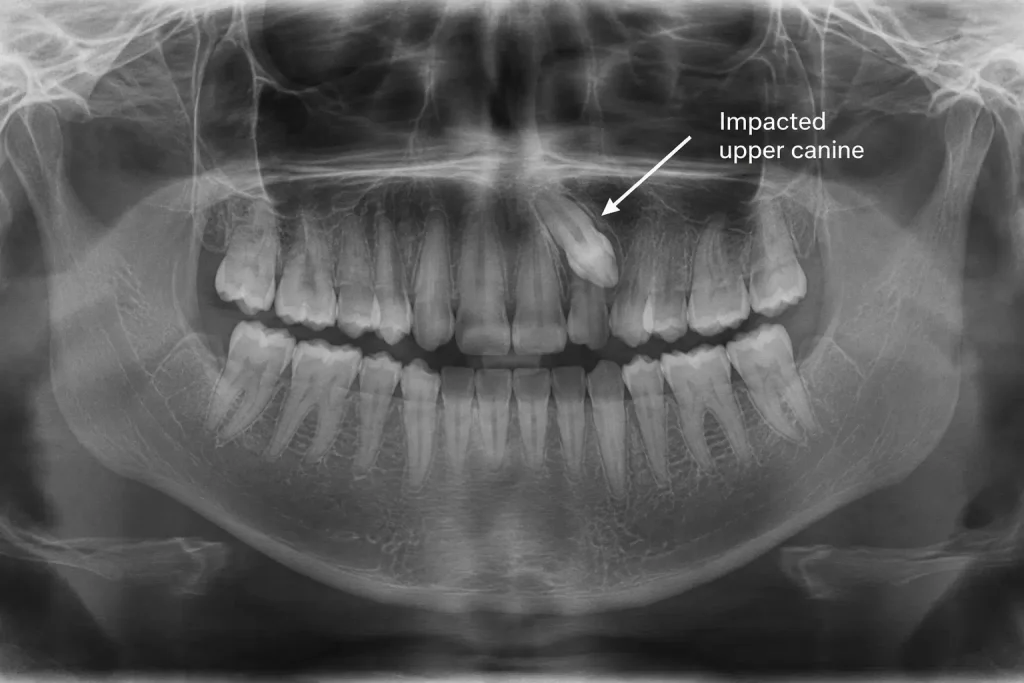
What Is an Impacted Canine?
A tooth is called impacted when it fails to erupt into its normal position and stays partly or fully trapped beneath the gum or within the jawbone. It is not missing, and it is not simply running late. It is physically stuck, blocked by bone, by a neighboring tooth, or by its own awkward angle of approach.
Wisdom teeth are the ones most people associate with impaction, and they are indeed the most commonly impacted teeth of all. The upper canines come in a clear second. After the third molars, no tooth gets stuck more often than the maxillary canine, the pointed tooth that sits just below the eye on each side. That frequency, paired with how important these teeth happen to be, is why orthodontists keep such a close watch on them.
Why Canines, of All Teeth?
It is a fair question why these specific teeth are so prone to trouble, and the answer comes down to timing and distance. The upper canines are among the last teeth at the front of the mouth to erupt, usually arriving somewhere around ages 11 to 13, well after the incisors and first molars have already claimed their spots. By the time a canine is finally ready to come in, much of the available room may be spoken for.
On top of that, the canine has the longest journey of any tooth in the mouth. It begins developing high up in the jaw, near the floor of the nose, and must travel a remarkable distance down and forward to reach its place in the arch. The longer that path, the more opportunity there is to veer off course along the way. These teeth also happen to be the cornerstones of your smile and your bite. They carry the longest roots, they guide the way your jaws slide against one another, and their pointed shape helps tear food. Losing one is never a small matter, which is exactly why saving an impacted canine is almost always worth the effort it takes.
How Common Is It, and Where Does the Tooth Go?
Impacted upper canines are far from rare, and they tend to follow a few consistent patterns. Around 85 percent of the time the tooth becomes trapped toward the roof of the mouth, which orthodontists call a palatal impaction. The rest sit toward the cheek and lip side, known as a buccal impaction, which makes palatal impactions roughly twice as common. In a small share of patients, somewhere near 8 percent, both canines are affected at once.
There is a notable sex difference as well. Impacted canines show up about twice as often in girls and women as in boys and men. None of these patterns changes how a particular case is treated, but together they explain why an orthodontist will check a young patient’s canines carefully even when everything looks perfectly normal from the front.
What Causes a Canine to Become Impacted?
Several factors can push a canine off its intended path, and more than one is often at play. The most common is simply a shortage of space. When the jaw does not offer enough room for every tooth, the late-arriving canine can find its spot already occupied, leaving it nowhere sensible to go. This ties directly into the crowding that underlies so many bite problems, which is one reason an orthodontist evaluates the entire arch rather than fixating on a single tooth.
Genetics carry a great deal of weight too. Impacted canines tend to run in families, and they are frequently linked to other inherited traits, such as missing or unusually small lateral incisors, the teeth sitting directly beside the canines. There is a well-supported idea that the lateral incisor’s root acts as a guide rail that steers the erupting canine into place, so when that neighbor is small or absent, the canine loses its signpost and drifts. A stubborn baby canine that refuses to fall out can likewise block or misdirect the permanent tooth behind it. And in plenty of cases the reasons trace back to the same forces behind why teeth end up crooked or out of position more broadly, from jaw size to the early loss of other teeth.

Why an Impacted Canine Should Not Be Ignored
It can be tempting to leave a buried tooth alone when it is not causing obvious pain, yet doing so carries real risks that build silently over time. The most serious is damage to the neighboring teeth. As an impacted canine presses against the roots of the adjacent incisors, it can wear them away in a process called root resorption, and a tooth cannot repair that kind of damage once it is done.
This is not a rare or merely theoretical worry. Imaging studies that examine these cases in three dimensions have found root resorption in a striking share of the incisors sitting next to impacted canines, with some reporting damage in roughly 40 percent of adjacent lateral incisors. In the worst cases the resorption reaches far enough to threaten the nerve and the survival of an otherwise healthy front tooth. Beyond resorption, a canine left buried in the bone can occasionally give rise to a cyst that erodes the surrounding bone, and the gap it leaves in the arch invites the other teeth to drift and crowd into the space. Every one of these problems is far easier to prevent than to repair after the fact.
Catching It Early Makes All the Difference
If there is a single message worth carrying away from all of this, it is that timing matters enormously. The earlier an impacted or impacting canine is identified, the simpler and more successful the solution tends to be. This is why orthodontists recommend a first evaluation well before the teenage years, generally around age 7, when a problem like this can be spotted long before it has fully taken shape.
Detection itself is often refreshingly simple. Around ages 9 and 10, an orthodontist can gently feel for the firm bulge of each canine high in the gum. If that bulge cannot be felt on one side, or if a baby canine is still planted firmly past about age 12 or 13 with no permanent tooth pushing through, it raises a flag worth investigating. A panoramic X-ray then confirms the picture, and a three-dimensional scan can pinpoint the exact position when the flat image leaves any doubt.
The reward for catching it early is considerable. In many younger patients, simply removing the stubborn baby canine at the right moment, usually around ages 10 to 11, gives the permanent canine the room it needs to correct its own course and erupt on its own, with no further treatment at all. That same move grows far less reliable once a child reaches 12 to 14, which is precisely why early screening earns its keep.
How an Impacted Canine Is Treated
When a canine has already drifted too far off course to right itself, the goal shifts to guiding it into place rather than removing it, because keeping your natural canine is almost always the better outcome. The standard approach, used in the large majority of cases, pairs a minor surgical step with steady orthodontic traction.
First, an oral surgeon or periodontist gently uncovers the crown of the buried canine and bonds a small bracket with a fine gold chain onto it. Then, working with braces, which give the precise three-dimensional control this kind of movement demands, the orthodontist applies gentle, carefully aimed force through that chain over many months, coaxing the tooth along a planned route into its proper position in the arch. It is an unhurried process by nature. Guiding an impacted canine all the way into place typically takes around two years, and it leans heavily on a cooperative patient who keeps every appointment.
When crowding is the underlying culprit, creating room in the arch may need to come before traction can begin, and expanding a narrow upper jaw can help in younger patients. In the uncommon event that a canine is simply too damaged or too poorly positioned to rescue, other options do exist, from replacing the tooth to repositioning a neighbor, though these are very much the last resort rather than the plan we hope to follow.
Protecting Your Smile at Freedman & Haas
An impacted canine is one of those problems where early, expert attention truly changes the outcome. At Freedman & Haas Orthodontics, our board-certified team has guided more than 30,000 patients across West Palm Beach and Wellington toward healthy, complete smiles, and we have the experience and the imaging to catch a wayward canine early and bring it safely into place.
If your dentist has mentioned an impacted canine, or if your child is approaching the age when these problems tend to surface, schedule an evaluation today. The sooner we take a look, the simpler the path forward is likely to be.
Frequently Asked Questions
Does an impacted canine have to be pulled?
Usually not. Because the canines are so important to the bite and the smile, the goal is almost always to guide the tooth into place rather than remove it. Extraction is reserved for the uncommon cases where the tooth is too damaged or too poorly positioned to save, and even then other teeth can often be repositioned to fill the role.
Is treatment for an impacted canine painful?
The surgical step to expose the tooth is done under local anesthesia or sedation, so it is not felt at the time, and the recovery is usually mild. The orthodontic traction that follows feels much like the pressure of ordinary braces, tender for a day or two after an adjustment and then unremarkable. Most patients find the process far easier than they expected.
How long does it take to fix an impacted canine?
Plan on roughly two years from start to finish in most cases. The tooth has to travel a considerable distance through bone, and that movement cannot be rushed without risking harm. The exact timeline depends on how far off course the canine sits and how faithfully appointments are kept.
What happens if an impacted canine is left untreated?
The risks grow quietly over time. An impacted canine can wear away the roots of the neighboring incisors, occasionally form a cyst that damages the surrounding bone, and leave a gap that lets the other teeth drift and crowd. What might have been a straightforward correction in childhood can become a far more complex problem in adulthood.
At what age should canines be checked for impaction?
A first orthodontic evaluation around age 7 is ideal, since it lets us watch how the canines are developing. By ages 9 to 10 we can feel for each canine in the gum, and a baby canine still firmly in place past age 12 or 13 is a reason to take a closer look. Early detection often means a much simpler solution.