
You brush twice a day, you have never missed a cleaning, and yet your teeth still came in crowded, twisted, or overlapping. It hardly seems fair. If you have ever stared in the mirror wondering what you did wrong, here is the first thing to know: almost certainly, you did nothing wrong at all. Crooked teeth are rarely a hygiene problem or a personal failing. They are the result of forces that were largely set in motion before you were old enough to hold a toothbrush.
Most articles on this topic hand you a tidy list of causes and leave it there. We want to do something more useful. As orthodontists, we spend our days tracing misalignment back to its origins, and the real story is far more interesting than “blame your genes.” It involves the jaw you inherited, the way you chewed as a child, where your tongue rests when you are not thinking about it, and even how human diets have changed over the last few centuries. Understanding the actual mechanisms will not only answer your question. It may also change how you think about your own smile, and your children’s.
The One Idea That Explains Almost Everything: Space
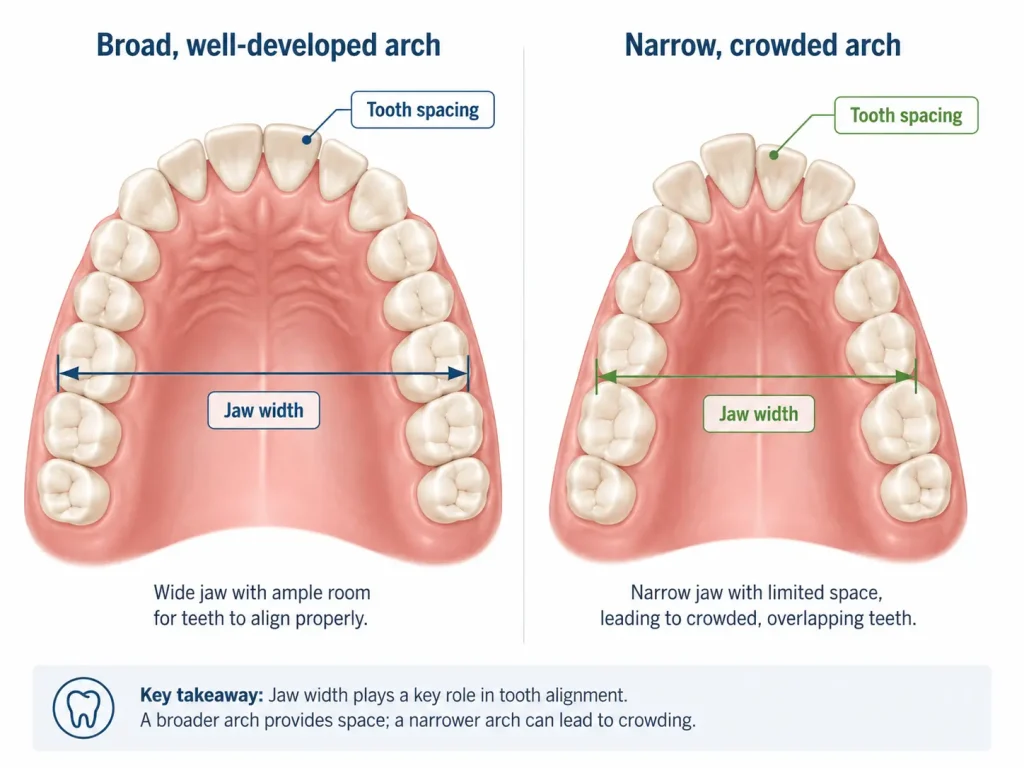
Before we get to specific causes, there is a single concept that underlies nearly all of them, and once it clicks, everything else makes sense. Crooked teeth are, at their core, a mismatch between two things: the size of your teeth and the amount of room your jaw provides for them.
Picture parking six cars in a driveway built for four. It does not matter how nice the cars are; some will end up angled, overlapping, or squeezed out of line. Teeth behave exactly the same way. When the jaw is a little too small, or the teeth a little too large, there simply is not enough arch length to give each tooth its proper place. So they rotate, tilt, and overlap to fit into the space available. Nearly every cause of crooked teeth below is really a story about how that space problem came to be, either because you were born with it or because it developed over time.
Crooked Teeth Are Now the Norm, Not the Exception
It helps to put your smile in perspective, because the numbers are genuinely surprising, and they point to something important about the true cause.
The World Health Organization ranks malocclusion, the clinical term for misaligned teeth and bites, as the third most common oral health problem worldwide, behind only tooth decay and gum disease. In modern industrialized populations, depending on how it is defined, misalignment affects somewhere between roughly half and the vast majority of people. Here is the detail that reveals the real story, though: it was not always this way, and it still is not this way everywhere.
| Population and diet | Malocclusion rate | Jaw stress from chewing |
| Hunter-gatherers (tough, unprocessed food) | Under 5% | Very high |
| Indigenous groups on traditional diets | 34 to 67% | High |
| Modern industrialized populations (soft, processed food) | 56 to 95% | Low |
Look closely at that table, because it upends the most common assumption about crooked teeth. If misalignment were purely genetic, rates would be roughly constant across human populations. Instead, they climb steadily as diets get softer and more processed. That single pattern tells us something profound: while genetics loads the gun, the modern environment very often pulls the trigger. Let us look at both halves of that equation, starting with what you inherit.
Part One: The Blueprint You Inherit
Genetics is the single most influential factor in how your teeth align, but not in the simple way most people picture. This is where a little precision changes everything.
You Don’t Inherit Crooked Teeth. You Inherit a Mismatch.
Here is the nuance that explains why two straight-toothed parents can have a child who needs braces. You do not inherit “crooked teeth” as a single trait. Malocclusion is polygenic, meaning many different genes contribute, and crucially, the genes that determine your jaw size are largely independent from the genes that determine your tooth size. This is the heart of the matter.
Imagine a child who inherits a petite, narrow jaw from one parent and a set of broad, large teeth from the other. Each feature is perfectly normal on its own, and each parent may have a flawless bite. But combine a small jaw with large teeth in the same mouth, and you have created exactly the space shortage we described earlier. The teeth have nowhere to go but out of line. This inherited mismatch is the most common reason for crowding, and it is why family resemblance in smiles is often unpredictable. You did not inherit a flaw. You inherited two normal features that happen not to fit together.
Extra, Missing, or Impacted Teeth
Sometimes the genetic blueprint contains a more direct surprise. Some people are born with extra teeth, which overload an already tight arch. Others are missing teeth entirely, a condition called hypodontia that affects an estimated 3.5 to 6.5% of people (excluding wisdom teeth), which lets neighboring teeth drift into the empty space. Impacted teeth, those that cannot fully erupt, can press against their neighbors from below and shove the whole arch out of alignment. Any of these can produce the crowded teeth that so often prompt a first orthodontic visit.
Part Two: How Modern Life Reshapes a Growing Jaw
If genetics were the whole story, the population data would not show that dramatic climb in misalignment. Something in modern life is actively making jaws smaller, and the science behind it is one of the most fascinating and least-discussed topics in all of orthodontics. This is the part almost no one explains properly, so let us do it justice.
Your Jaw Is Not Just Programmed. It Is Sculpted by Use.
For a long time, people assumed jaw size was fixed at birth by genetics, full stop. Then a body of research, anchored by the work of dental anthropologist Robert Corruccini and framed by what is called the functional matrix theory, revealed something remarkable. Bone growth in the jaw is not purely pre-programmed. It is substantially adaptive, meaning the jaw grows partly in response to the physical demands placed on it. In plainer terms, a jaw that is worked hard during childhood grows larger than a jaw that is not.
The engine of that growth is chewing. Our ancestors ate tough, fibrous, minimally processed foods that demanded hours of vigorous chewing every day. That relentless mechanical stress stimulated the jawbones to grow to their full genetic potential, wide and long enough to hold every tooth, wisdom teeth included, with room to spare. This is why malocclusion is remarkably rare in ancient human skulls. Their jaws were, quite literally, exercised into a larger size.
The Soft-Food Effect: Why Modern Jaws Fall Short
Now the flip side, and the crux of the whole story. Modern diets are soft. Processed, cooked, and tender foods ask almost nothing of a growing jaw. Deprived of that childhood mechanical stress, the jaw grows smaller than its genetic potential, while the teeth, whose size is more rigidly determined by genetics, arrive at their full expected dimensions. The predictable result is a jaw too small for its own teeth. Controlled animal studies make the mechanism undeniable: animals raised on soft versions of the same food develop jaws roughly 10% smaller, with markedly more crowding, than genetically similar animals raised on hard food. This is why some researchers describe malocclusion as a modern, largely environmental condition rather than a purely inherited one.
Where Your Tongue Rests, and Why It Matters So Much
Here is a mechanism that surprises nearly every patient. Your tongue is a powerful muscle, and its resting position acts like a natural, round-the-clock orthodontic appliance. When the tongue rests gently against the roof of the mouth, as it is meant to, it presses outward on the upper jaw and helps mold a broad, well-shaped upper arch. But when the tongue sits low in the mouth, that shaping force disappears, and the arch tends to grow narrow and crowded. This is precisely why chronic mouth breathing in childrenis such a significant and under-recognized cause of crooked teeth. A child who cannot breathe through the nose, often because of enlarged tonsils or allergies, must keep the mouth open and the tongue low for years, quietly steering the entire face toward a narrower, longer shape with insufficient room for the teeth.
Childhood Habits: Small Forces, Repeated Endlessly
The same principle, that soft tissue exerts real force on growing bone, explains why certain childhood habits leave a lasting mark. Prolonged thumb-sucking, extended pacifier use, and tongue thrusting each apply gentle but ceaseless pressure to the developing teeth and jaws. A thumb resting against the front teeth for hours a day, month after month, can push them forward and create an open bite, because bone yields to sustained light force. This is exactly the biology orthodontists harness to move teeth on purpose, working here in reverse. Catching these habits early is a cornerstone of preventing orthodontic problems in children.
Early Loss of Baby Teeth
Baby teeth have a job that outlasts them: they hold space open for the permanent teeth forming underneath. Each one is a placeholder, reserving the exact slot its successor will need. When a baby tooth is lost too early to decay or injury, the neighboring teeth drift into the vacancy, and the permanent tooth waiting below finds its parking spot already taken when it finally erupts. The result is crowding or a tooth forced to erupt out of position, and it is one reason a palatal expander or early is sometimes recommended to preserve that space before it disappears.
Why Teeth Keep Shifting Long After Childhood
Here is a question we hear constantly from adults: “My teeth were straight for years. Why are my lower front teeth suddenly crowding now?” It feels like a betrayal, but it is actually normal biology, and the mechanism is precise enough to explain.
Teeth are not cemented in place. Throughout your entire life, they drift slowly forward toward the front of the mouth, a phenomenon called physiologic mesial drift. At the same time, the lower dental arch gradually loses length. Research tracking lifetime dental changes has measured this with real numbers: the lower arch shortens by nearly 5 millimeters between ages 9 and 20, and lower front tooth crowding continues to increase by about 1.5 millimeters between ages 17 and 60, even in people who never had a crooked tooth in their lives. The math is unforgiving. When the arch quietly shrinks but the same number of teeth still have to fit, something has to give.
That something is almost always the lower incisors, and their anatomy explains why. These teeth sit in the narrowest, least stable part of the arch, and their small, flat contact points offer little resistance to shifting. So, they are the first to buckle when space runs short, which is why so many adults notice new crowding there specifically. It is worth knowing that this natural drift is different from teeth shifting back after orthodontic treatmentwhich is why a retainer is a lifelong ally rather than a temporary one.
Why Straightening Crooked Teeth Is About More Than Looks
It is tempting to file misalignment under “cosmetic,” but as orthodontists we see the functional consequences up close, and they are real. Crowded and crooked teeth carry genuine health implications:
• Harder cleaning and more disease. Overlapping teeth create tight, sheltered spots a toothbrush and floss cannot reach, raising the long-term risk of cavities and gum disease exactly where cleaning is hardest.
• Uneven wear and strain. When teeth do not meet properly, chewing forces concentrate on the wrong surfaces, accelerating wear and placing extra strain on certain teeth and the jaw joints.
• Higher risk of damage. Teeth that protrude or sit out of the arch are more exposed to chips and fractures from everyday bumps.
• Bite problems that compound over time. Misalignment often travels with overbites, underbites, and crossbites, which is why our article on whether braces can correct overbites and underbites looks at the functional side in more depth.
The Reassuring Part: Crooked Teeth Are Highly Treatable
For all the complexity of how misalignment develops, the conclusion is genuinely encouraging. Whatever the cause, whether an inherited jaw-tooth mismatch, a childhood of mouth breathing, or the slow drift of adulthood, crooked teeth respond beautifully to treatment at virtually any age. The key is matching the treatment to the true underlying cause, which is precisely why a real diagnosis matters more than a quick glance.
A narrow arch shaped by years of mouth breathing calls for a different plan than a straightforward genetic space shortage or the gradual crowding of later life. At Freedman & Haas Orthodontics, our board-certified orthodontists begin by identifying why your teeth are misaligned, then tailor treatment accordingly, whether that means braces, clear aligners, early intervention for a growing child, or a combination. If you are weighing your options, our guide on deciding between braces and aligners is a natural next step.
With more than 30 years of experience and over 30,000 smiles transformed across West Palm Beach and Wellington, our team has traced every cause of crooked teeth imaginable back to its root, and helped patients of every age achieve a straighter, healthier result.
Frequently Asked Questions
Are crooked teeth genetic or caused by environment?
Both, working together. You inherit your jaw size and tooth size separately, and a mismatch between them is the most common genetic cause of crowding. But environment matters enormously: soft modern diets lead to smaller jaws, and habits like mouth breathing and thumb-sucking reshape growing arches. Population studies show misalignment is far more common in modern societies than in those eating traditional, tougher diets, which points to a strong environmental role.
Why are my teeth crooked if my parents had straight teeth?
Because jaw size and tooth size are inherited independently. You can receive a smaller jaw from one parent and larger teeth from the other, creating a space shortage that neither parent had. Developmental factors during your own childhood, such as mouth breathing or early loss of baby teeth, can also cause misalignment your parents never experienced.
Can crooked teeth get worse over time?
Yes, and it is completely normal. Teeth drift slowly forward throughout life, and the lower arch gradually loses length, so lower front teeth in particular tend to crowd with age, by roughly 1.5 millimeters between ages 17 and 60 on average, even in people who were never crooked. This is natural biology, not necessarily a sign anything went wrong, and it is very treatable.
Can crooked teeth be fixed without braces?
Often, yes. Clear aligners like Invisalign treat a wide range of crowding and spacing issues, and other appliances address specific causes such as a narrow arch. The best option depends entirely on the underlying cause and the type of movement needed, which an orthodontist determines through diagnosis. You can learn more about how aligners straighten teeth to see whether they might suit your case.
Understand Your Smile, Then Do Something About It
Crooked teeth are one of the most common conditions in the modern world, rarely anyone’s fault, and driven by a fascinating mix of the jaw you inherited and the life it grew up in. Most importantly, once you understand the cause, there is a clear and effective path forward. Whether your misalignment traces back to genetics, a childhood habit, or the quiet arithmetic of aging, a straighter, healthier smile is well within reach.
Schedule a consultation at Freedman & Haas Orthodontics in West Palm Beach or Wellington, and let our board-certified team pinpoint exactly why your teeth are crooked and design the treatment that fits your smile, your cause, and your goals.