
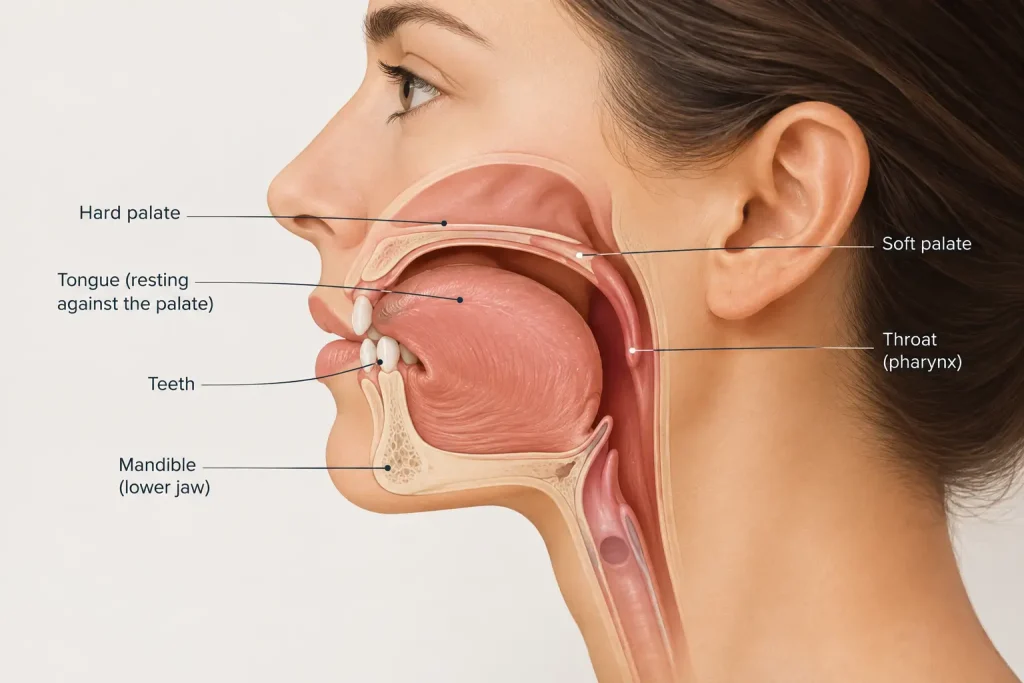
Mewing comes up in our office almost every week now, usually from a teenager who saw it on TikTok and wants to know if resting their tongue a certain way will hand them a sharper jawline. It has become one of the most searched dental trends of the past few years, and also one of the most misunderstood. So here is the honest orthodontist’s version, without the hype and without the marketing.
The short version is this. Good tongue posture and nasal breathing are real, healthy habits genuinely worth having. But mewing will not reshape an adult’s jawbone, and it will not straighten your teeth or fix your bite. The dramatic before-and-after photos you see online are almost always explained by something other than tongue placement. Let me walk you through what mewing actually is, what the science supports, where the promises fall apart, and what the professional bodies are now saying about it.
The Short Answer, and Where the Myth Comes From
Mewing is the practice of pressing your tongue flat against the roof of your mouth in the hope of defining your jawline over time. Its supporters claim that with enough consistency it can sculpt the face, improve your bite, and even straighten teeth. That is a big set of promises for a tongue position, and it is worth knowing where they came from.
The technique is named after John Mew, a British orthodontist whose ideas about facial growth were never accepted by mainstream orthodontics. He ultimately lost his license over claims that lacked scientific support. That origin matters, because much of the mewing movement online traces back to a theory that the profession examined and did not validate. Understanding that background helps put the viral confidence of the trend in perspective.
What the Science Really Says About Mewing
This is where I have to be direct with you, because the evidence is not ambiguous. The American Association of Orthodontists reviewed the available literature and found no peer-reviewed studies supporting mewing’s effectiveness for any of its claimed benefits. None.
In its public guidance, the AAO states plainly that there is no scientific evidence to support mewing’s claims of reshaping the jawline, and that the potential risks outweigh any unproven benefits. As AAO leadership put it, proper tongue posture does play a role in oral health, but mewing oversimplifies the complexities of facial structure. That single phrase captures the whole problem. Your face is the product of genetics, years of bone growth, muscle interactions, and airway function, and a tongue position cannot override all of that.
I want to be fair rather than dismissive, though, because there is a real kernel underneath the hype, and it is the part that gets distorted online. So let me explain the one place tongue posture genuinely matters, and why it does not translate into the promises you are seeing.
Why Tongue Posture Matters, but Can’t Reshape an Adult Jaw
Tongue posture is not nonsense. Where your tongue rests really does influence how the upper jaw develops, because the tongue acts as a gentle natural mold against the palate during the years the face is growing. This is exactly why orthodontists care about it, and why we screen children for low tongue posture and mouth breathing. The catch is that this influence belongs almost entirely to childhood, when the bones are still forming.
The Difference Between a Growing Child and an Adult
Here is the nuance the viral videos skip, and it is the most important thing in this entire article. In children and young teens, whose facial bones are still growing, tongue posture and breathing patterns really can influence development. That window is genuinely responsive, which is part of why we evaluate kids early. In adults, growth is finished. The bones of the face have fused, and no amount of tongue pressure remodels a mature jaw. The two situations could not be more different.
| Growing child or young teen | Adult |
| Facial bones are still developing and responsive | Facial bones have fused and stopped growing |
| Tongue posture and breathing genuinely influence growth | Tongue pressure cannot remodel a mature jawbone |
| Screened early for mouth breathing and airway issues | Structural change requires orthodontics or surgery |
| Guided by professional appliances, not tongue habits alone | Any real jawline change online is usually something else |
This is the same principle behind why we treat mouth breathing and airway issues in children early, while growth can still be guided. What that childhood biology does not do is give a grown adult a new jawline through tongue exercises. If you are past your late teens, mewing is essentially cosmetic theater for your bone structure, however sincerely you practice it.
The Real Risks of Aggressive Mewing
Mewing is often sold as harmless, and gentle attention to tongue posture usually is. The problem starts when people push hard, force unnatural positions, and keep it up for months chasing a result. The AAO has specifically warned that this carries real risks, not just disappointment.
According to the association’s guidance, chronic pressure from aggressive mewing can loosen teeth, throw off the bite, and contribute to tooth wear over time. It can also affect speech, causing slurring or difficulty pronouncing certain sounds when the tongue is held in an altered position. The frustrating irony is that some people end up needing orthodontic treatment to fix problems that mewing created, which is the opposite of what they set out to do. When you apply sustained force to teeth without professional planning, teeth can move in ways you did not intend, because that is simply how teeth respond to pressure.
What Actually Changes Your Jawline and Smile
If your goal is a more balanced profile or a straighter bite, the honest path is also the effective one. Real structural change comes from methods that account for what is happening beneath the surface, not from a posture habit.
In a growing child, an orthodontist can genuinely guide jaw development using appliances designed for that purpose, at the age when it works. In an adult, braces and clear aligners move teeth and can meaningfully improve the profile and bite, and when true skeletal change is needed, that falls to surgical orthodontics. This is the terrain we cover in our article on whether braces change your face shape, where the changes are real, measurable, and supervised rather than wished for.
As for those striking mewing transformations online, treat them with heavy skepticism. Search any before-and-after and you are usually looking at weight loss, better posture, clever camera angles and lighting, the natural maturing of a young face, or actual orthodontic work quietly left out of the story. The tongue rarely deserves the credit it is given.
The Healthy Habits Mewing Gets Half-Right
Rather than leave you with only what not to do, here is the useful part worth keeping. Mewing took a few genuinely good habits and wrapped them in exaggerated promises. The habits themselves are worth adopting, especially for children, as long as you drop the expectation that they will resculpt your face.
• Breathe through your nose. Nasal breathing supports healthy oral and facial development in children and better sleep and oral health at any age. Chronic mouth breathing is worth having evaluated, because it can point to an airway issue.
• Let your tongue rest naturally against the palate. A relaxed resting tongue posture is normal and healthy. The key word is relaxed, not forced or strained for hours.
• Keep your lips together at rest. This supports nasal breathing and is a sign of balanced oral muscle function.
• Get children evaluated early. If a child mouth-breathes, snores, or has a low tongue posture, an early orthodontic visit can catch airway and growth issues while they are still treatable, which is the evidence-based version of what mewing only pretends to do. Our guide on preventing orthodontic problems in children covers this window.
Notice the theme. These habits happen naturally in most people and support health rather than promising a new jawline. That is the honest place for tongue posture in your life, helpful background habits, not a facial transformation tool.
Get an Honest Answer at Freedman & Haas
Mewing sits in a place worth naming clearly. Good tongue posture and nasal breathing are healthy and worth encouraging, especially in children. But as a way to reshape an adult jaw, straighten teeth, or replace orthodontic care, it is not supported by evidence, and pushed too hard it can cause harm. You deserve real answers rather than viral ones, and that is exactly what a professional evaluation gives you.
At Freedman & Haas Orthodontics, our board-certified orthodontists can assess your tongue posture, breathing, jaw, and bite, and tell you honestly what is achievable for your face and how. We have guided more than 30,000 patients across West Palm Beach and Wellington, and we would rather give you the truthful picture than sell you a trend. If a jawline or bite concern is on your mind, schedule a consultation and let us show you what genuinely works.
Frequently Asked Questions
Does mewing actually work to change your jawline?
Not in adults. The American Association of Orthodontists found no peer-reviewed evidence that mewing reshapes the jawline, because adult facial bones have fused and cannot be remodeled by tongue pressure. Tongue posture influences facial growth only during childhood, and even then it works alongside professional guidance, not as a standalone fix.
Can mewing straighten teeth or fix my bite?
No. Straightening teeth and correcting a bite require controlled, measured forces applied over time, which is what braces and aligners provide. Mewing cannot deliver that, and forcing sustained tongue pressure against your teeth can actually move them in unintended ways, potentially worsening your bite rather than improving it.
Is mewing safe to do?
Gentle, natural tongue posture and nasal breathing are healthy habits. Aggressive mewing is a different story. The AAO warns it can loosen teeth, misalign the bite, contribute to tooth wear, and affect speech. Some people end up needing orthodontic treatment to correct problems that aggressive mewing caused.
Why do mewing before-and-after photos look so convincing?
Because the change usually comes from something other than the tongue. Most dramatic before-and-afters reflect weight loss, improved posture, camera angles and lighting, the natural maturing of a young face, or actual orthodontic treatment that is not mentioned. The results are real in the photos, but mewing is rarely the reason.
Does tongue posture matter at all?
Yes, especially in children. Where the tongue rests helps shape the developing upper jaw, which is why orthodontists screen young patients for low tongue posture and mouth breathing. The benefit belongs mostly to the growing years, and it supports healthy development rather than sculpting an adult jawline on its own.