
If you have a history of gum disease and you want straighter teeth, you have probably wondered whether that ship has already sailed. Maybe a dentist mentioned bone loss years ago. Maybe your gums have receded and you assume braces would only make things worse. It is a common worry, and it stops a lot of adults from ever asking the question.
So let me answer it directly. Yes, in most cases you can straighten your teeth with braces or Invisalign even with a history of gum disease, but only under one firm condition: the disease has to be controlled first. That single word, controlled, is what this entire article turns on. Get it right and orthodontics can actually improve your long-term gum health. Get it wrong and you risk real harm. Here is exactly how it works.
The Short Answer: Often Yes, With One Key Condition
A history of gum disease does not disqualify you from orthodontic treatment. What matters is whether the disease is active right now or has been brought under control.
If your gum disease is active, meaning there is ongoing inflammation, bleeding, and progressing bone loss, then no, you should not start braces or Invisalign yet. Moving teeth through inflamed, infected tissue can accelerate the damage. But if the disease has been treated and stabilized, and you keep up with your periodontal maintenance, then orthodontic treatment is often not only possible but genuinely beneficial. The distinction is everything, so let me explain why the biology demands it.
Why Gum Health Matters So Much for Moving Teeth
To understand the rule, you have to understand what actually holds a tooth in place and what happens when you move it.
Your teeth are not anchored directly to bone. Each root sits in its socket, cushioned by the periodontal ligament and supported by the surrounding alveolar bone. When braces or aligners apply pressure, that support structure remodels: bone dissolves on one side and rebuilds on the other, letting the tooth migrate. It is the same process we explain in our article on how teeth move with braces. The whole system depends on healthy bone and healthy gums to work safely.
Now add gum disease to the picture. Periodontal disease destroys exactly that support, the bone and connective tissue holding your teeth. Here is the problem in concrete terms. When bone height is reduced, the point around which a tooth pivots, called the center of resistance, shifts further down the root. That change concentrates force on a smaller area of remaining support and raises the risk of root resorption, where the root itself shortens. Push on a tooth with active disease and reduced support, and you can drive it loose instead of into place.
This is why orthodontists who treat these cases use much lighter forces than usual. In teeth with bone loss, recommended intrusion forces can be as low as 5 to 10 grams per tooth, a fraction of what a healthy tooth tolerates. The reduced support demands a gentler, slower, more carefully monitored approach. It can be done well, but it cannot be rushed or forced.
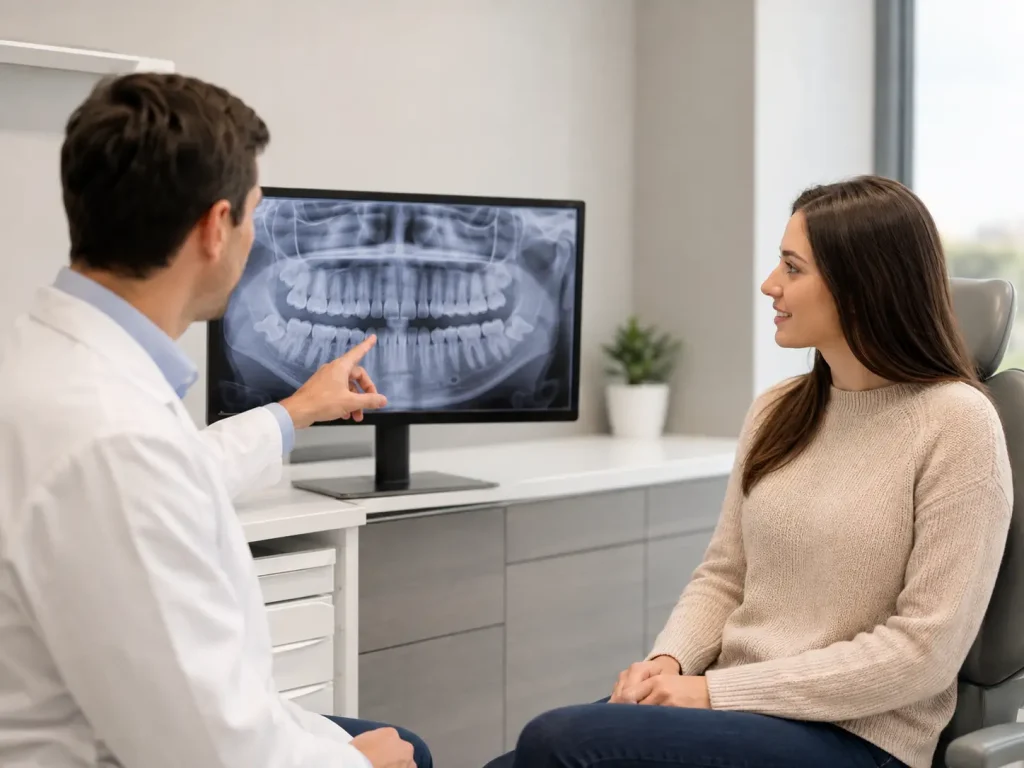
It also explains why the evaluation before treatment is so thorough. A proper periodontal assessment for an orthodontic candidate includes probing the depth of the gum pockets around key teeth, checking for bleeding and mobility, and reading bone levels on radiographs or a 3D scan. Clinicians recommend spending real time on this exam rather than glancing at the gums, because the details it reveals, how much bone remains and where, directly shape whether and how your teeth can be moved. In short, the map has to be drawn before the journey can begin.
Active vs. Controlled Gum Disease: The Critical Difference
Since everything hinges on this distinction, here is how to tell the two apart. This is roughly what your orthodontist and periodontist will assess together before giving a green light.
| Active gum disease (treat first) | Controlled gum disease (often ready) |
| Red, swollen, or bleeding gums | Gums pink and firm, no bleeding on brushing |
| Deep periodontal pockets and ongoing inflammation | Pocket depths stable and within a healthy range |
| Progressing bone loss or loose teeth from disease | Bone levels stable, confirmed on imaging |
| Not yet under a periodontist’s care | Enrolled in regular periodontal maintenance |
Getting from the left column to the right is a real process, not a formality. Before orthodontics can begin, the inflammation and bacterial biofilm must be brought under control, typically through deep cleaning, known as scaling and root planing, and sometimes gum surgery or antibiotics. That stabilization phase commonly takes anywhere from 3 to 9 months, depending on severity. It is tempting to see that as a delay. I would frame it differently: it is the groundwork that makes safe tooth movement possible at all.
One more point that matters. Even after treatment starts, gum disease can flare if plaque control slips, because fixed appliances tend to collect the very bacteria linked to periodontal disease. That is why ongoing periodontal maintenance during orthodontics is non-negotiable, and why keeping your teeth and gums healthy throughout treatment carries even higher stakes for you than for the average patient.
Why Invisalign Is Often the Better Choice After Gum Disease
For patients with a periodontal history, I usually lean toward clear aligners over traditional braces, and the reasoning is practical, not promotional. It comes down to hygiene, and hygiene is the whole ballgame here.
The single biggest advantage is that aligners are removable. You take them out to brush and floss normally, exactly the way your periodontist wants you to. Fixed braces do the opposite: brackets and wires trap plaque and food, and research shows fixed appliances accumulate more of the specific bacteria tied to gum disease than removable ones do. For someone whose gums are already vulnerable, that difference is meaningful.
There are a few more reasons aligners tend to suit these cases well:
• Smooth plastic is gentler on gum tissue than metal brackets and wires, which can irritate already sensitive gums.
• Removability makes professional cleanings and periodontal maintenance far easier during treatment.
• Digital planning allows the gradual, controlled, light forces that fragile periodontal support requires. If you are weighing your choices, our guide on how to decide between braces and aligners lays out the trade-offs.
I want to be fair, though. Aligners are not automatically the answer for everyone. Some complex movements are still handled better by braces, and severe cases may need approaches only fixed appliances provide. The right tool depends on your specific bite and how much support your teeth have left. That is a judgment call for an in-person exam, not a blog post.
The Surprising Upside: Straighter Teeth Can Mean Healthier Gums
Here is the part that reframes the whole question. For the right patient, orthodontic treatment does not just coexist with gum health, it can actively support it.
Crowded, overlapping teeth are genuinely harder to clean. Plaque hides in the tight spaces a brush and floss cannot reach, and those hidden spots are where gum disease takes hold and returns. Straightening those teeth opens up access, making daily hygiene more effective and professional cleanings more thorough. Over the long run, that improved access can help you keep periodontal disease from coming back.
There is more. Orthodontics can correct issues that overload specific teeth, and it can improve root parallelism and address certain bone defects, distributing bite forces more evenly across the arch. In fact, orthodontic treatment is sometimes used deliberately as part of a broader periodontal treatment plan, working alongside your periodontist rather than in spite of them. Straightening teeth is not a cure for gum disease. But once the disease is controlled, alignment can be a real ally in keeping it that way.
What Treatment Looks Like When You Have a Periodontal History
If you fall into the controlled category, here is roughly what to expect, so there are no surprises.
• A team approach. Your orthodontist and periodontist coordinate from the start, and often a dentist too. This is not a solo project.
• Thorough imaging up front. X-rays or a 3D scan map exactly how much bone support each tooth has before any movement begins.
• Lighter forces and a slower pace. Treatment is deliberately gentle and closely monitored, since reduced support means less margin for error.
• More frequent periodontal cleanings. Expect to see your periodontist for maintenance on a tighter schedule throughout treatment.
• Diligent home care. Your daily hygiene, including proper flossing, matters more for you than for almost any other orthodontic patient.
Warning Signs to Watch For During Treatment
If you start orthodontic treatment with a periodontal history, you become an active partner in protecting your own gums. Knowing what to watch for lets you catch a flare early, before it undoes your progress. Contact your orthodontist or periodontist promptly if you notice any of these:
• Gums that start bleeding regularly when you brush or floss, especially if they had stopped bleeding before treatment.
• Persistent redness, swelling, or tenderness along the gumline that does not settle within a few days.
• A tooth that begins to feel genuinely loose, well beyond the mild, expected mobility of normal tooth movement.
• Gums that appear to be pulling back or receding from a tooth during treatment.
• A change in how your teeth fit together, or a persistent bad taste or odor that good hygiene does not resolve.
None of these mean disaster, but all of them mean pause and check. In a patient with reduced periodontal support, a small problem caught early is a minor adjustment. The same problem ignored for months is how treatment goes wrong. This is exactly why these cases are monitored so closely, and why the honest answer to most concerns is a quick call rather than a wait-and-see.
Straightening Safely at Freedman & Haas
A history of gum disease is not the end of the road for a straighter smile. For most adults whose periodontal health has been restored and maintained, braces or Invisalign are very much on the table, and the treatment can even leave your gums easier to care for than before. The key is doing it in the right order: control the disease first, then move the teeth, with a team watching closely the whole way.
At Freedman & Haas Orthodontics, our board-certified team works hand in hand with periodontists to evaluate your gum health honestly and build a plan that protects your teeth while it straightens them. We have helped more than 30,000 patients across West Palm Beach and Wellington, including many adults with a periodontal history, achieve results they were told might not be possible. If you have had gum disease and want to know where you stand, schedule a consultation and we will give you a straight answer based on your own mouth.
Frequently Asked Questions
Can you get braces if you have gum disease?
Only if the gum disease is controlled first. With active disease, meaning ongoing inflammation, bleeding, and bone loss, braces can accelerate the damage and should be postponed. Once a periodontist has stabilized the disease and you maintain good gum health, braces or Invisalign are often possible with lighter forces and close monitoring.
Is Invisalign safer than braces for gum disease?
For many patients with a periodontal history, yes, largely because aligners are removable. You can take them out to brush and floss normally, while fixed braces trap plaque and the bacteria linked to gum disease. Aligners are also smoother on sensitive gum tissue. That said, the best option depends on your specific case, and some complex movements are still better handled by braces.
Can I get Invisalign with bone loss?
Often, yes. Bone loss exists on a spectrum. Mild bone loss may have little effect on treatment, while more advanced loss requires a slower, carefully monitored approach with lighter forces. Diagnostic imaging determines how much support remains around each tooth and whether movement can be done safely. Many adults with stable, treated bone loss complete orthodontic treatment successfully.
Will straightening my teeth help my gums?
It can, once your gum disease is under control. Straighter teeth are easier to clean, since crowding creates hidden spots where plaque and gum disease thrive. Better access means more effective brushing and flossing and more thorough professional cleanings, which supports long-term gum health. Orthodontics is not a treatment for gum disease itself, but it can help you keep it from returning.
How long after gum treatment can I start braces?
It varies with severity. The periodontal stabilization phase, which includes deep cleaning and sometimes surgery, commonly takes 3 to 9 months to bring inflammation and bacteria under control. Orthodontic treatment can begin once your periodontist confirms the disease is stable and you are maintaining healthy gums. Your care team will decide the timing together.