
Watch a child bite down and you might catch it for just a second. The lower jaw slides a little to one side as the teeth come together, settling into a position that does not look quite centered. Or perhaps you have noticed it in your own mouth, a quiet sense that your top and bottom teeth meet in a way that feels slightly off, even if you could never put your finger on why.
That small misalignment often has a name, and it is one worth knowing. A crossbite ranks among the more common bite problems we treat, and also among the most quietly consequential, because it tends to hide in plain sight and seldom announces itself with any pain. What follows is a plain look at what a crossbite actually is, how to recognize it at any age, and why acting on one sooner almost always beats waiting it out.
First, What a Bite Is Supposed to Do
A crossbite is easiest to grasp if you picture a healthy bite first. When your teeth come together the way they should, the upper teeth rest just slightly outside the lower ones all the way around the arch, a little like a lid settling over a box. That gentle overlap is no accident. It keeps your cheeks and tongue clear of the chewing surfaces, spreads the force of each bite evenly, and guides the jaw into a stable, comfortable resting place.
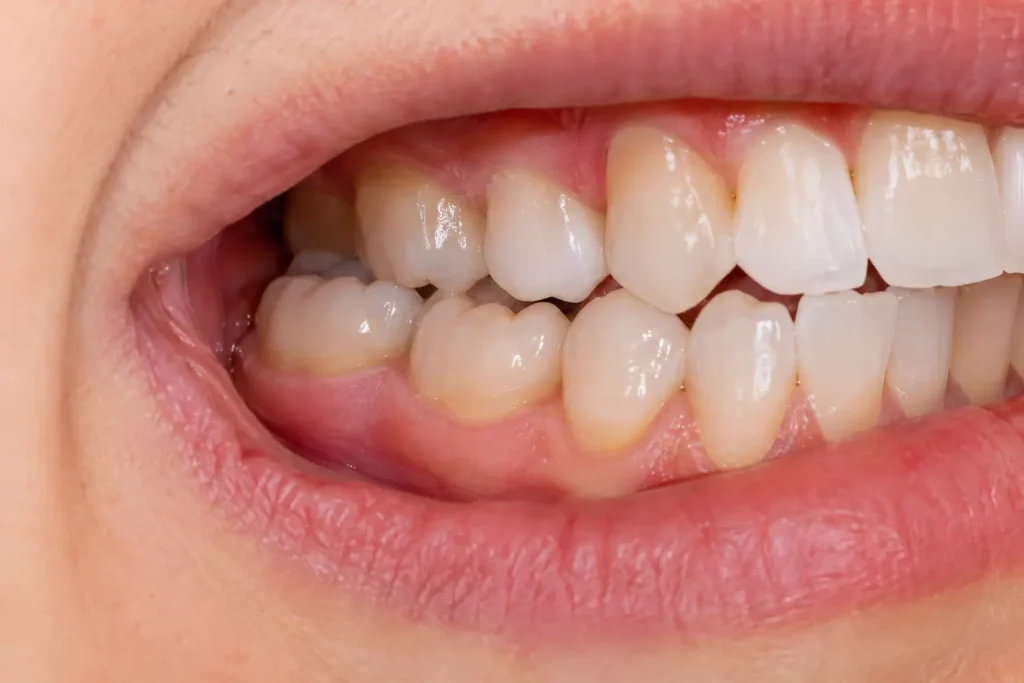
A crossbite reverses that relationship in one or more spots. Rather than sitting outside, one or more upper teeth close inside the lower teeth. The lid, so to speak, slips under the edge of the box where it was meant to rest on top. This can involve a single tooth or an entire segment, and it can show up at the front of the mouth or along the sides, with each version telling an orthodontist something a little different about what is going on.
The Two Places It Shows Up
Crossbites sort into two broad families according to where in the mouth they occur, and both belong to the wider group of bite problems orthodontists call malocclusion.
An anterior crossbite affects the front teeth, where one or more upper teeth close behind the lower ones instead of in front. At a glance, it can look like an underbite, and the two are easy to confuse, although a true underbite is a skeletal matter of jaw position while an anterior crossbite may involve nothing more than a tooth or two tipped the wrong way.
A posterior crossbite affects the back teeth, the premolars and molars along the sides, where the upper teeth bite inside the lower ones. This is the more common of the two, and research pooling data across populations places posterior crossbite at roughly 9 percent. More often than not it traces back to an upper jaw that is simply too narrow to sit correctly over the lower arch. A posterior crossbite can appear on one side alone, which is called unilateral and accounts for about half of all crossbites, or on both sides at once.
How to Tell If You or Your Child Has One
Since a crossbite so rarely hurts, it is easy to miss, which makes it worth knowing the telltale signs. A handful of them tend to give it away.
- Upper teeth closing inside the lower teeth, at the front or along the sides, when you bite together gently in front of a mirror.
- A lower jaw that appears to slide or shift toward one side as the teeth meet.
- A chin that looks slightly off-center, most noticeable when the teeth are fully closed.
- Uneven wear, with certain teeth looking more worn down than their neighbors or than the matching teeth on the other side.
- A tooth that sits out of line proving hard to keep clean, or gums that have started to recede around it.
- In a child, a clear habit of chewing on one side far more than the other.
No single sign on its own confirms a crossbite, and some can point toward other issues entirely. Any of them, though, is a sound reason to have an orthodontist take a proper look, because a crossbite is one of the problems that gains the most from being caught early.
The Part Most People Miss
Here is the detail that lifts a crossbite above a mere cosmetic quirk, and it is the one we spend the most time explaining to parents. When a crossbite sits on only one side, the jaw often cannot close comfortably in its natural position, so it adapts. The lower jaw quietly shifts sideways to find a bite where the teeth actually fit together, and before long that shifted position starts to feel completely normal.
Orthodontists call this a functional shift, and in a growing child it is anything but harmless. A jaw that habitually closes off to one side is a jaw that grows off to one side. Months and years of that daily displacement can steer the lower jaw and its joints toward developing asymmetrically, quietly turning what began as a simple dental problem into a skeletal one. What makes it so easy to overlook is the very thing that makes it risky. It causes no pain, the child adapts without a word of complaint, and the shift grows invisible precisely because it has become a habit.
Why Crossbites Do Not Fix Themselves
It is only natural to hope a bite problem might sort itself out as a child grows, and with a few orthodontic issues there is a grain of truth to that. A crossbite is not one of them, and the evidence on this is consistent. Crossbites do not self-correct. The reason lies in the cause. Most posterior crossbites stem from an upper jaw that is narrower than it ought to be, and a narrow jaw does not spontaneously widen on its own. If anything, the longer the teeth meet in the wrong relationship, the more the surrounding bone, muscle, and joints adapt around it, which tends to entrench the problem rather than ease it. That same narrow-arch tendency sits behind many of the reasons teeth end up crooked or crowded, and much like those, a crossbite answers to guidance far more readily than to patience.

What Is Really at Stake
Left alone, a crossbite seldom stays a small matter. In children the gravest concern is the asymmetric jaw growth described above, which only grows harder to correct with each passing year. Across every age, the lopsided way a crossbite loads the teeth takes its toll. Certain teeth absorb more force than they were built to handle and wear down unevenly, and that lost enamel never comes back. The teeth stranded on the wrong side of the bite are also prone to gum recession and the strain that comes with exposed roots. And a jaw made to work from an unnatural position can feed muscle fatigue and joint strain over the long haul.
None of this is meant to sound alarming. The great majority of crossbites are corrected smoothly and completely. The point is only that a crossbite is a problem that compounds quietly in the background, which is why orthodontists treat it as something to address rather than something to watch indefinitely.
The Good News Is About Timing
If there is an encouraging thread running through all of this, it is that crossbites respond very well to treatment, and exceptionally well when they are caught early. The approach hinges far less on the appliance than on the stage of life it is used in.
In children, the window around the late baby-teeth and early mixed-teeth years, frequently near ages 7 to 9, is close to ideal. At that age the upper jaw has not yet fused into its final shape, so a palatal expander can gently widen a narrow arch over a matter of weeks, giving the upper teeth the room to sit correctly and allowing a shifted jaw to settle back toward center. Treatment at this stage is usually quick, uncomplicated, and highly successful, which is much of the reason orthodontists urge a first evaluation around age 7.
In teenagers and adults, correction remains very achievable, often carried out with braces or clear aligners that reposition the teeth into a proper bite. Once the jaw has finished growing, a severely narrow upper jaw becomes harder to widen through the teeth alone, and the most pronounced skeletal cases occasionally call for a combined surgical and orthodontic approach. Even in those situations the goal never changes, and neither does the outcome we are after, a bite that finally fits together the way it was always meant to.
Where Freedman & Haas Comes In

A crossbite is one of those problems that rewards an early, experienced eye, and it is exactly the kind of thing we look for in every evaluation we do. At Freedman & Haas Orthodontics, our board-certified team has guided more than 30,000 patients across West Palm Beach and Wellington toward bites that work and smiles that last, and we treat crossbites at every age, from a child’s first expander to an adult’s full correction.
If you have spotted any of the signs described here, whether in your own smile or your child’s, do not wait for it to resolve on its own, because it will not. Schedule an evaluation today, and we will tell you exactly what is happening and how simply it can be put right.
Common Questions About Crossbites
Can a crossbite correct itself over time?
No. Unlike a few orthodontic issues, crossbites do not self-correct, and the evidence on this is consistent. Because most posterior crossbites come from a narrow upper jaw that will not widen on its own, waiting tends to let the problem settle in rather than resolve. This is why early evaluation and treatment are so strongly recommended.
What is the difference between a crossbite and an underbite?
They can look similar at the front of the mouth, but they are not the same thing. An underbite is a skeletal problem where the entire lower jaw sits ahead of the upper one. An anterior crossbite can be far more limited, sometimes just a tooth or two closing behind their upper counterparts, without the jaws themselves being misaligned.
At what age should a crossbite be treated?
Earlier is better, and the ideal window is often around ages 7 to 9, while the upper jaw is still easy to widen with an expander. That said, crossbites can be corrected at any age. Teenagers and adults are treated successfully too, though more advanced cases in adults sometimes need a combined surgical and orthodontic plan.
How is a crossbite fixed?
It depends on the age and the cause. In children, a palatal expander widens a narrow upper jaw so the teeth can meet correctly. In teenagers and adults, braces or clear aligners reposition the teeth into a proper bite, and the most severe skeletal cases may require surgery alongside orthodontics. An evaluation determines which path fits.
Is a crossbite a serious problem?
It can be, which is why it is worth taking seriously even though it rarely hurts. In children it can lead to asymmetric jaw growth, and at any age it can cause uneven tooth wear, gum recession, and strain on the jaw joint. Treated early, though, most crossbites are resolved completely and without difficulty.