
You wore braces for two or three years as a teenager. Your smile was straight. Then one day, maybe a decade later, you notice your bottom front teeth have started to overlap again. It feels like a betrayal, or like the braces somehow failed. You paid for straight teeth, so why are they crooked again?
Here is the reassuring truth: in most cases, nothing went wrong, and it is not your orthodontist’s fault or yours. The lower front teeth are the single most common place teeth shift after treatment, and often it is a completely natural process that happens to almost everyone, including people who never had braces at all. Let me explain exactly why your bottom teeth in particular do this, the difference between two things that get confused constantly, and the one habit that actually keeps your smile straight for life.
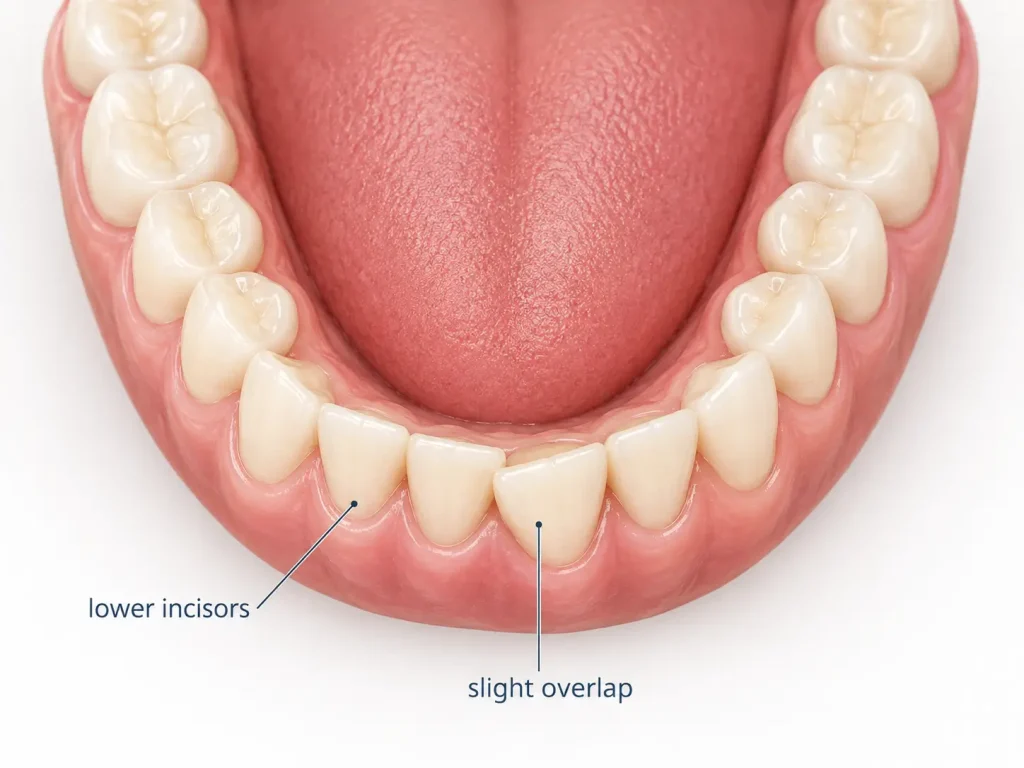
The Short Answer: It’s Usually Natural, Not a Failure
Your teeth were never meant to stay frozen in one place. They move throughout your entire life, slowly and continuously, whether or not you ever wore braces. The lower front teeth simply show that movement first and most visibly.
So when your bottom teeth crowd up years after treatment, it is usually one of two things: either the natural shifting that happens to everyone with age, or a relapse because retainer wear stopped. Both are common, both are manageable, and neither means your original treatment was a waste. The distinction between them matters, though, so let me draw it clearly, because most articles blur the two together.
Relapse vs. Natural Crowding: Two Different Things
This is the confusion at the heart of the whole question, and untangling it changes how you think about your teeth. Orthodontic researchers have pointed out for decades that these two phenomena get mixed up constantly, even though they have different causes.
| Orthodontic relapse | Natural late crowding |
| Teeth move back toward their pre-braces position | New crowding that appears regardless of past treatment |
| Usually follows stopping or losing a retainer | Happens even to people who never had braces |
| Can begin within months of ending retention | Builds slowly over years and decades |
| Largely preventable with consistent retainer wear | Slowed, not fully stopped, by lifelong retention |
Relapse is the more familiar one. After braces, your teeth are in new positions but the bone and fibers around them have not fully stabilized, so without a retainer they drift back toward where they started. That is preventable, and it is exactly why retainers exist.
Natural late crowding is the one almost nobody warns you about. Research on lifetime dental changes shows that lower front teeth tend to crowd with age even in people who never had a single orthodontic problem. In fact, orthodontists have a name for it: late lower incisor crowding, and it typically shows up in young adulthood. The key insight is that some crowding of your bottom teeth over the years may not be relapse at all. It may be the same aging process everyone experiences, and your braces did not cause it or fail to prevent it. It is just biology.
Why the Lower Front Teeth Are the First to Shift
Of all your teeth, why do the bottom front ones crowd up first? It is not random. Their location and anatomy make them uniquely vulnerable, and understanding why takes the mystery out of it.
The lower incisors sit in the narrowest, least stable part of your entire dental arch. Think of the lower arch as a curve: the front is the tightest part of that curve, with the least room to absorb any change. So when space anywhere in the arch shrinks even slightly, that reduction gets expressed first and most visibly right at the front, where the incisors have nowhere to go but to rotate and overlap.
Their small size and shape add to it. Lower incisors are the smallest teeth in your mouth, with narrow, flat contact points that offer little resistance to shifting. Compared to the broad, sturdy back teeth, they buckle easily when squeezed. Combine the tightest part of the arch with the smallest, least stable teeth, and you have the perfect location for crowding to appear first. It is not that your bottom teeth are weak. It is that they are the early warning system for changes happening across your whole mouth.
The Role of Mesial Drift and Lifelong Tooth Movement
Now for the engine behind it all, and the part that surprises most people: your teeth are quietly migrating forward for your entire life. This forward creep is called mesial drift, and it never fully stops.
Here is why it matters for your bottom teeth. As teeth drift forward and their contact points wear down slightly from decades of chewing, the total length of the dental arch shrinks. And the numbers are real. A major review of lifetime dental changes found that the lower arch shortens by roughly 4.83 millimeters between ages 9 and 20, and that lower front crowding continues to increase by about 1.54 millimeters between ages 17 and 60, even in people who never had orthodontic problems. When the arch gets shorter but you still have the same number of teeth to fit, something has to give, and it is the crowded front that gives first.
This is the same space principle that causes crooked teeth in the first place, which we explore in our article on why teeth become crooked. The arch is a fixed amount of real estate, and when it shrinks, the teeth compete for room. Your bottom incisors lose that competition first.
What About Wisdom Teeth? Clearing Up a Common Myth
Almost everyone has heard that wisdom teeth push the other teeth forward and cause the bottom ones to crowd. It sounds logical, and it is one of the most common explanations people repeat. But the science is far less certain than the myth suggests, so let me be straight with you.
Multiple studies and systematic reviews have looked at whether wisdom teeth actually cause lower incisor crowding, and the evidence is weak and conflicting. Some studies found a small association, others found none at all. What researchers largely agree on is that wisdom teeth emerge around the same age that late lower incisor crowding naturally appears, so the two get blamed on each other purely because of timing. In other words, the wisdom teeth show up at the scene of the crime, but they are probably not the main culprit. Late crowding happens in plenty of people who had their wisdom teeth removed years earlier, or who never developed them at all. If your dentist recommends removing wisdom teeth, there are often good reasons, but preventing lower crowding is not a reliable one.
The Retainer Connection: The One Thing That Prevents It
If your teeth are going to keep drifting for life, what can you actually do about it? The answer is refreshingly simple, and it is the single most important message of this article: wear your retainer, essentially forever.
A retainer is the only proven way to hold your teeth against the natural forces trying to move them. Stop wearing it, and both relapse and natural drift take over. The long-term research here is genuinely striking. In classic studies following patients for decades after braces, crowding of the lower front teeth continued to increase from 10 to 20 years after retention stopped, and only about 10% of patients still had clinically acceptable lower alignment years later without ongoing retention. Ten percent. That is why the importance of wearing a retainer is not a suggestion your orthodontist makes lightly.
Let me set an honest expectation, though. A retainer does not freeze time completely. Natural aging changes are powerful, and even diligent retainer wearers may see very minor settling over many decades. But consistent retention dramatically reduces drift and is the difference between teeth that stay essentially straight and teeth that noticeably crowd. If you still have your retainer and it fits, start wearing it nightly again. If it no longer fits because your teeth have already moved, that is worth a conversation, which brings us to the next question.
Can Crowded Bottom Teeth Be Re-Straightened?
Yes, and usually more easily than you might fear. If your bottom teeth have already crowded, you are not stuck with them, and the fix is often simpler than your original treatment was.
For mild to moderate lower crowding, clear aligners like Invisalign are frequently an excellent option. Because the movement needed is often small, treatment can be relatively short, sometimes just a few months, and aligners are discreet enough that most adults never hesitate on that front. Your orthodontist may combine them with small techniques to create the needed space. For more significant crowding, braces or a more comprehensive plan may be the better route.
One important point: whatever re-straightens your teeth, the same rule applies afterward. Without committed retention, they will simply crowd again, because the underlying forces never went away. Re-treatment fixes the current crowding. Lifelong retention is what makes the fix last. This time, keep the retainer.
What Not to Do When You Notice Crowding
The moment people spot their bottom teeth shifting, they often reach for the wrong fix. A few mistakes are common enough to be worth flagging, because they can make things worse or waste your money.
• Do not force an old retainer that no longer fits. If your teeth have already moved, jamming in a retainer built for their old position can hurt, crack the retainer, or apply harmful uneven pressure. If it does not seat easily, stop and get it checked.
• Do not buy mail-order aligners to quietly fix it yourself. Lower crowding can involve subtle space and bite issues that need a professional eye. Moving teeth without proper diagnosis risks your gums, your roots, and your bite.
• Do not assume it will stop on its own. Because the forces behind drift are constant, untreated crowding tends to slowly increase, not reverse. Earlier attention usually means a simpler, shorter fix.
• Do not ignore it if it comes with gum problems. Crowded lower teeth are harder to clean, and if you notice bleeding or tender gums, that is worth addressing promptly, as we cover in our guide to keeping your teeth and gums healthy.
The simplest move when you first notice crowding is also the cheapest: dig out your retainer and see if it still fits. If it does, resume wearing it nightly. If it does not, book a quick consultation before the crowding grows.
Keeping Your Results for Life at Freedman & Haas
Crooked bottom teeth after braces are one of the most common and most misunderstood things adults notice about their smiles. Usually it is not a failure of your treatment but a mix of natural lifelong tooth movement and, often, retention that stopped somewhere along the way. Your lower incisors are simply the first place that movement shows. The encouraging part is that it is both preventable and fixable, and the tool for both is the same: a retainer, worn consistently, for the long haul.
At Freedman & Haas Orthodontics, our board-certified team can tell you whether your lower crowding is relapse, natural change, or a bit of both, and lay out the simplest path to a straight smile you keep this time. We have guided more than 30,000 patients across West Palm Beach and Wellington, and we are here whether you need a new retainer, a short round of aligners, or just honest answers. If your bottom teeth have started to crowd, schedule a visit and let us take a look.
Frequently Asked Questions
Why are my bottom teeth crooked again after braces?
Usually because of natural lifelong tooth movement, a relapse from stopping retainer wear, or a combination of both. The lower front teeth are the first and most visible place teeth shift, because they sit in the narrowest, least stable part of the arch. In many cases this is normal aging rather than a failure of your original treatment.
Is my lower crowding relapse or just natural aging?
It can be either, and often both. Relapse is teeth moving back toward their pre-braces position, usually after retainer wear stops. Natural late crowding happens to almost everyone with age, even people who never had braces, as the arch shortens over time. An orthodontist can assess which is driving your specific case.
Do wisdom teeth cause bottom teeth to crowd?
Probably not, despite the popular belief. Research on this is weak and conflicting. Wisdom teeth simply emerge around the same age that natural lower crowding appears, so they get blamed by coincidence of timing. Late crowding happens in plenty of people who never had wisdom teeth or had them removed early.
Can I fix my crooked bottom teeth without full braces again?
Often, yes. Mild to moderate lower crowding can frequently be corrected with clear aligners like Invisalign, sometimes in just a few months since the movement needed is usually small. More significant crowding may require braces. Whatever the method, consistent retainer wear afterward is essential to keep the result.
How do I stop my teeth from shifting again?
Wear your retainer, ideally for life, typically at least nightly. It is the only proven way to hold teeth against the natural forces that keep moving them. Long-term studies show that without ongoing retention, most people lose their lower alignment over the years, while consistent retainer wear dramatically reduces that drift.