
If you have started researching braces, you have probably run into self-ligating systems, often sold under brand names like Damon, and a long list of impressive claims. Faster treatment. Fewer visits. Less pain. Better results. It sounds like an easy upgrade, and it leaves a lot of patients wondering whether traditional braces are somehow the outdated choice.
Here is what I can tell you as an orthodontist who works with both. Self-ligating braces are a genuinely good technology with one real, well-documented advantage, but several of the biggest marketing claims are not backed by the research. My goal here is not to talk you into either option. It is to show you what actually differs between the two, what the evidence says, and how to think about which fits your case. Let me lay it out honestly.
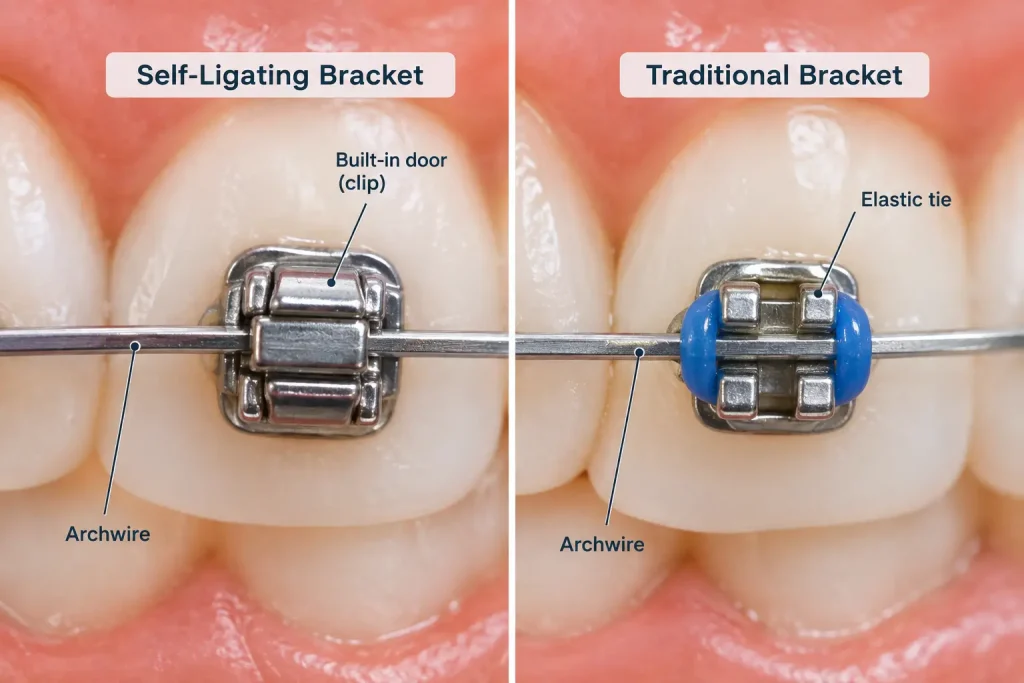
The Short Answer: The One Real Difference
Strip away the marketing and the core difference between these two systems is simple. It comes down to how the archwire, the main wire that guides your teeth, is held onto each bracket.
Traditional braces use a small elastic band, called a ligature, on every bracket to hold the wire in place. Those are the colored ties patients often enjoy picking. Self-ligating braces skip the elastics entirely. Instead, each bracket has a built-in door or clip that snaps shut to trap the wire. That one design change, a built-in clip instead of an elastic tie, is the source of every genuine difference between the two, and also the source of a lot of overstated claims. Everything below flows from it.
What Self-Ligating Braces Are
Self-ligating brackets are not new, which surprises some people. They were first introduced back in the 1930s, specifically to cut down on the time spent tying wires at the chair. The technology matured over the decades and became a routine part of modern orthodontics.
They come in two varieties worth knowing about. Passive self-ligating brackets use a clip that leaves a little room around the wire, aiming for lighter force in the early stages. Active self-ligating brackets use a clip that presses more firmly on the wire for greater control later on. Both still rely on the same fundamentals of tooth movement as any braces, and both come in metal and clear versions, just like traditional brackets. The clip is the innovation. The underlying orthodontics is the same.
How They Compare: Comfort, Cleaning, Visits, and Speed
This is where honesty matters most, because the gap between what is advertised and what the studies show is wide. I pulled the major claims together against the current evidence so you can see them side by side.
| Common claim | What the research actually shows |
| Faster treatment | Systematic reviews find no clinically meaningful reduction in overall treatment time |
| Fewer appointments | No significant difference in the number of visits |
| Less pain | Pain levels are similar at 4 hours, 24 hours, 3 days, and 7 days |
| Lower friction | True in laboratory tests, but that advantage does not clearly carry over inside a real mouth |
| Shorter chair time | Genuinely supported, wire changes can be several times faster without elastic ties |
Look closely at that table, because the pattern is important. Multiple systematic reviews, including recent analyses of Damon brackets in adults, have found that self-ligating braces do not deliver a clinically meaningful reduction in total treatment time or number of appointments compared to traditional braces. One meta-analysis concluded plainly that the lack of significant effects contradicts the common evidence-based statements about self-ligating advantages for discomfort, visits, and treatment time. That is the profession checking the marketing, and the marketing came up short.
The Friction Claim, Honestly Assessed
The headline selling point of self-ligating braces is lower friction. The idea is that without an elastic tie squeezing the wire against the bracket, the wire slides more freely, teeth move with less resistance, and treatment speeds up. In a laboratory, that lower friction is real and measurable.
The problem is that a lab bench is not a mouth. Real teeth sit at angles, chew, and generate forces that laboratory setups do not replicate, and research shows that resistance to sliding increases in both bracket types once you introduce those real-world angles. So the friction advantage that looks so clean on paper largely washes out inside an actual mouth. This is exactly why the promised time savings do not show up in the clinical studies. It is a genuine lesson in why in vitro findings do not always translate to real results, and why a good clinician trusts outcomes over brochures.
Where Self-Ligating Braces Genuinely Shine
None of this means self-ligating braces are a gimmick. They have real, defensible advantages, and I use them often. The key is that the true benefits are quieter than the marketing ones.
• Shorter chair time. Without dozens of elastic ties to place and remove, wire changes go much faster, with some studies showing archwire replacement several times quicker. Your appointments can be shorter and more comfortable, even if your total treatment length is similar.
• Easier cleaning, potentially. Elastic ties collect plaque, and because self-ligating brackets skip them, some research suggests they accumulate less biofilm and may be a little kinder to gum health during treatment. Diligent hygiene still matters enormously, but the design gives you a small head start.
• No elastics to stretch out. Traditional elastic ties gradually lose their grip and discolor between visits. A built-in clip does not, so the wire stays consistently engaged.
Those are worthwhile benefits, especially the reduced chair time and the hygiene edge. They just are not the same as the dramatic speed and comfort promises you may have read. For a fuller picture of how different appliances trap or resist plaque, our guide on keeping your teeth clean with braces is a useful companion.
A Word on the “Arch Development” Claim
One self-ligating claim deserves its own mention, because it comes up so often and sounds so appealing. Some marketing suggests that low-force, passive self-ligating systems can widen the dental arches and expand your smile without extractions, almost as if the braces gently grow your jaw. It is worth understanding what is really happening there.
Research does show that passive self-ligating brackets can increase the transverse width of the arches, particularly in the premolar region. But here is the honest nuance. That change is tooth movement, tipping the teeth outward within the bone, not new jaw growth. The distinction matters, because teeth tipped too far past the supporting bone can be unstable or affect the gums. In the right case, a modest arch expansion is a legitimate and useful tool. Presented as a magic alternative to extractions for everyone, it oversells what is actually a careful clinical judgment. A good orthodontist decides when arch development is appropriate for your specific anatomy, rather than applying it as a blanket promise.
Where Traditional Braces Still Hold an Edge
Traditional braces have earned their staying power, and they remain an excellent, often preferable choice. Their track record is the longest in orthodontics, and that history means their behavior is deeply understood in every kind of case.
They also offer a level of fine control that many orthodontists value, particularly for complex movements, because the elastic tie can be selected and placed to apply force in very specific ways. They tend to cost less, since the brackets themselves are less expensive. And for younger patients, the colored ties are a genuine morale boost, letting kids change colors at each visit and feel some ownership over their treatment. Never underestimate how much that engagement helps a teenager stick with their care.
Which Is Right for You?
Here is the honest bottom line. Both systems straighten teeth effectively, and the research shows their final results are comparable. The choice is rarely about one being clearly superior and almost always about the specifics of your case and your preferences.
Self-ligating braces can be a great fit if shorter, quicker appointments matter to you or if you want a small hygiene advantage. Traditional braces shine on cost, on certain complex cases, and for kids who love the colors. What matters far more than the bracket type is the skill of the person planning your treatment, which is why choosing a board-certified orthodontist outweighs choosing a brand. The same is true when you weigh braces against clear aligners, where the right answer depends on your teeth, not the trendiest option.
Find Your Fit at Freedman & Haas
Self-ligating and traditional braces are both proven, effective tools, and the truth is less dramatic than the advertising. Self-ligating braces offer shorter chair time and a modest hygiene edge, but not the sweeping speed and comfort gains often claimed. Traditional braces remain a reliable, cost-effective, and highly controllable choice. Neither is outdated, and the best system is the one matched thoughtfully to your smile.
At Freedman & Haas Orthodontics, we work with both systems and recommend based on your case, not on a sales pitch. Our board-certified team has guided more than 30,000 patients across West Palm Beach and Wellington to finished smiles using the right tool for each one. If you want a straight answer about which bracket system fits your teeth, your budget, and your life, schedule a consultation and we will walk you through it honestly.
Frequently Asked Questions
Are self-ligating braces faster than traditional braces?
Not according to the research. Multiple systematic reviews, including recent analyses of Damon brackets, found no clinically meaningful difference in overall treatment time or number of appointments between self-ligating and traditional braces. The lower friction that looks promising in laboratory tests does not clearly translate into faster treatment inside a real mouth.
Do self-ligating braces hurt less?
The evidence says pain is similar. Studies comparing the two found no significant difference in pain levels at 4 hours, 24 hours, 3 days, or 7 days after adjustments. Any comfort difference between the systems is minor, so pain relief is not a strong reason to choose one over the other.
Are self-ligating braces better for oral hygiene?
Possibly, slightly. Because they skip the elastic ties that tend to collect plaque, some research suggests self-ligating brackets accumulate less biofilm and may be a little gentler on the gums during treatment. It is a modest edge, and diligent daily brushing and flossing still matter far more than the bracket type.
Are self-ligating braces worth the extra cost?
It depends on what you value. They offer genuinely shorter chair time at appointments and a small hygiene advantage, but not the dramatic speed or comfort gains often advertised. If quicker visits appeal to you, they may be worth it. If cost is a priority, traditional braces deliver comparable final results for less.
Which gives better results, self-ligating or traditional braces?
Research shows comparable final results between the two systems. Neither is inherently superior in outcome. What most determines your result is the skill and planning of your orthodontist, not whether the brackets use a clip or an elastic tie. Both can produce an excellent smile in capable hands.