
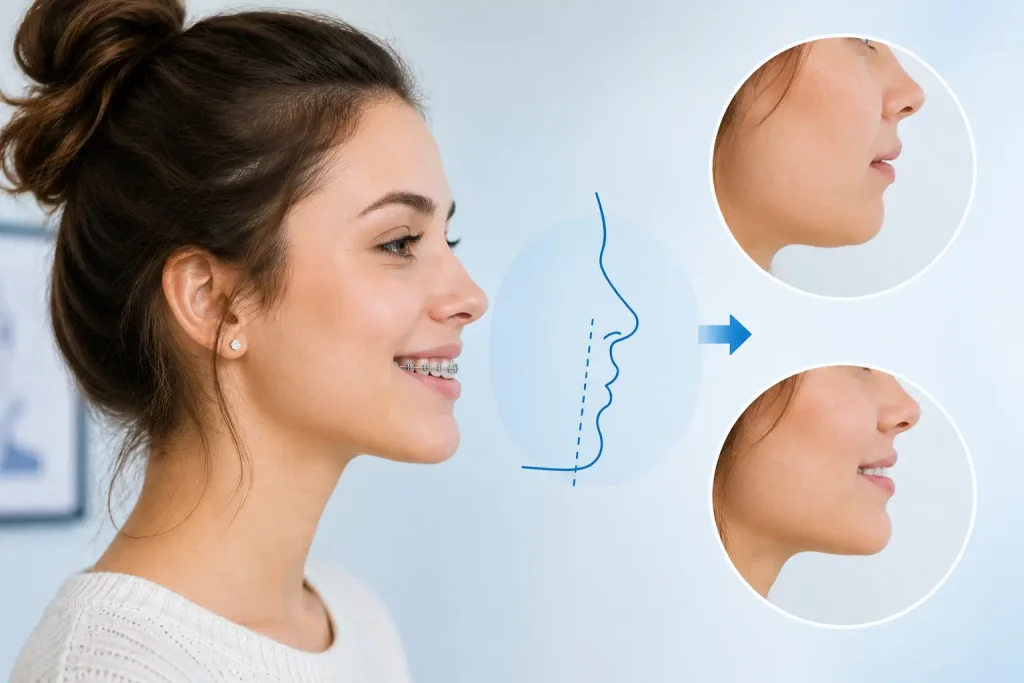
Scroll through social media for five minutes and you will find someone crediting their braces for a sharper jawline, a slimmer face, or a dramatic transformation. Search a little more and you will find the opposite claim, that braces ruined someone’s profile or hollowed out their cheeks. So which is it? It is one of the most common questions patients bring to our office, and the honest, evidence-based answer sits somewhere between the two extremes, but far closer to the truth than either viral version.
Yes, orthodontic treatment can change your facial appearance, and we can actually tell you by how much, because it has been measured in millimeters and degrees in dozens of studies. What braces almost never do is the bone-reshaping magic the internet promises. In this article, we will show you exactly what changes, exactly why, and roughly how much, so you can walk into a consultation knowing the real science instead of the myths. Let us get specific.
The Honest Answer: Yes, but Not How Social Media Says
Let us start with the core truth, because it clears up most of the confusion. Braces move teeth, and in a growing child they can guide how the jaw develops. What they do not do, in an adult who has finished growing, is carve new bone into your cheekbones or lengthen your jaw the way a filter or a surgeon might.
Even so, your teeth sit directly beneath your lips and support the entire lower third of your face. Moving them changes the scaffolding that soft tissue rests on, and that is what alters your profile. These changes are real, measurable, and usually harmonious rather than dramatic. Understanding the difference between moving teeth and reshaping bone is the single key to interpreting everything you have seen online. So let us look, in concrete detail, at what actually shifts.
What Actually Changes, and by How Much
When orthodontic treatment affects your appearance, the changes concentrate in specific, predictable places. Here is where they happen and what the research says, with real numbers, not vague promises.
Lip Support and Profile: The Lips Follow the Teeth
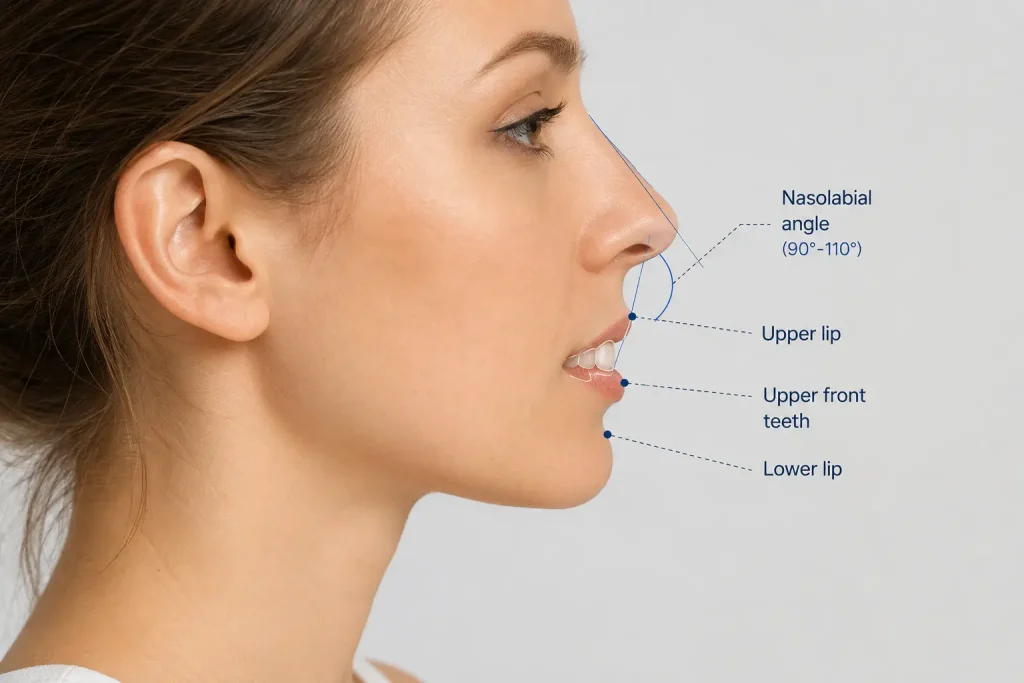
This is by far the most measurable and best-documented facial change, and understanding it takes all the mystery out of the question. Your upper lip is not held up by muscle alone. It drapes over your upper front teeth, which act like a curtain rod. Move those teeth, and the curtain moves with them.
The relationship has been quantified with real precision. In classic cephalometric research, when the upper front teeth were retracted (pulled back) by an average of 6.7 millimeters, the upper lip followed and retracted by roughly 4.3 millimeters, and the nasolabial angle, the angle between the nose and upper lip, opened by about 5 degrees. Studies measuring lip position against Ricketts’ esthetic line, a standard reference from the tip of the nose to the chin, found the lips settling back by roughly 3 to 3.6 millimeters after this kind of treatment. So if your front teeth stuck out before treatment, bringing them into alignment genuinely softens a protrusive profile, and now you know the approximate magnitude.
Here is the nuance almost no one mentions, and it is the reason two patients can get the same tooth movement and see different facial results: lip thickness. Research shows that patients with thinner lips display a much more pronounced change, because a thin lip conforms tightly to the teeth behind it and moves almost one-to-one with them. A fuller, thicker lip absorbs some of that movement and changes less visibly. This is exactly the kind of individual factor a good orthodontist weighs before predicting your result, and it is why blanket promises about profile change are meaningless without examining your specific lips and teeth.
Jawline and Chin Balance: Position, Not New Bone
When people say braces changed their jawline, what almost always changed is the position their jaw rests and closes in, not the bone itself. This distinction matters enormously, and the mechanism is different for children and adults.
In a growing child or young teen, the jaw is still developing, and that growth can genuinely be influenced. When a lower jaw sits too far back (a common overbite pattern), functional appliances worn during the growth spurt encourage the mandible to grow forward. The numbers are real: meta-analyses show functional appliances produce roughly 1.8 millimeters of additional mandibular growth per year compared to no treatment, and appliances like the Twin Block have been measured advancing the chin point by an average of around 4 millimeters. For a young face, that is a visible, skeletal improvement in chin projection and profile balance, and it is precisely why timing treatment to a child’s growth spurt is so valuable.
In an adult, the story is honest but different. The jawbones are set, so braces cannot lengthen them. What can improve is how balanced the lower face looks once a bad bite is corrected. If your jaw was being forced to close in a strained, retruded position by a misaligned bite, fixing that bite lets the jaw close where it is anatomically meant to, which can make the chin and jawline look more defined and balanced, without a single millimeter of new bone. It is a positional improvement, and it is real, but it is not the skeletal transformation shown in viral videos.
Facial Symmetry: Correcting a Jaw That Closes Crooked
Some bite problems make the face look subtly lopsided, and correcting them can visibly improve symmetry. The most common culprit is a functional crossbite. Here is the mechanism: when the upper and lower teeth meet in a way that forces the lower jaw to shift sideways to find a comfortable bite, the chin ends up habitually deviated to one side. Over years, that shift becomes the face’s resting appearance, and one side can even develop slightly differently from the other in a growing child.
When an orthodontist corrects that crossbite, the jaw no longer needs to slide sideways to close. It settles into a centered, straight-ahead position, and the chin recenters with it. Patients are often surprised that fixing their bite made their whole face look more even, but the explanation is simple: you are not restructuring the skull, you are removing the sideways detour the jaw was forced to take every time it closed. The earlier this is caught in a growing child, the more completely the symmetry can be restored.
Which Bite Problems Change the Face Most
Not every case produces a visible facial change. Straightforward crowding with a normal bite, for instance, mostly changes the smile, not the profile. The cases most likely to shift your appearance are the ones involving how the jaws and lips relate to each other:
• Protrusive teeth and overbites, where the upper front teeth stick forward, show the clearest change. Retracting them softens the profile and can dramatically improve a ‘gummy’ or protrusive smile line, because the lip finally has room to close naturally over the teeth.
• Underbites, where the lower jaw sits ahead of the upper, look more balanced after correction, and in growing children early treatment can meaningfully redirect jaw growth rather than just masking it.
• Bimaxillary protrusion, where both upper and lower teeth flare forward, tends to produce the most noticeable lip retraction, since both lips are being supported by forward teeth that are being brought back.
• Crossbites and open bites, which pull the face out of balance, often look markedly more harmonious afterward. Our article on whether braces can correct overbites and underbites covers exactly how these bite corrections work.
Teens vs. Adults: Why Age Completely Changes the Answer
If there is one reason online before-and-afters mislead people, it is that they almost never mention age, which changes the entire equation. The distinction is not a technicality. It is the difference between changing bone and changing position.
In children and adolescents, the jaws are still growing, and a skilled orthodontist can steer that growth. This is real skeletal change: the mandible can be encouraged to grow forward, a narrow upper jaw can be widened while the mid-palate is still open, and the face can be nudged toward better balance while biology is still cooperating. The measured gains in chin advancement and mandibular length we cited above only happen in this growing window, which is why orthodontists care so much about evaluating children early, ideally around age seven.
In adults, growth is complete, so orthodontics works entirely by moving teeth and the soft tissue they support. The facial changes are genuine but confined to the profile, the lips, and the balance of a corrected bite, never the underlying skeleton. When an adult truly needs skeletal change, that requires surgical orthodontics, an entirely different treatment. This is one more reason a proper diagnosis matters so much, and why seeing a board-certified orthodontist gives you a realistic picture from the very first visit.
Myths vs. Facts: What Braces Cannot Do to Your Face
Now for the claims the viral videos get wrong. Here they are, measured against what orthodontics can actually deliver.
Myth: Braces will give an adult a sharper jawline by reshaping the bone.
In an adult who has stopped growing, braces do not reshape the jawbone, full stop. A corrected bite can make the jaw look more balanced by letting it close in its proper position, but the dramatic jawline transformations you see online almost always reflect something else happening at the same time: weight loss, the natural maturation of a young face still growing during treatment, better posture, camera angles, or simply the confidence of a new smile. The braces get the credit, but the bone did not change.
Myth: Extractions for braces will collapse your face and hollow your cheeks.
This is one of the most persistent and damaging myths online, and the research directly contradicts it. A systematic review and meta-analysis comparing extraction and non-extraction patients found that extraction treatment does produce a measurable flattening of the profile, but a slight, controlled one that stays within normal, balanced limits, not a collapsed or sunken face. Cheeks are supported by fat pads, muscle, and cheekbones, none of which extractions touch. When a skilled orthodontist plans extractions, it is precisely to create balance, and the profile remains within healthy proportions. The horror stories that circulate almost always involve factors far beyond a well-planned extraction case.
Myth: Braces will slim down or narrow your whole face.
Braces do not affect the fat, muscle, or cheekbones that determine how wide or full your face looks. Any perceived slimming is typically the result of other changes during the same period, most often a teenager’s face maturing naturally as they grow, or an adult losing weight. What braces can change is the specific area supported by your teeth and bite, which is the profile and smile, not overall facial width.
Does Invisalign Change Your Face the Same Way?
Because facial changes come from moving teeth rather than from the appliance itself, clear aligners produce the same kinds of profile changes as braces when they achieve the same tooth movements. If aligners retract your front teeth, your lips respond exactly as they would with braces. The soft-tissue result depends on how your teeth and bite are repositioned, not on which tool did the repositioning. If you are comparing your options, our guide on choosing between braces and aligners walks through the trade-offs, and it is worth knowing that certain modern aligners even include mandibular advancement features for growing patients, aiming for some of the same skeletal benefits described above.
See Your Own Projected Change at Freedman & Haas
The honest reality is that the facial effect of orthodontic treatment is specific to you: your teeth, your bite, your lip thickness, and, if you are young, your growth potential. Averages from studies are useful for understanding the mechanisms, but only an in-person evaluation can predict your result. A skilled orthodontist can map those changes from the start, plan treatment to enhance your natural balance, and set realistic expectations rather than internet-fueled ones.
At Freedman & Haas Orthodontics, our board-certified orthodontists use digital imaging and decades of experience to show you what to expect for your specific case. Rather than promising a viral transformation, we focus on the balanced, healthy, natural-looking result that fits your face. With more than 30 years of experience and over 30,000 smiles across West Palm Beach and Wellington, we have helped patients understand exactly how treatment will, and will not, change their appearance.
Frequently Asked Questions
Do braces change your face shape permanently?
The changes from repositioned teeth and a corrected bite, such as lip support and profile balance, are generally lasting, as long as you wear your retainer to keep your teeth in place. In growing children, the skeletal changes achieved during treatment become part of their adult face. Braces do not reshape adult bone, so they will not permanently alter your underlying bone structure.
How many millimeters can braces change your profile?
It depends on how much your teeth move and how thick your lips are. Research shows that retracting the upper front teeth by around 6.7 millimeters moves the upper lip back by roughly 4.3 millimeters, with thinner lips changing more and fuller lips changing less. These are meaningful refinements to the profile, measured in a few millimeters, not the dramatic transformations seen online.
Can braces make your jawline better?
In growing children and teens, yes, functional appliances can advance the chin by an average of around 4 millimeters by encouraging real jaw growth. In adults, braces cannot lengthen the jawbone, but correcting a bite that held the jaw in a strained position can make the jawline look more balanced and defined. The improvement in adults is positional, not skeletal.
Will getting braces ruin my face or make my cheeks sink in?
No. This common fear is not supported by the evidence. Studies show that well-planned orthodontic treatment, including cases with extractions, leaves patients with balanced profiles within normal limits. Your cheeks are supported by fat and bone that braces do not affect. A qualified orthodontist plans treatment specifically to protect and enhance your facial harmony.
Curious How Treatment Would Affect Your Profile?
Braces and aligners can genuinely refine your appearance, but the real, evidence-based changes are specific, measurable, and harmonious, not the dramatic bone-reshaping transformations that go viral. The best way to know what to expect for your face is to ask a specialist who can evaluate your unique teeth, bite, and lips.
Schedule a consultation at Freedman & Haas Orthodontics in West Palm Beach or Wellington, and let our board-certified team show you, honestly and clearly, exactly what straightening your teeth would do for your smile and your profile.