
If you have invested in dental work over the years, a crown here, a bridge there, maybe a set of veneers you saved up for, the idea of straightening your teeth can raise a genuinely nervous question. Will Invisalign damage the restorations you already paid for? Will moving your teeth ruin how your veneers fit? Many adults quietly assume that existing dental work rules out orthodontic treatment entirely, and so they never even ask.
Here is the reassuring headline: in the large majority of cases, you can absolutely straighten your teeth with Invisalign even with crowns, bridges, or veneers. But the useful answer is not simply yes or no. It is understanding why each type of restoration behaves the way it does under orthodontic force, because that is what determines how your treatment must be planned, and it is knowledge that will help you ask sharper questions at your own consultation. We are going to go deeper than the usual overview, restoration by restoration, including the one detail about implants that changes everything.
The One Principle That Explains Everything: Root and Ligament
Before we look at each restoration, there is a single biological fact that governs all of them, and once it clicks, every answer below becomes obvious. Natural teeth do not sit rigidly in the jaw. Each one is suspended in its socket by a thin, living cushion called the periodontal ligament. When an aligner applies gentle pressure, that ligament signals the surrounding bone to dissolve on one side and rebuild on the other, and the tooth migrates. No ligament, no movement. Full stop.
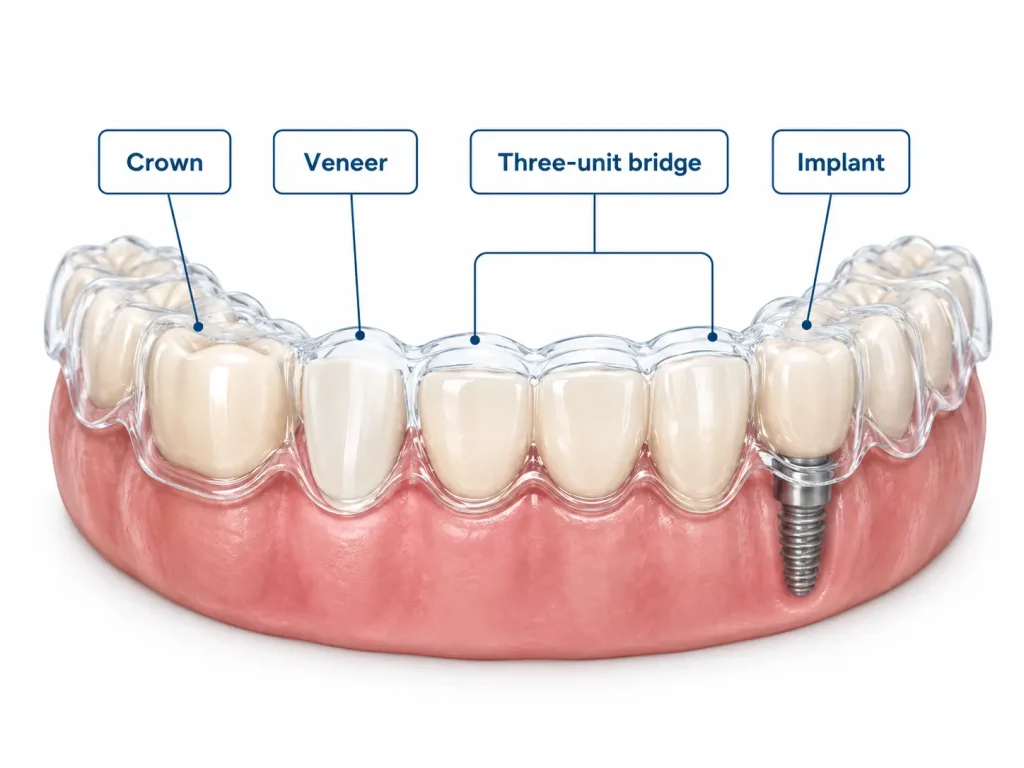
That single principle sorts every restoration into place. A crown or a veneer sits on a natural tooth that still has its root and its ligament, so it moves like any other tooth. A bridge locks several teeth together so they can only move as one block. And an implant, fused directly to bone with no ligament at all, cannot be moved by orthodontic force no matter how much pressure you apply. Keep that root-and-ligament idea in mind, and here is how it plays out for each case.
| Restoration | Can it move? | The reason (and what it means for treatment) |
| Crown | Yes | It caps a natural tooth with a living root and ligament, so it moves normally. Only the attachment bonding needs special handling. |
| Veneer | Yes | The tooth underneath still has its root and ligament and moves normally. The porcelain surface just needs protecting. |
| Bridge | Only as a unit | It fuses two or more teeth into one rigid block, so those teeth cannot move independently of each other. |
| Implant | No | It is fused to the bone with no ligament, so orthodontic force cannot move it. This can even be used as an advantage. |
Invisalign with Crowns: The Tooth Moves, the Bonding Is the Nuance
A crown is a custom cap that covers a damaged or heavily filled tooth to restore its strength and shape. Crucially, the natural tooth and its root remain alive beneath that cap, complete with the periodontal ligament that makes movement possible. So a crowned tooth responds to Invisalign just like any natural tooth. On the movement side, crowns are rarely a problem at all.
The real nuance is bonding, and this is where a specialist’s experience genuinely shows. Invisalign often relies on attachments, small tooth-colored bumps of composite resin bonded to specific teeth to give the aligner extra grip for difficult movements. Attachments bond beautifully to natural enamel because the enamel can be micro-etched to create a grippy surface the resin locks into. The smooth, glazed porcelain of a crown is a different story. That glaze is designed to be slick and stain-resistant, which is wonderful for your smile but poor for adhesion, so a standard attachment can bond less securely and may pop off under load.
Experienced orthodontists have a whole toolkit for this, and the choice is deliberate:
• Placing attachments on the natural teeth next to the crown instead of on the crown itself, so the aligner still gets its grip where bonding is strongest. This is often the simplest and safest solution.
• Conditioning the porcelain surface when an attachment truly must sit on the crown. The evidence-based technique involves gently roughening and etching the glaze and applying a silane primer, a chemical coupling agent that dramatically improves the resin’s grip on ceramic. Done well, this brings the bond close to that of natural enamel.
• Adjusting the attachment’s size or engineering the pressure directly into the aligner’s shape, avoiding the crown surface altogether.
Location and condition matter too. A crown on a back molar is rarely an issue, while a crown on a front tooth, where attachments are more often needed for precise movement, calls for more thoughtful planning. And an old or loose crown should always be checked before treatment, because a crown that is already failing needs attention before it takes an 18-month journey. A single well-seated crown is almost never an obstacle; several crowns in strategic positions simply add a layer of planning.
Invisalign with Veneers: Protecting a Surface You Paid Dearly For
Veneers are thin shells of porcelain bonded to the front of teeth to transform their appearance. Like crowns, they sit on natural teeth that keep their roots and ligaments, so the underlying teeth move normally under Invisalign. Most patients with veneers in good condition complete clear aligner treatment without trouble. But veneers carry a specific concern that deserves real attention: they are thin, meticulously crafted, expensive, and the front teeth are exactly where attachments are most often wanted.
Two risks come with bonding an attachment to a veneer. First, the same glazed-porcelain adhesion challenge as a crown. Second, and more importantly, the process of removing an attachment at the end of treatment carries a small but real risk of chipping the veneer or dulling its polished surface, since the composite has to be carefully ground away. For this reason, a careful orthodontist will usually design the treatment plan to avoid placing attachments on veneered teeth wherever possible, leaning on the adjacent natural teeth instead, and will use gentle removal and repolishing techniques if an attachment on a veneer is truly unavoidable. The guiding principle is simple: achieve the alignment without compromising the investment sitting on the front of your smile.
There is one honest expectation to set. Your veneers were crafted to look perfect on your teeth in their original positions. If Invisalign moves those teeth, the way your veneers relate to your gumline, your bite, and each other can shift slightly. For many patients this is negligible, but some choose to refresh or replace older veneers after orthodontic treatment so the final result is flawless. A good plan discusses this with you up front rather than leaving it as a surprise.
Invisalign with Bridges: The Rigid-Block Problem
Of all the common restorations, a traditional bridge poses the biggest genuine challenge for Invisalign, and understanding exactly why makes the limitation clear rather than mysterious. A bridge replaces a missing tooth by fusing a false tooth in the middle to crowns on the natural teeth on either side, creating one solid, rigid unit that spans the gap.
Now apply the root-and-ligament principle. Invisalign works by moving teeth individually, coaxing each one along its own path a fraction of a millimeter at a time. But the anchor teeth of a bridge are physically welded to that false tooth. They cannot move independently. They can only move together, as a single block, if they move at all, and the false tooth in the middle has no root or ligament of its own. This sharply limits any tooth movement in that segment of the arch. If your alignment goals do not require movement where the bridge sits, Invisalign can often work beautifully around it, treating the rest of your smile while leaving the bridged section as a stable anchor. If your goals do require movement there, the options become more involved: your orthodontist might redesign the plan to work around the bridge, recommend fixed braces for their greater control, or coordinate with your restorative dentist about temporarily sectioning or removing the bridge during treatment and replacing it afterward. This is precisely the kind of case where an in-person evaluation is essential, because the answer hinges entirely on where the bridge sits relative to the movements your smile needs.
Invisalign and Dental Implants: The Detail That Changes Everything
Implants deserve their own deep dive, because they follow a completely different rule from every restoration above, and because there is a fascinating twist most patients are never told.
A dental implant replaces a missing tooth with a titanium post surgically placed into the jawbone. Over several months, bone grows directly onto and fuses with that post in a process called osseointegration. This is what makes implants so wonderfully stable for chewing, but it also creates one absolute limitation: an implant has no periodontal ligament. Remember, the ligament is the entire mechanism of tooth movement. A natural tooth can shift because its ligament tells the bone to remodel around it. An implant is locked directly into bone with no ligament to send that signal, so orthodontic force simply cannot move it. Push on an implant all you like; it will not budge. It behaves like a fence post set in concrete while the natural teeth around it are still planted in soil.
So what does that mean for your treatment? First, the practical reality: Invisalign can straighten all the natural teeth around an implant, but the implant itself stays exactly where it is. Your orthodontist marks it as a fixed landmark in the digital plan and designs every movement around it. For most patients, this works out perfectly, and the aligned natural teeth simply integrate the implant into a finished, harmonious smile.
Now the twist that showcases why an orthodontist’s expertise matters so much. That very immobility, a limitation on paper, can become a powerful tool in skilled hands. Because an implant will not move, it can serve as a rock-solid anchor point to move stubborn neighboring teeth with precision, without the usual side effect of those teeth pushing back and drifting out of place. In other words, the same feature that stops an implant from moving can be harnessed to move other teeth better. A limitation, reframed by expertise, becomes an advantage. This is exactly the kind of judgment that separates comprehensive orthodontic care from a one-size-fits-all approach.
The Timing Question That Can Save You Money and Months
If there is one insight in this entire article that can genuinely change your outcome, it is this: the order in which you do things matters enormously. As a general rule, orthodontic treatment should come before permanent restorations like implants and final veneers, and the reasoning is worth understanding.
Consider an implant again. Because it cannot be moved once it is placed and osseointegrated, positioning it before straightening your teeth is like cementing a fence post in the middle of a yard you are still landscaping. If you straighten first, your dentist can then place the implant in its ideal final position, with the perfect amount of space on each side, producing a more natural and lasting result. The same logic applies to veneers: align the teeth first, then craft veneers to fit your newly straightened smile, rather than making them to fit teeth that are about to move out from under them.
Here is a sophisticated wrinkle that a coordinated team can use to your advantage, though. In some carefully planned cases, an implant can actually be placed partway through orthodontic treatment, once the aligners have created the ideal space for it. The clever part is that the several-month healing period the implant needs to osseointegrate can run in parallel with the remaining orthodontic treatment, rather than adding months onto the end. Working this way, in parallel instead of in series, can shorten your total time to a finished smile and give the implant ample time to heal. It is a perfect example of why an orthodontist and a restorative dentist planning together from the very start beats piecing treatment together one office at a time.
Why This Is Never a Do-It-Yourself Situation
By now a clear theme has emerged: almost every answer here depends on the specific type, location, condition, and material of your restorations, and on the exact movements your smile needs. That is not a dodge. It is the honest reality of treating patients with dental work, and it is precisely why this is not a job for a remote, mail-order aligner service that never physically examines your mouth. Bonding decisions, bridge workarounds, implant anchorage, and treatment sequencing all require hands-on evaluation, precise records, and the judgment that only comes from experience. It is one of the clearest reasons that seeing a board-certified orthodontist matters so much for adults with existing restorations.
A qualified orthodontist will assess every restoration before recommending a plan, and will coordinate with your restorative dentist so the whole sequence, from straightening to final crowns or veneers, unfolds in the right order. In some cases that plan points to clear aligners; in others, to braces or a combination of approaches. Either way, the goal is to protect both your smile and the dental work you have already invested in. If you are curious about the mechanics behind it all, our article on how aligners straighten teeth explains exactly how the trays do their work.
Straighten Your Smile Without Sacrificing Your Dental Work
Having crowns, veneers, a bridge, or an implant does not close the door on a straighter smile. In the vast majority of cases, it simply means your treatment deserves a thoughtful, customized plan built around the dental work you already have, and often that dental work can be incorporated seamlessly, or even used to your advantage. The techniques to do this well are more advanced than ever, and experienced hands make all the difference between protecting your investment and putting it at risk.
At Freedman & Haas Orthodontics, our board-certified team has helped more than 30,000 patients across West Palm Beach and Wellington, including many adults with existing restorations, achieve the smiles they wanted while safeguarding their prior dental work. If you have dental work and have been wondering whether Invisalign is possible for you, schedule a consultation and let us give you a clear, honest, specific answer based on your own smile.
Frequently Asked Questions
Can you get Invisalign if you have crowns?
Yes, in nearly all cases. A crown caps a natural tooth that keeps its root and periodontal ligament, so the tooth moves normally under Invisalign. The only nuance is that attachments bond less securely to a crown’s glazed porcelain than to natural enamel, which an experienced orthodontist handles by placing attachments on adjacent natural teeth or by properly conditioning the porcelain surface with a silane primer.
Will Invisalign damage my veneers?
It should not, when the plan is designed carefully. The teeth beneath your veneers move normally, and most patients with well-bonded veneers finish treatment without issue. The main precautions are avoiding attachments on veneered teeth where possible, since bonding to and later removing composite from porcelain carries a small risk of chipping, and using gentle techniques if an attachment on a veneer is unavoidable.
Can Invisalign move a tooth that is part of a bridge?
Not independently. A bridge fuses its supporting teeth into a single rigid unit, so they can only move together, if at all, and the false tooth in the middle has no root to move. If your alignment goals do not require movement in the bridged area, Invisalign can often work around it. If they do, your orthodontist may modify the plan, use braces for more control, or coordinate with your dentist about the bridge.
Can you get Invisalign with a dental implant?
Yes, but the implant itself will not move, because it is fused to the bone with no periodontal ligament to allow orthodontic movement. Invisalign straightens the natural teeth around it while the implant stays fixed. Interestingly, a skilled orthodontist can even use that immobility as a stable anchor to move neighboring teeth more precisely.
Should I straighten my teeth before or after getting an implant or veneers?
Generally before. Since an implant cannot be moved once placed, and veneers are made to fit your teeth’s current positions, aligning first lets your dentist place the implant or craft the veneers to suit your finished smile. In some coordinated cases an implant can be placed during orthodontic treatment so its healing overlaps with the remaining alignment, which can save overall time.