
Your dentist mentioned an overbite. Or was it an overjet? If you left that appointment not quite sure which one you have, you are in very good company. The two words sound almost identical, they both involve your front teeth, and even some dental professionals use them loosely as if they mean the same thing. They do not.
The difference between them is not just trivia. Overbite and overjet describe two completely different directions of the same front-tooth relationship, and that direction changes what the problem does to your mouth and how an orthodontist corrects it. Once you understand the distinction, a lot of confusing dental conversations suddenly make sense. Here is the clear version, with the actual measurements and what each one means for you.
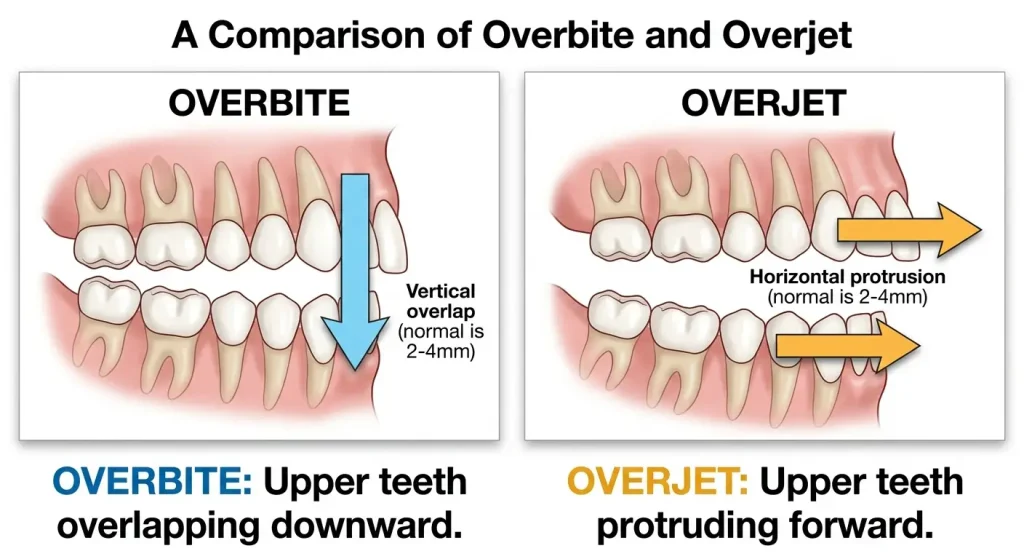
The Short Answer: Vertical vs. Horizontal
Here is the whole distinction in one sentence. An overbite is a vertical relationship, how far your upper front teeth overlap down over your lower front teeth, while an overjet is a horizontal relationship, how far your upper front teeth stick out in front of your lower ones.
Picture your front teeth from the side. If the top teeth hang down and cover the bottom teeth, that downward coverage is your overbite. If the top teeth jut forward ahead of the bottom teeth, that forward distance is your overjet. Down versus out. That single image is all you really need to keep them straight, and everything else in this article builds on it.
What an Overbite Is
An overbite is the vertical overlap of your upper front teeth over your lower front teeth when your back teeth are closed together. Some overbite is completely normal and even desirable. In a healthy bite, the upper teeth are meant to overlap the lower ones a little.
Orthodontic sources typically describe a normal overbite as roughly 1 to 3 millimeters of vertical overlap, or about 20 to 40 percent coverage of the lower front teeth. When the upper teeth cover significantly more than that, it is called an excessive or deep overbite. According to research referenced by the National Institutes of Health, abnormal overbite measurements can point to underlying misalignment worth addressing. In more serious cases, the lower front teeth can bite so far up that they contact the gum tissue behind the upper teeth, which causes wear and irritation over time.
What an Overjet Is
An overjet is the horizontal distance between your upper and lower front teeth, measuring how far the upper teeth protrude forward. This is the one patients often call buck teeth when it is pronounced. Like overbite, a small amount is normal and healthy.
A normal overjet sits at about 2 to 3 millimeters of horizontal projection, with the upper teeth resting just slightly ahead of the lower ones. Once that gap grows well beyond a couple of millimeters, it is considered an excessive overjet. This matters for more than looks. A large overjet can make it hard to close your lips comfortably, can affect speech, and notably increases the risk of injury to those protruding front teeth, since they are more exposed in a fall or impact. A review in the Dental Press Journal of Orthodontics found that around 20 percent of people studied across the United States, the United Kingdom, India, China, and parts of Africa and Europe had an overjet, so it is genuinely common.
Why the Distinction Actually Matters for Treatment
This is the part that makes the whole conversation worth having, and it is where most articles stop too soon. Overbite and overjet are measured independently, because you can have one without the other, and the combination you have shapes your treatment.
It is entirely possible to have a significant overjet with a perfectly normal overbite, a deep overbite with a normal overjet, or a noticeable amount of both at the same time. Because the two capture different dimensions of your bite, an orthodontist evaluates each one separately rather than lumping them together. A deep overbite that is wearing down your lower teeth calls for a different mechanical approach than front teeth protruding forward, even though both involve the same four or six front teeth. Getting the diagnosis right in each direction is what makes the correction effective.
Both overbite and overjet fall under the same broad category orthodontists call Class II problems, and both are closely tied to the bite issues we cover in our article on whether braces can correct overbites and underbites. The point here is simply that naming the direction correctly is the first step to fixing it well.
Here is the comparison at a glance.
| Overbite | Overjet | |
| Direction | Vertical, how far the top teeth overlap down over the bottom teeth | Horizontal, how far the top teeth stick out in front of the bottom teeth |
| Healthy range | About 1 to 3 mm of overlap, roughly 20 to 40 percent coverage | About 2 to 3 mm of horizontal distance |
| When excessive | A deep bite, upper teeth cover too much of the lower teeth | Protrusion, sometimes called buck teeth |
| Common concern | Lower teeth can contact the gum and wear over time | Lip closure and higher risk of injury to front teeth |
What Causes Them, and When Each Needs Correcting
Understanding the cause helps explain why treatment varies so much from person to person. Both conditions can be dental, meaning the teeth themselves are positioned incorrectly, or skeletal, meaning the jawbones are mismatched, or a combination of the two. That distinction is central, because it changes everything about the fix.
Genetics plays a large role, since jaw size and shape are inherited, which is part of the story we tell in our article on why teeth become crooked. Early childhood habits matter too, especially for overjet. Prolonged, vigorous thumb-sucking or pacifier use pushes the front teeth outward as they erupt. Interestingly, a 2016 study in the Journal of the American Dental Association found that pacifier use posed a higher risk of developing a malocclusion than thumb-sucking, though both are known contributors. This is one more reason orthodontists like to see children early.
As for when correction is needed, a mild overbite or overjet within the normal ranges is healthy and requires nothing. Treatment becomes worthwhile when the measurements are excessive enough to cause the problems described above, tooth wear, gum irritation, difficulty closing the lips, speech effects, or a raised risk of injury to protruding teeth. The American Association of Orthodontists recommends a first orthodontic evaluation by age 7, not because most young children need treatment, but because that is when these bite relationships can first be assessed while the jaw is still growing.
How Braces and Invisalign Fix Each
The good news is that both conditions are highly treatable, and often with the same tools applied in different ways. The right approach depends on severity and, crucially, on whether the cause is dental or skeletal.
Mild to moderate cases of either overbite or overjet are commonly corrected with braces or clear aligners like Invisalign, which reposition the front teeth into a healthier relationship. For a deep overbite, treatment focuses on the vertical dimension, intruding or repositioning teeth so the overlap is reduced. For an overjet, treatment works horizontally, retracting the protruding upper teeth or advancing the lower jaw in a growing patient. More significant cases, particularly those driven by a skeletal jaw mismatch rather than tooth position alone, may call for growth-guiding appliances in children or, in some adults, a combined surgical approach.
For adults wondering whether it is too late, it is not. Both overbite and overjet are treatable at any age. The strategy may differ once the jaw has stopped growing, but neither condition is off the table.
Get Your Bite Assessed at Freedman & Haas
Overbite and overjet are easy to confuse and easy to clarify. One is vertical, the coverage of your lower teeth by your upper teeth. The other is horizontal, the forward projection of your upper teeth. Knowing which you have, and in what combination, is the starting point for understanding your bite and any treatment it might need. The direction is not a technicality. It genuinely determines the fix.
At Freedman & Haas Orthodontics, our board-certified orthodontists measure both dimensions precisely, using clinical exams and digital scans to determine whether the cause is dental or skeletal and what that means for you. We have guided more than 30,000 patients across West Palm Beach and Wellington toward healthier bites and smiles. If you are unsure whether you have an overbite, an overjet, or a bit of both, schedule a consultation and we will give you a clear, measured answer.
Frequently Asked Questions
What is the difference between an overbite and an overjet?
An overbite is vertical, describing how far your upper front teeth overlap down over your lower front teeth. An overjet is horizontal, describing how far your upper front teeth stick out in front of the lower ones. In short, overbite is downward coverage and overjet is forward projection. You can have one, the other, or both.
What is a normal overbite and overjet?
A healthy overbite is roughly 1 to 3 millimeters of vertical overlap, or about 20 to 40 percent coverage of the lower front teeth. A healthy overjet is about 2 to 3 millimeters of horizontal distance. Small amounts of both are normal and desirable. Problems arise only when the measurements become excessive.
Can you have both an overbite and an overjet?
Yes. Because they measure different directions, you can have a significant overjet with a normal overbite, a deep overbite with a normal overjet, or a notable degree of both together. That is exactly why orthodontists assess each one independently rather than treating them as the same problem.
Is an overjet or overbite worse for my health?
Neither is automatically worse, since each causes different issues. An excessive overbite can wear down teeth and irritate the gums as the lower teeth contact tissue behind the upper teeth. An excessive overjet can affect lip closure and speech and raises the risk of injuring the protruding front teeth. Both are worth correcting when significant.
Can overbite and overjet be fixed without surgery?
Usually, yes. Mild to moderate cases are commonly corrected with braces or clear aligners that reposition the teeth. Surgery is generally reserved for more severe cases caused by a skeletal jaw mismatch rather than tooth position. An orthodontist can determine which applies to you through an exam and imaging.