
Maybe your orthodontist added a stretchy little chain across your brackets at your last visit, and now you are wondering what it is and why it showed up. Or maybe you saw someone with a row of connected colored rings on their braces and got curious. Either way, that chain has a specific and rather clever job, and understanding it tells you a lot about how your treatment is progressing.
A power chain is one of the most common tools an orthodontist reaches for in the second half of treatment, and it works differently than the individual bands you started with. Below I will explain exactly what it does, why it needs replacing so often, and what to expect while you are wearing one. I will also share a detail about power chain materials that most patient guides leave out, because it genuinely affects how well yours works.
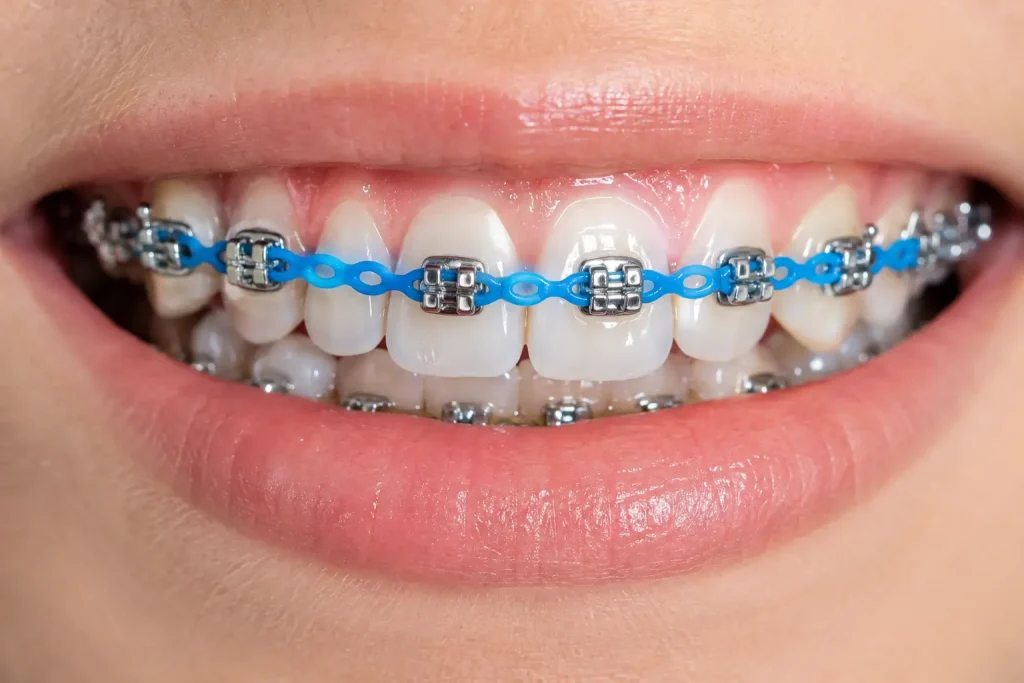
The Short Answer: What a Power Chain Actually Does
A power chain is a connected string of elastic rings that stretches across several teeth at once, rather than sitting on a single bracket. Because it is stretched under tension, it pulls the teeth it connects toward each other. That gentle, continuous pull is what closes gaps and holds teeth together as they move.
In simple terms, if the goal at this stage of your treatment is to bring teeth closer together or close a space, a power chain is often the tool that gets it done. Its arrival usually signals that your teeth are aligned enough to start refining the spaces between them, which is a good sign of progress.
Power Chains vs. Regular Elastic Ties: The Difference
When your braces first went on, each bracket likely held its archwire in place with a tiny individual elastic, called a ligature. Those single ties come in fun colors and simply secure the wire to one bracket. They do not connect one tooth to the next.
A power chain is different in one important way. Instead of separate rings on separate brackets, it is a single continuous chain of rings linked together, spanning several teeth as one piece. That connection is the whole point, because it lets the chain apply a pulling force from tooth to tooth. So while a regular ligature holds a wire, a power chain actively moves teeth closer together. Same family of material, very different job.
What Power Chains Are Used For
Power chains are versatile, which is why orthodontists use them so often. According to the orthodontic literature, elastomeric chains are used for closing spaces, retracting canines and front teeth after an extraction, correcting the dental midline, pulling in impacted teeth, and helping level and align the arch. Most of the time, though, patients encounter them for one main reason.
Closing Gaps and Extraction Spaces
The most common use by far is closing gaps. If you have spaces between your teeth, or if a tooth was removed earlier to make room in a crowded mouth, a power chain draws the neighboring teeth together to close that space smoothly and evenly. This is closely related to how we approach crowded teeth in general, where creating and then closing space is part of the plan. The chain keeps steady pressure on the whole group of teeth so they move together rather than tipping out of line.
The Three Types: Closed, Short, and Long
Not every gap is the same size, so power chains come in three configurations. The right one depends on how far apart your brackets sit, and your orthodontist matches the chain to your spacing.
| Type | What it looks like | Common use |
| Closed (continuous) | Rings connected directly, no space between them | Teeth that sit close together |
| Short (open) | One small gap of filament between each ring | Teeth spaced a bit further apart |
| Long (broad) | A longer stretch of filament between rings | Teeth with wider gaps between them |
Why Power Chains Get Changed Every Few Weeks
Here is the part that surprises most patients, and it is the single most useful thing to understand about power chains. They are not permanent, and they are not meant to be. They lose their pulling strength surprisingly fast, which is exactly why you get a fresh one at your regular appointments.
The research on this is striking. A 2025 study in the Journal of Orthodontic Science, reviewing how these chains behave, reported that power chains lose roughly 50 to 75 percent of their force within the first 24 hours, followed by a slower, continued decline after that. Read that again, because it matters. Most of the chain’s strength is spent on day one, and it keeps fading from there.
That rapid fade is not a defect. It is simply how stretched elastic behaves in a warm, wet mouth, and orthodontists plan around it. The chain still delivers useful, gentle force for weeks after that initial drop, which is why it keeps working between visits. But because the force does decline, it needs refreshing. Laboratory research on tooth movement suggests replacing these chains somewhere around every two to four weeks keeps the pulling force in its most effective range, which lines up neatly with the typical four to six week gap between orthodontic appointments.
There is a lesser-known wrinkle here that is worth knowing, because it can affect your results. Not all power chains are made the same. Some manufacturers now produce so-called memory chains, engineered to resist that early force loss. In one force-degradation study, conventional chains lost about 18 percent of their force in the very first hour, while memory-type chains lost under 5 percent in the same window. If you are curious why your friend’s chain seemed to last differently than yours, the material is often the reason. This is one of many small, behind-the-scenes choices that separate a carefully run practice from a rushed one.
Do Power Chains Hurt, and How to Care for Them
When a fresh power chain goes on, or an existing one is replaced, you can expect a day or two of tightness or mild soreness, similar to what you felt after your braces were first placed or adjusted. That sensation comes from the renewed pressure moving your teeth, and it is a normal, temporary sign that the chain is working. Over-the-counter pain relief and soft foods for a day usually handle it comfortably.
Caring for a power chain takes a little extra attention, because the connected rings trap food and plaque more easily than single ties do. That makes diligent cleaning genuinely important while you wear one, both to protect your teeth and to keep the chain working properly. Brushing carefully around each ring and flossing with a threader under the wire go a long way, as we cover in our guides to keeping your teeth clean with braces and how to floss with braces. A couple of practical habits protect your chain too.
• Go easy on staining foods and drinks if you chose a clear or light-colored chain, since coffee, tea, curry, and tomato sauce can discolor it before your next visit.
• Skip sticky and hard foods, which can stretch out or snap the chain and set your progress back.
• If a section pops loose or breaks, call your orthodontist rather than waiting, because a broken chain stops doing its job the moment it fails.
Choosing Your Power Chain Color
One of the small perks of power chains is that, like the ligatures you may have had before, many come in a range of colors. You can pick something bright and expressive, match a season or a team, or choose a clear or tooth-colored option if you prefer the chain to stay discreet. It is a genuinely fun part of treatment, especially for younger patients who look forward to switching colors at each visit.
One honest note worth mentioning. Clear and lighter chains look subtle at first but are more prone to picking up stains from food and drink over the weeks between appointments. Darker or bolder colors hide staining better and stay looking fresh longer. Neither is wrong, it just depends on whether you care more about discretion or about a color that stays vivid.
Power Chains at Freedman & Haas
A power chain is a small piece of your treatment with a big role, and seeing one appear usually means your smile has reached the stage of refining spaces and bringing teeth together. Used thoughtfully, and refreshed on the right schedule, it is one of the most reliable tools we have for closing gaps evenly and predictably. The care behind choosing the right type, color, and replacement timing is part of what makes treatment with a board-certified orthodontist run smoothly.
At Freedman & Haas Orthodontics, our team has guided more than 30,000 patients across West Palm Beach and Wellington toward finished smiles, power chains and all. If you have a chain on now and something feels off, or you are curious about what this stage of your treatment means, reach out anytime or bring it up at your next visit. We are always glad to walk you through what is happening in your mouth and why.
Frequently Asked Questions
What do power chains do on braces?
Power chains apply a continuous pulling force across several teeth at once to close gaps and bring teeth closer together. Unlike the single elastic ties that hold your wire to each bracket, a power chain is one connected strip of rings, so it actively moves teeth as a group rather than just securing the wire.
How often do power chains need to be changed?
Usually every four to six weeks, at your regular adjustment appointments. Power chains lose 50 to 75 percent of their force within the first day and continue to weaken over time, so they need periodic replacement to keep applying effective pressure. Laboratory studies suggest changing them within about two to four weeks maintains optimal force, which your orthodontist balances against your visit schedule.
Do power chains hurt more than regular braces?
Not more, but you may notice a day or two of tightness or soreness when a new chain is placed, similar to the feeling after a routine adjustment. It comes from the added pressure moving your teeth and fades quickly. Over-the-counter pain relief and soft foods usually make it very manageable.
How long will I need a power chain?
It varies by case, since power chains are used for a specific goal like closing a particular space. Some patients wear one for a few weeks, others for several months, depending on how much space needs to close and how the teeth respond. Your orthodontist can give you a realistic estimate based on your treatment plan.
Do power chains stain?
Clear and light-colored chains can pick up stains from foods and drinks like coffee, tea, curry, and tomato sauce over the weeks between visits. Darker colors resist visible staining better. If a discreet look matters to you, a tooth-colored chain works, but expect it to show more discoloration than a bold color would before your next appointment.