
You are going about your day, maybe running your tongue across your teeth or biting into something soft, when you feel it: one of your teeth wiggles. Just slightly, but unmistakably. If you are wearing braces, that little movement can send a jolt of panic through you. The thought is immediate and alarming: are my teeth about to fall out? Is something going wrong? Did the braces damage them?
Let us put your mind at ease right away. In almost every case, teeth that feel a little loose during orthodontic treatment are not a problem at all. In fact, that looseness is one of the clearest signs that your braces are doing exactly what they are supposed to do. Rather than a warning, it is usually a green light. Over the next few sections, we will explain the biology behind that wobble in plain terms, show you how to tell a normal loose feeling from the rare kind that deserves a call, and answer the question everyone asks next: will my teeth firm back up when this is all over?
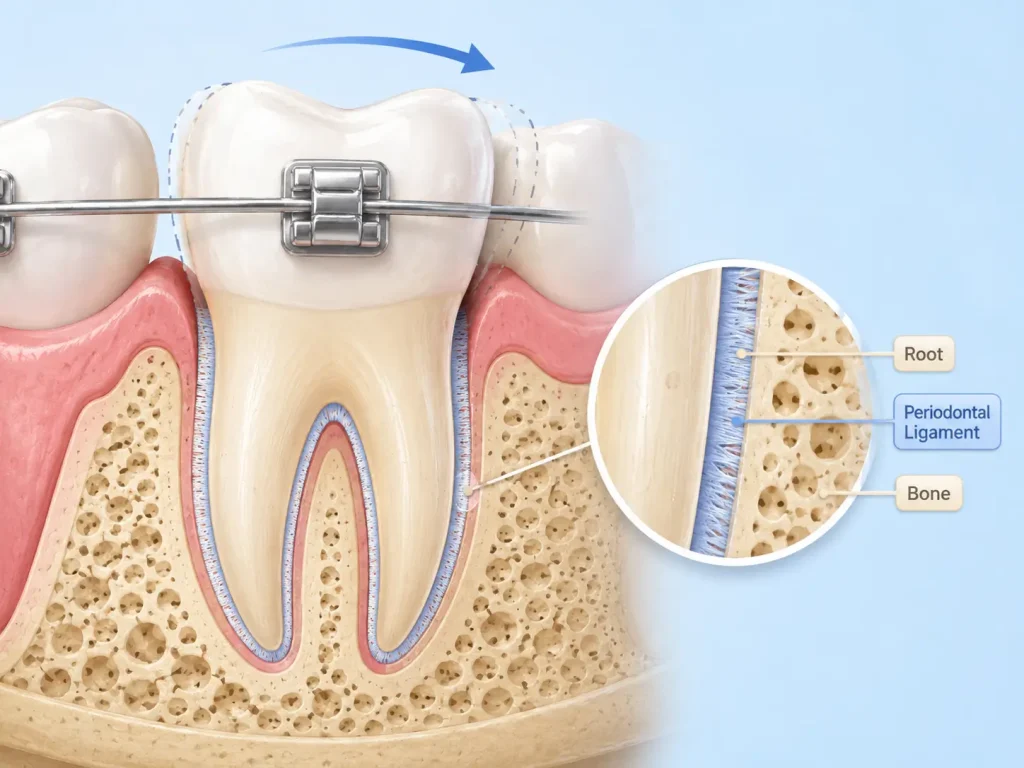
The Short Answer: Yes, and Here’s Why It’s a Good Sign
Loose-feeling teeth during braces are normal, expected, and usually a signal of progress. Your teeth are not falling out and they are not being damaged. They are moving, and movement is the entire point of orthodontic treatment. A tooth that feels slightly loose is simply a tooth in transit, on its way from where it was to where your orthodontist is guiding it.
Here is the reassuring truth in one sentence: to move a tooth into a better position, your body must first loosen it slightly, then firm it back into place once it arrives. The wobble you feel is the middle of that process, not a breakdown of it. To really understand why, though, it helps to look at how a tooth actually sits in your jaw, because it is not fused in place the way most people imagine.
What’s Actually Happening: The Periodontal Ligament at Work
Most people picture teeth as being cemented rigidly into the jawbone, like fence posts set in concrete. In reality, the arrangement is far more elegant and far more dynamic. Each of your teeth is suspended in its socket by a network of tiny, elastic fibers called the periodontal ligament. This ligament is a thin, living cushion, only a fraction of a millimeter thick, that connects the root of your tooth to the surrounding bone. It acts like a shock absorber, letting your teeth handle the forces of chewing without cracking the bone beneath them.
This ligament is also the secret to how teeth move at all. When your braces apply gentle, steady pressure, that force is transmitted through the ligament to the bone on either side of the root. On the side the tooth is being pushed toward, specialized cells dissolve bone to make room. On the opposite side, other cells lay down fresh bone to fill in behind. This is the same bone-remodeling process we describe in our article on how teeth move with braces, and it is happening quietly around every tooth under treatment.
Here is the part that directly explains your loose feeling. During active movement, the periodontal ligament space actually widens. Research using high-resolution imaging has confirmed that the ligament thickens and expands while a tooth is being moved. That slightly wider, more flexible ligament space is precisely what you are sensing when a tooth feels a little loose. Your tooth has a touch more room to flex within its socket because the ligament around it is temporarily stretched and remodeling. It is not detaching. It is loosening its grip just enough to let the tooth travel.
Why Loose Teeth Mean Your Braces Are Working
Once you understand the periodontal ligament, the logic flips completely. A tooth that feels perfectly rigid and immovable is a tooth that is not going anywhere. A tooth that has a slight give to it is a tooth whose ligament is actively remodeling and whose surrounding bone is being reshaped. In other words, the wobble is the treatment.
Think of it like loosening a plant from hard soil before transplanting it. You gently work the roots free so you can move the plant to a better spot, and once it is planted in fresh ground, it takes hold and grows sturdy again. Your teeth follow the same arc. The ligament loosens to allow the journey, the tooth reaches its planned position, and then the bone and ligament settle and firm the tooth back into place. The looseness is not the opposite of success. It is a necessary stage of it.
This is also why your orthodontist uses light, controlled forces rather than aggressive ones. Gentle pressure keeps blood flowing through the ligament so the remodeling cells can do their work efficiently. Too much force actually backfires by crushing the tiny blood vessels in the ligament, which stalls movement instead of speeding it up. The measured, patient approach is what produces safe, healthy tooth movement and the mild, normal looseness that comes with it.
When Looseness Is Normal vs. When to Call Your Orthodontist
Almost all of the looseness you feel during braces falls firmly in the normal category. Still, it is worth knowing the small handful of situations that warrant a quick call, purely for peace of mind. The difference usually comes down to degree and to whether other symptoms come along for the ride.
| Normal and expected | Worth a call to your orthodontist |
| A mild wiggle or looseness in teeth that are actively being moved | A tooth that feels dramatically loose or painful, well beyond a gentle wobble |
| Looseness that comes and goes, especially after an adjustment | Looseness paired with bleeding, swelling, or tender, receding gums |
| Tenderness for a few days after tightening, then settling | A tooth that was hit or injured and now feels loose |
The simplest rule of thumb: a gentle wiggle in a tooth that is being actively moved is expected, while a dramatic looseness combined with pain, bleeding, or swollen gums is worth reporting. The latter can occasionally signal a gum health issue rather than normal movement, and gum health is the foundation everything rests on, as we cover in our guide to keeping your teeth and gums healthy in braces. When in doubt, a brief phone call always beats worrying, and your orthodontist would far rather hear from you than have you sit at home anxious.
Will My Teeth Tighten Back Up After Treatment?
This is the question that reassures patients most, and the answer is a confident yes. The looseness is temporary by design. Once a tooth reaches its final planned position and the pressure of active movement stops, the periodontal ligament space returns to its normal, narrower width, and the fresh bone that formed around the root continues to mineralize and harden. Your teeth firm back up in their new, straighter alignment.
There is one crucial detail here, though, and it explains why the next phase of treatment matters so much. When your braces come off, that newly formed bone is still maturing and the ligament is still settling. Your teeth are in their beautiful new position but are not yet fully anchored, which makes them prone to drifting back if left unsupported. This is exactly why a retainer is not optional. It holds your teeth steady during the months the bone needs to fully harden around them, and it is the single most important factor in keeping your teeth from shifting after braces. Wear it as directed, and the looseness you felt during treatment gives way to a stable, lasting result.
Why the Looseness Comes in Waves (and Follows Your Adjustments)
Here is a pattern many patients notice but few have explained to them: the loose, tender feeling is not constant. It tends to arrive in waves, often peaking in the days right after an adjustment appointment and then fading as the weeks go on. Understanding this rhythm makes the whole experience far less mysterious.
When your orthodontist activates or tightens your braces, they apply a fresh dose of pressure to the ligament. For roughly the first several days afterward, the tooth enters its most active phase of movement, and this is when it feels tenderest and loosest. If the force is firm, part of the ligament on the pressure side can briefly become compressed enough to pause movement for a short window, a normal biological checkpoint, before the body clears the area and movement resumes. As that phase completes and the bone remodels, the tooth settles, the tenderness eases, and the looseness quiets down, until your next adjustment starts the cycle again. So if you notice your teeth feel wiggliest in the days after a visit and steadier before the next one, that is not your imagination. It is the predictable rhythm of healthy tooth movement.
Straightening With Confidence at Freedman & Haas
A tooth that feels a little loose during braces is not a crack in the plan. It is the plan working. It reflects the remarkable, living process by which your body reshapes bone to give you a straighter, healthier smile. Understanding that biology turns a moment of worry into a sign of reassurance, which is exactly how it should feel.
At Freedman & Haas Orthodontics, our board-certified team has guided more than 30,000 patients across West Palm Beach and Wellington through every stage of this process, including the perfectly normal wobble along the way. If a loose-feeling tooth ever has you concerned, we are only a call away, and we would rather answer your question than have you wonder. Schedule a visit or reach out anytime, and let us keep your treatment moving smoothly toward the finish line.
Frequently Asked Questions
Is it normal for teeth to feel loose with braces?
Yes, it is completely normal and usually a sign your treatment is working. To move a tooth, the periodontal ligament around its root temporarily widens, which gives the tooth a slight wiggle. That looseness is a stage of healthy movement, not a sign of damage, and it resolves as the tooth settles into its new position.
Can braces make my teeth fall out?
No. Properly applied orthodontic force moves teeth safely through bone using the body’s natural remodeling process, and it does not cause teeth to fall out. The mild looseness you feel is the ligament flexing to allow movement, not the tooth detaching. Your teeth firm back into place as treatment progresses and finishes.
How loose is too loose during braces?
A gentle wiggle in teeth that are being actively moved is expected. Looseness becomes worth a call when a tooth feels dramatically loose or painful, when it is accompanied by bleeding, swelling, or receding gums, or when it follows an injury to the mouth. In those cases, contact your orthodontist to rule out a gum or trauma issue.
Will my teeth be firm again after braces come off?
Yes. Once active movement stops, the ligament space narrows back to normal and the new bone around each root hardens, firming your teeth in their new alignment. Wearing your retainer as directed is essential during this period, because it holds your teeth steady while the bone fully matures and prevents them from drifting.