
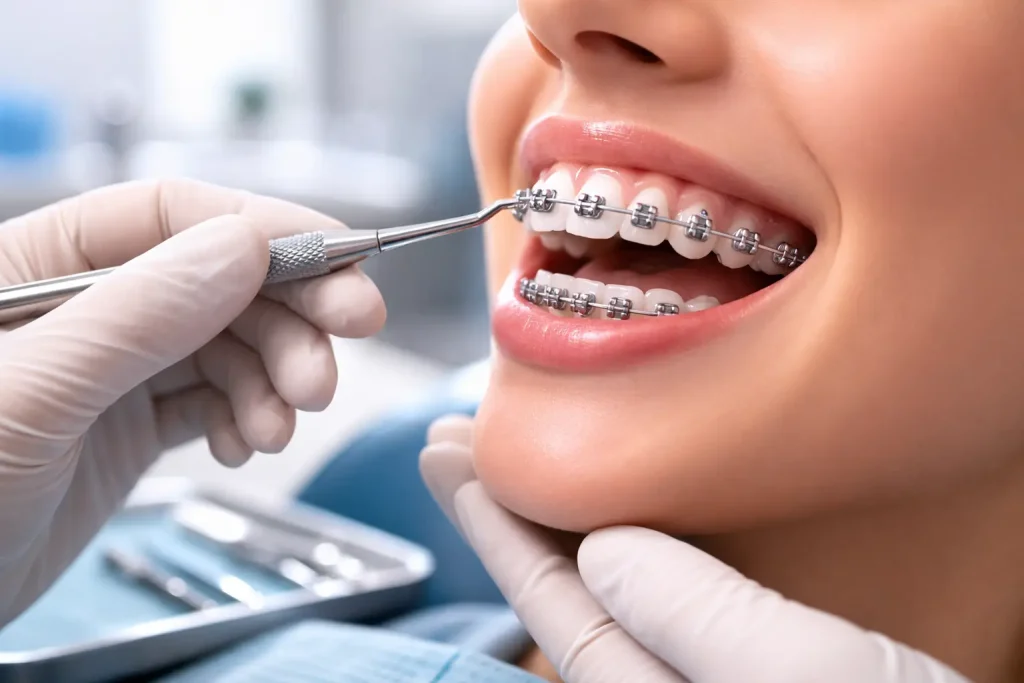
If you’re new to braces or considering orthodontic treatment, one of the practical questions you’re probably wondering about is how often you’ll need to come in for adjustments. These appointments are a key part of the treatment process, and understanding what to expect helps you plan your schedule, prepare for any discomfort, and stay motivated as you track your progress.
Here’s what you need to know upfront: braces are typically adjusted, or “tightened,” every 4 to 8 weeks depending on the treatment stage, the type of braces you have, and how your teeth are responding to treatment. During these appointments, the orthodontist changes wires, replaces elastics, monitors progress, and makes any necessary modifications to keep treatment moving forward. Most adjustment appointments take 15 to 30 minutes.
At Freedman & Haas Orthodontics, we schedule adjustments based on your individual treatment plan and what your teeth need at each stage. Let’s dive deeper into what happens during these appointments, why timing matters, and how to manage any soreness that comes with adjustments.
The Standard Braces Adjustment Schedule: Every 4 to 8 Weeks
For most patients with traditional braces, adjustment appointments are scheduled every 4 to 8 weeks. The specific interval depends on several factors including which phase of treatment you’re in, how quickly your teeth are moving, and what needs to happen at the next stage.
In the early stages of treatment, when teeth are being aligned and major movements are happening, adjustments might be scheduled every 4 to 6 weeks. This is when teeth typically move fastest, and more frequent monitoring helps ensure everything is progressing as planned.
In the middle stages of treatment, when arches are aligned and bite correction is happening, adjustments often stretch to every 6 to 8 weeks. Movements become more refined, and teeth need more time to settle into their new positions before the next change.
In the finishing stages, appointments might remain at 6 to 8 weeks as final detailing happens and the orthodontist fine-tunes tooth positions and bite relationships.
Why not tighten braces more often to speed up treatment? It’s a common question, but the biology of tooth movement doesn’t work that way. Teeth move through bone remodeling, which is a slow process involving specialized cells that break down and rebuild bone. Adjusting braces every 2 weeks wouldn’t make teeth move twice as fast, it would just cause unnecessary discomfort without added benefit.
Teeth move most actively in the first week or two after an adjustment, then movement slows as the bone begins to stabilize. The 4 to 8 week interval is designed to coincide with this natural cycle. By the time you come in for your next appointment, teeth have moved as much as they’re going to with the current wire configuration, and it’s time to progress to the next stage.
We get asked whether self-ligating braces or other modern systems require fewer appointments. In some cases, yes. Self-ligating brackets allow wires to slide more freely, which can mean slightly longer intervals between adjustments, sometimes 8 to 10 weeks. However, this varies by case and by orthodontist preference.
What Actually Happens During a Braces Tightening Appointment
The term “tightening” is a bit misleading because the orthodontist isn’t actually cranking your braces tighter like you might tighten a bolt. What’s really happening is progression, moving to the next stage of treatment with new wires or modifications that continue guiding teeth toward their ideal positions.
Here’s what a typical adjustment appointment looks like from start to finish. You’ll be seated in the treatment chair and the orthodontist or assistant will examine your teeth to see how much movement has occurred since your last visit. This visual check helps confirm that treatment is progressing as expected.
Next, the elastic ligatures, those small colored rubber bands that hold the wire in the bracket slots, are removed. If you have self-ligating braces, the clip that holds the wire is opened. Then the archwire is removed from the brackets.
With the wire out, the orthodontist can thoroughly examine your teeth, check that brackets are secure, and clean around brackets if needed. This is also when they assess how much more movement is needed and decide what comes next.
In most cases, a new archwire is inserted. This wire might be thicker than the previous one to apply more force, or it might be the same thickness but shaped differently to make specific movements. Sometimes the same wire is reinserted if no change is needed yet.
New elastic ligatures are placed to hold the new wire in position. This is when patients get to choose their colors if they want colored elastics. Clear or silver elastics are also available for patients who prefer a subtle look.
If you’re wearing elastics, also called rubber bands, for bite correction, you’ll receive fresh elastics and instructions on how to wear them. Elastics are critical for many treatments, and wearing them exactly as prescribed makes a huge difference in how quickly treatment progresses.
The orthodontist will check your bite to make sure teeth are coming together properly as they move. They might have you bite down, move your jaw side to side, and open and close to assess how the bite is developing.
Finally, your next appointment is scheduled, usually 4 to 8 weeks out, and you’re sent home with instructions on what to expect over the next few days.
The whole appointment typically takes 15 to 30 minutes depending on what needs to be done. Sometimes appointments are longer if brackets need to be repositioned, new attachments added, or elastics set up for the first time.
How Adjustment Frequency Varies by Braces Type
Different types of braces systems can affect how often you need adjustments, though the differences are often smaller than people expect.
Traditional metal braces with elastic ligatures typically require adjustments every 4 to 8 weeks. The elastic ligatures lose their elasticity over time, which is one reason they’re changed at each visit. The wires also need to be progressed regularly to keep treatment moving.
Self-ligating braces use a built-in clip instead of elastic ligatures to hold the wire. Because there are no elastics to replace and because the wire can slide more freely, some orthodontists schedule self-ligating adjustments every 6 to 10 weeks. However, this varies widely based on treatment needs and orthodontist preference.
Ceramic braces follow the same adjustment schedule as metal braces, typically every 4 to 8 weeks. The brackets themselves function identically to metal brackets, so adjustment frequency is based on tooth movement, not bracket material.
Clear aligners like Invisalign work differently than braces. Instead of coming in for wire changes, patients change aligners at home, usually every 1 to 2 weeks. However, in-office check-ups are still important, typically scheduled every 6 to 10 weeks to monitor progress, place or remove attachments, and ensure aligners are tracking properly.
Lingual braces, which are placed on the back of teeth, typically follow the same 4 to 8 week adjustment schedule as traditional braces. Appointments may take slightly longer because accessing brackets on the back of teeth is more complex.
Factors That Influence How Often Your Braces Need Adjusting
While 4 to 8 weeks is the standard, several factors can influence your specific adjustment schedule.
One big factor is how quickly your teeth are moving. Some people’s teeth move faster than average due to individual biology, age, and bone density. If your teeth are moving very efficiently, your orthodontist might stick with 4-week intervals. If movement is slower, stretching to 6 or 8 weeks might be appropriate.
Age plays a role because younger patients, especially kids and teens, often have more active bone remodeling and may progress through treatment stages more quickly. Adults can achieve the same results but sometimes on slightly longer timelines.
Treatment complexity affects scheduling too. Simple alignment cases might need fewer total adjustments than complex bite corrections. A case that requires careful sequencing of movements or precise biomechanics might need more frequent monitoring.
Cooperation and compliance matter. If you’re wearing your elastics exactly as prescribed, avoiding bracket-breaking foods, and maintaining excellent oral hygiene, treatment stays on schedule and adjustments happen at regular intervals. If you’re frequently breaking brackets or not wearing elastics, appointments might be scheduled more frequently to address issues and get treatment back on track.
Your orthodontist’s treatment philosophy also influences appointment frequency. Some orthodontists prefer more frequent short appointments to make incremental changes. Others use longer intervals with bigger wire progressions. Both approaches can be effective.
What Happens If You Skip or Delay a Braces Adjustment
Life happens, and sometimes you need to reschedule an orthodontic appointment. While one missed appointment isn’t a disaster, regularly skipping or delaying adjustments can significantly impact your treatment.
When you skip an adjustment, teeth stop progressing. The current wire has already moved teeth as much as it’s going to. Without progressing to the next wire or making the next modification, treatment stalls. Teeth sit in their current positions, and you’re essentially wasting time.
Skipping multiple appointments can add months to your overall treatment time. If you’re supposed to have adjustments every 6 weeks and you skip 3 appointments, that’s 18 weeks or about 4 months, of stalled progress. Your total treatment time extends accordingly.
There’s also a risk of relapse. Teeth have a memory and want to drift back toward their original positions. Retainers prevent this after braces are removed, but during active treatment, the next stage of wires and adjustments is what keeps teeth moving forward. If too much time passes, teeth can shift in unwanted directions.
In some cases, delaying appointments can cause discomfort. A wire that’s been in place too long might start to feel loose or less effective. Elastic ligatures can lose their elasticity and become less secure. If the orthodontic plan calls for elastics and you’re not wearing them consistently, the wire alone may not deliver the intended movements.
If you absolutely must miss an appointment due to travel, illness, or other circumstances, call the office as soon as possible to reschedule. Most orthodontists can accommodate schedule changes if you communicate early. What’s problematic is repeatedly no-showing or going months between appointments without coordination.
Many patients worry that missing one appointment means treatment will be drastically delayed. In most cases, one missed appointment might add an extra month to treatment, but it’s not catastrophic. The key is rescheduling promptly and then staying on track going forward.
Managing Pain and Soreness After a Braces Tightening
One of the main concerns people have about adjustment appointments is the soreness that often follows. Let’s talk about what’s normal, how long it lasts, and what you can do to feel better.
First, some soreness after an adjustment is completely normal. You’ve just progressed to a new wire that’s applying new forces to your teeth. Your periodontal ligament is compressing and stretching, and that creates pressure and tenderness. This is a sign that treatment is working, not that something is wrong.
The soreness typically starts a few hours after the appointment and peaks around 24 to 48 hours later. For most people, it fades significantly by day 3 or 4. Some patients barely notice any discomfort, while others are quite sore, there’s a lot of individual variation.
What helps manage soreness? Several strategies work well for most patients. Over-the-counter pain medication like ibuprofen or acetaminophen, taken as directed on the label, can reduce discomfort significantly. Take it when you first notice soreness rather than waiting until it’s severe.
Eating soft foods for the first day or two after an adjustment gives your teeth a break from chewing pressure. Think yogurt, smoothies, mashed potatoes, pasta, scrambled eggs, soup, and soft fruits like bananas. Avoid crunchy, hard, or chewy foods until sensitivity subsides.
Cold foods and drinks can numb soreness temporarily. Ice cream, smoothies, and cold water provide relief and are easy to consume when teeth are tender.
Warm salt water rinses can soothe irritated gums and reduce inflammation. Mix half a teaspoon of salt in a cup of warm water and swish gently for 30 seconds several times a day.
Orthodontic wax can help if new wires or adjustments are irritating your cheeks or lips. Place a small amount of wax over the bracket or wire that’s causing discomfort.
What’s not normal and should prompt a call to your orthodontist? Sharp, severe pain that doesn’t respond to over-the-counter medication. Soreness that gets worse after day 3 instead of better. A wire that’s actively poking or cutting your cheek. A bracket that comes loose or breaks. If any of these happen, call the office rather than waiting for your next scheduled appointment.
Some patients worry that soreness means teeth are moving too fast or that something is damaged. In most cases, soreness is just the normal sensation of bone remodeling. If you’re concerned, though, reach out to your orthodontist for reassurance.
How the Adjustment Schedule Changes as Treatment Progresses
Adjustment frequency and what happens at appointments evolves as you move through different phases of orthodontic treatment.
In the initial alignment phase, typically the first 3 to 6 months, adjustments focus on getting teeth aligned and into the archwire. This is when you’ll see the most dramatic visible changes. Appointments might be every 4 to 6 weeks, and each visit usually involves progressing to a thicker or stiffer wire. Soreness tends to be more noticeable during this phase because teeth are moving most actively.
During the leveling and bite correction phase, which often lasts 6 to 12 months, adjustments focus on creating proper bite relationships and refining tooth positions. Elastics are often introduced during this phase if bite correction is needed. Appointments might stretch to every 6 to 8 weeks as movements become more refined.
In the finishing phase, the last few months of treatment, adjustments become very detail-oriented. The orthodontist is fine-tuning tooth positions, making sure the bite is perfect, and ensuring everything is stable before braces come off. Appointments remain at 6 to 8 weeks, and changes at each visit are smaller and more subtle.
Once braces are removed, you enter the retention phase. You’ll still have follow-up appointments to check that retainers fit properly and that teeth are stable, but these are scheduled less frequently, often every 3 to 6 months initially and then yearly.
What’s consistent across all phases is that regular appointments are essential. Orthodontic treatment is a process that requires monitoring, adjustments, and professional guidance from start to finish. Staying on schedule with appointments ensures treatment progresses efficiently and achieves the best possible results.
Conclusion
Braces are typically adjusted every 4 to 8 weeks depending on your treatment stage, the type of braces you have, and how your teeth are responding to treatment. During these appointments, which usually take 15 to 30 minutes, your orthodontist changes wires, replaces elastics, monitors progress, and makes modifications to keep treatment moving forward.
Skipping or delaying adjustments can stall progress and extend your overall treatment time, so staying on schedule is important. Soreness after adjustments is normal and usually peaks within 24 to 48 hours before fading. Soft foods, over-the-counter pain medication, and cold foods can help manage discomfort.
At Freedman & Haas Orthodontics in West Palm Beach, Wellington, and Indiantown, we schedule adjustments based on your individual needs and what your teeth require at each stage of treatment. We make the process as comfortable and efficient as possible while ensuring you’re always progressing toward your smile goals.
Ready to start your orthodontic journey or have questions about what to expect during treatment? Schedule a complimentary consultation with us at Freedman & Haas Orthodontics. We’ll evaluate your smile, explain the full treatment process including adjustment schedules, and create a personalized plan that fits your life and your goals.