
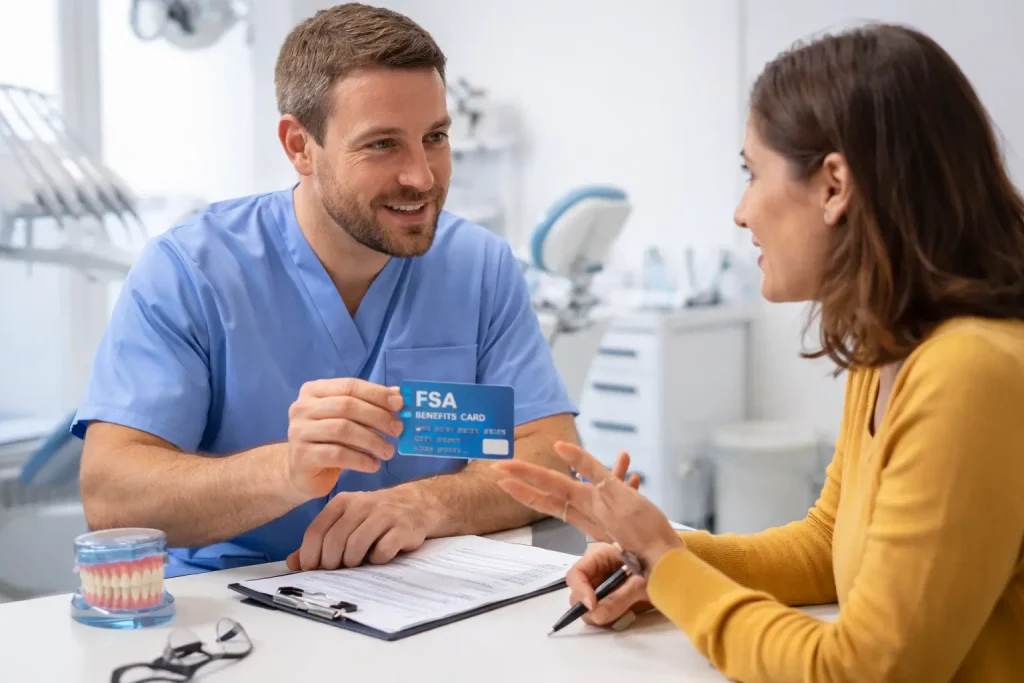
Open enrollment season brings a familiar question to millions of American households: how do I actually make the most of my Flexible Spending Account? For families with upcoming dental or orthodontic needs, the answer matters, because an FSA lets you pay for qualified medical and dental expenses with pre-tax dollars, which effectively gives you an instant discount on the cost of care.
The short answer to the headline question is yes, you can absolutely use FSA funds for dental expenses, including many orthodontic treatments like braces and Invisalign. But the details matter. Not all dental expenses qualify, there are rules about timing and contribution limits, and using your FSA strategically requires understanding how it works.
This guide covers everything you need to know: what dental expenses are FSA-eligible, what’s excluded, how to use your FSA for orthodontic treatment, and how to make sure you don’t leave money on the table at year-end.
What Is a Flexible Spending Account (FSA)?
A Flexible Spending Account is an employer-sponsored benefit that allows you to set aside pre-tax dollars from your paycheck to cover eligible medical and dental expenses throughout the year. Because contributions come out before federal, state, and FICA taxes are applied, you’re effectively getting a tax discount on everything you spend the account on.
For example, if you contribute $2,000 to your FSA and you’re in the 22% federal tax bracket, you save approximately $440 in federal income tax alone, before accounting for state taxes or FICA. The actual savings depend on your tax bracket and state, but the principle is consistent: every dollar you run through an FSA costs you less than a dollar of take-home pay.
FSAs are funded through payroll deductions, and the full annual election amount is available on the first day of the plan year, meaning you can use the full amount you’ve committed to contributing even before you’ve actually contributed it all. This front-loading feature is one of the things that makes FSAs particularly useful for large planned expenses like orthodontic treatment.
How an FSA Differs From an HSA
FSAs and HSAs (Health Savings Accounts) are both pre-tax savings vehicles for healthcare expenses, but they work differently in important ways. The most significant difference for dental purposes is the use-it-or-lose-it rule that applies to FSAs: funds that aren’t spent by the end of the plan year (or the grace period, if your employer offers one) are forfeited. HSA funds, by contrast, roll over indefinitely.
HSAs also require enrollment in a High Deductible Health Plan (HDHP) and are “triple tax advantaged”, contributions are pre-tax, growth is tax-free, and qualified withdrawals are tax-free. FSAs have no HDHP requirement and are offered by a broader range of employers, making them accessible to more people.
Both FSAs and HSAs can be used for qualifying dental and orthodontic expenses. If you have access to both, coordinating them can maximize your tax savings on healthcare spending.
What Dental Expenses Are FSA Eligible?
The IRS determines what counts as a qualified medical or dental expense for FSA purposes. The general rule is that expenses must be for the diagnosis, cure, mitigation, treatment, or prevention of disease, or for the purpose of affecting any structure or function of the body. Purely cosmetic procedures don’t qualify.
Preventive Care: Cleanings, X-Rays, and Exams
Routine preventive dental care is fully FSA-eligible. This includes professional teeth cleanings (prophylaxis), dental X-rays, comprehensive oral exams, and periodontal evaluations. These visits are often covered by dental insurance as well, but if you have a deductible, out-of-pocket portion, or a service not covered by insurance, your FSA can pick up the remainder.
Fluoride treatments, sealants, and mouthguards (when prescribed for bruxism or teeth grinding) also qualify. If you or your child need any of these services and you have FSA funds to spend, these are straightforward eligible expenses.
Restorative Work: Fillings, Crowns, and Root Canals
Restorative dental treatments, those designed to repair damaged or diseased teeth, are clearly FSA-eligible. Fillings, dental crowns, bridges, root canals, periodontal treatment, extractions, and dental implants all qualify. These can be significant expenses, and using FSA dollars for them reduces the effective cost substantially.
Dental implants deserve a specific mention because they represent a large investment. The implant itself, the abutment, and the crown placed on top all qualify as eligible FSA expenses. If you’re planning implant work, maximizing your FSA contribution to cover as much of it as possible is a smart strategy.
Orthodontic Treatment: Braces and Invisalign
Yes, orthodontic treatment qualifies as an FSA-eligible expense. This includes traditional metal braces, ceramic (clear) braces, and Invisalign. The FSA treats orthodontic treatment as a medical expense for the purpose of correcting a physical condition, dental misalignment, rather than as a cosmetic enhancement.
There’s an important nuance for orthodontic treatment: because it typically spans multiple years, FSA reimbursement rules require that the payment be for services already rendered, not prepaid for future treatment. In practice, this means you can use FSA funds to pay for current-year treatment, but you can’t use one year’s FSA to prepay for two or three years of future orthodontic care.
Many orthodontic practices, including Freedman & Haas Orthodontics, work with patients on FSA payment scheduling to help maximize reimbursements across plan years. Retainers after treatment also qualify, something patients sometimes overlook.
What Dental Expenses Are NOT Covered by an FSA?
The clearest exclusion from FSA eligibility is cosmetic procedures, treatments whose primary purpose is to improve appearance rather than treat a medical condition. The line isn’t always obvious, but here are the most common examples.
Cosmetic Procedures: Teeth Whitening and Veneers
Professional teeth whitening is not FSA-eligible. Neither are veneers placed purely for aesthetic reasons (veneers used to restore damaged or broken teeth may qualify, but purely cosmetic veneers do not). Tooth bonding done strictly for appearance is also excluded.
This is the point where people sometimes wonder about orthodontic treatment, is straightening teeth cosmetic? The IRS considers orthodontic treatment a qualifying medical expense because it corrects functional bite and alignment issues, not purely aesthetic ones. The distinction matters: treatment that corrects a structural or health-related problem qualifies; treatment that serves only cosmetic purposes does not.
If you’re unsure whether a specific procedure qualifies, ask your HR department or FSA plan administrator before assuming one way or the other. Submitting a non-qualifying expense for reimbursement can trigger complications with your plan.
How to Use Your FSA for Orthodontic Treatment
Using FSA funds for orthodontic treatment is straightforward in principle, but there are a few procedural steps to understand to avoid any issues.
Paying for Braces or Invisalign With FSA Funds
Most FSA plans come with a debit card that can be used at the point of service. You can typically use this card directly to pay for orthodontic treatment, and many orthodontic offices, including ours, accept FSA cards just like any other payment method.
Some plans require documentation. Keep your Explanation of Benefits (EOB) from your dental insurance, itemized receipts from the orthodontist, and any treatment records. If your FSA plan administrator requests documentation to verify a claim, having this on file makes the process smooth. Your orthodontist’s office can always provide an itemized receipt if you need one.
Because orthodontic treatment is paid in installments rather than as a single lump sum, you’ll typically submit FSA reimbursement requests as you make each monthly payment, rather than for the full treatment cost upfront.
Can You Combine FSA With Insurance or Payment Plans?
Yes, and doing so is one of the smartest ways to minimize your out-of-pocket cost for orthodontic treatment. The typical approach is: your dental insurance pays its orthodontic benefit (often a lifetime maximum of $1,000 to $2,500), and you use FSA funds to cover a portion of the remaining balance, with any remainder going on a payment plan.
At Freedman & Haas Orthodontics, we help patients map out exactly how their insurance benefit, FSA funds, and payment plan can work together. This kind of coordination can make treatment that seems financially out of reach very manageable.
FSA Rules You Need to Know Before Year-End
The most critical thing to understand about FSAs is the deadline. Unlike HSAs, FSA funds are subject to a use-it-or-lose-it rule. Any money left in your account at the end of the plan year, typically December 31, is forfeited. This is money you’ve already paid into the account, and you lose it if you don’t spend it on qualifying expenses.
The Use-It-or-Lose-It Rule and Grace Periods
Many employers offer one of two relief options: a grace period or a carryover provision. A grace period gives you an extra two and a half months after the plan year ends to incur and submit qualifying expenses. A carryover provision allows you to roll over up to a set amount (currently up to $660 for 2025 plan years) into the next year.
Not all employers offer these options. Check your specific plan documents or ask your HR department whether your FSA includes a grace period or carryover. If neither applies, December 31 is a hard deadline.
If you’re approaching year-end with unused FSA funds, dental and orthodontic expenses are one of the most practical ways to spend them. Scheduling a cleaning, getting X-rays, paying for a portion of orthodontic treatment, or purchasing prescribed dental products (like a prescription-grade fluoride toothpaste or a night guard) are all ways to put FSA money to work before it expires.
How Much Can You Contribute to an FSA in 2026?
For the 2026 plan year, the IRS contribution limit for health FSAs is $3,400 per employee. If both you and your spouse have access to FSAs through your respective employers, each of you can contribute up to the limit, potentially doubling the pre-tax dollars available for qualifying healthcare and dental expenses.
You set your contribution election during your employer’s open enrollment period, and the amount you elect is typically fixed for the plan year. The full amount is available from day one, which means you can schedule and pay for significant dental work at the beginning of the year and use the rest of the plan year’s deductions to pay it back.
FSA vs. HSA for Dental and Orthodontic Care
If you’re enrolled in a High Deductible Health Plan, you may have access to an HSA instead of (or in addition to) an FSA. For dental planning purposes, the key differences come down to flexibility and strategy.
HSAs are more flexible in timing, because funds roll over indefinitely, you can build up your HSA over several years and then deploy a larger balance for a major dental expense. FSAs require you to spend the funds within the plan year, which means you need to plan your elections based on expected expenses rather than long-term savings.
For predictable, scheduled expenses like orthodontic treatment, an FSA often works well because you know roughly how much treatment will cost and can elect accordingly. For unpredictable or larger future expenses, an HSA’s rollover flexibility offers an advantage.
If you have access to both, a common strategy is to use the FSA for current-year known expenses and the HSA to build reserves for future needs. Talk with a tax advisor or financial planner if you want to optimize the strategy for your specific situation.
How to Maximize Your FSA for Your Family’s Dental Needs
FSA planning is most effective when it’s intentional. A few strategies make a real difference.
First, plan your dental calendar before open enrollment. If you know a family member will be starting orthodontic treatment, getting a crown, or having another significant procedure, factor those expected costs into your FSA election. Electing too little means missing out on tax savings; electing too much risks forfeiture.
Second, schedule appointments strategically. If you have FSA funds to use before December 31, contact your dental and orthodontic offices in October or November to schedule any outstanding appointments. Many practices have limited availability in December as patients rush to use year-end benefits.
Third, don’t overlook small qualifying purchases. Prescription dental products, medically necessary mouthguards, and any copays or deductibles for dental visits all qualify. If you’re facing year-end funds you might otherwise lose, these smaller purchases add up.
Finally, if you’re considering orthodontic treatment for yourself or a child, schedule a consultation early in the plan year so you can incorporate the cost into your FSA election and insurance benefit strategy from the start. At Freedman & Haas Orthodontics, we’re happy to provide a cost estimate during your initial consultation so you can plan accordingly.
Conclusion
Using your FSA for dental and orthodontic expenses is one of the most straightforward ways to reduce the out-of-pocket cost of care, without changing what you’re getting or who provides it. The tax savings are real, the qualifying expenses are broad, and the process is simpler than most people expect.
The most important thing is to plan ahead: know what’s eligible, know your deadlines, and elect an amount that reflects your actual expected expenses. For families considering orthodontic treatment, factoring FSA funds into the financial plan can make the difference between delaying treatment and starting it.
Freedman & Haas Orthodontics sees patients at our West Palm Beach and Wellington offices, and we’ll help you understand exactly how your FSA, insurance benefits, and payment plan can work together. Book a free consultation and let’s map it out.