
If you have spent any time weighing braces against Invisalign, you already know the question rarely has a tidy answer. A friend swears by one. A cousin quietly regretted the other. The internet, predictably, insists both that aligners are a small miracle and that nothing will ever beat good old metal brackets. Somewhere underneath all of that noise sits a real decision about your teeth, your daily routine, and a result you will live with for decades.
So let us set the noise aside. In our practice we walk patients through this exact choice every week, and what follows is the same conversation we would have with you across the consultation chair, grounded in what the research shows rather than what sounds persuasive in an advertisement. By the time you reach the end, you will understand how each option really works, where each one shines, where each one struggles, and which questions matter far more than the label on the treatment itself.
The Short Answer: There Is No Universal Winner
Here is the honest truth we offer every patient who walks in hoping for a simple verdict. Neither braces nor Invisalign is better in some absolute sense. Each is a tool, and the right tool depends on the problem in front of it, the life you lead, and how reliably you will follow the plan. For a great many cases the two can reach almost the same destination, and the decision comes down to preference. For a smaller set of complex cases, one option genuinely outperforms the other, and a specialist should say so plainly. The aim of this guide is not to crown a champion. It is to help you recognize which situation you are actually in.
How Each One Actually Works
Before comparing them, it helps to know that braces and Invisalign are not as different under the hood as they look. Both rely on the same piece of biology. Steady, gentle pressure prompts the body to remodel the bone around a tooth, loosening its grip on one side and rebuilding on the other so the tooth can migrate into a new position. This is also why, in the early weeks, teeth can feel tender or slightly mobile, a sensation we explain in more depth when patients ask us why their teeth feel loose during treatment. Whether that pressure arrives through a wire or a plastic tray, the body answers the same way, and it answers slowly, which is precisely why orthodontic treatment is measured in months rather than weeks.
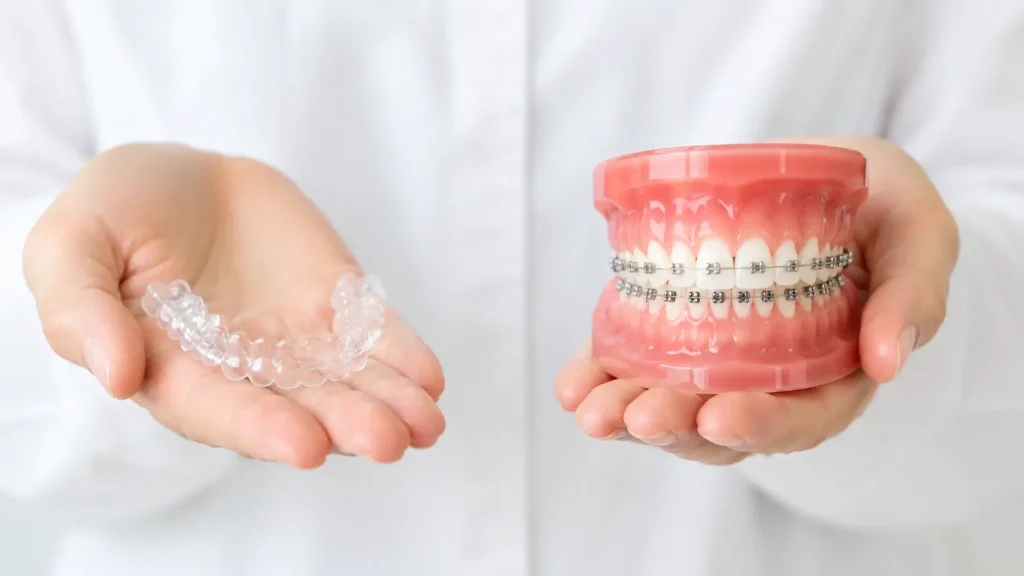
Braces apply that pressure through brackets bonded to each tooth and a thin archwire threaded between them. As the orthodontist adjusts and upgrades that wire over the course of treatment, it delivers precise, continuous force in three dimensions at once. Invisalign takes a different route to the same end. It uses a series of custom clear trays, each shaped a little differently from the last. You wear a tray for a week or two, your teeth shift a fraction of a millimeter toward its shape, and then you graduate to the next one. Small tooth-colored attachments bonded to certain teeth give the trays something to grip, which lets them produce movements that smooth plastic alone never could. Different delivery, same underlying science.
Head to Head: The Comparison That Matters
Patients tend to arrive with the same short list of practical questions, so it is worth laying the two options side by side on the factors that actually shape daily life.
| Factor | Braces | Invisalign |
| Appearance | Visible brackets and wires | Nearly invisible trays |
| Removable | Fixed until treatment ends | Taken out to eat and clean |
| Office visits | Roughly every 6 to 8 weeks | Check-ins, often spaced further apart |
| Food | Some hard and sticky foods limited | No restrictions, trays come out |
| Cleaning | Brushing and flossing around hardware | Normal brushing and flossing |
| Depends on you | Works regardless of habits | Only works while trays are worn |
| Best suited to | Complex cases and all ages | Mild to moderate cases, steady wearers |
Appearance and Discretion
For many adults this is the deciding factor, and understandably so. Invisalign trays are genuinely difficult to notice in ordinary conversation, which is why they appeal to professionals, public speakers, and anyone who would rather not announce their treatment to a room. Braces, for their part, have grown far more discreet than the mouthful of metal older generations remember, and clear ceramic brackets soften their look even further, yet they remain visible up close. Visibility, though, cuts both ways. A teenager who would forget to put a removable tray back in may be far better served by an appliance that simply cannot be taken out and lost.

Comfort and Daily Life
Comfort turns out to be less lopsided than most people assume. Invisalign has no brackets to rub against the inside of the cheek, so it tends to cause fewer of those small irritations. In exchange, each new tray brings a day or two of tightness as it begins its work, a feeling our patients usually describe as pressure rather than pain. Braces can occasionally irritate the soft tissue, something a dab of orthodontic wax normally settles, and the days just after an adjustment carry a similar ache. The larger everyday difference is removability. With Invisalign you take the trays out to eat, so no food is off the table, but it also means the trays have to come out and go back in several times a day, every single day, which asks a certain discipline of you.
Treatment Time and Compliance
Here the research is both reassuring and easy to misread. For mild to moderate crowding, a 2024 systematic review of ten studies found no significant difference in overall treatment time between clear aligners and fixed braces. Put plainly, for the cases aligners were designed to handle, they tend to keep pace with braces. The picture shifts as cases grow more complex. When teeth must be removed to create space, a multicenter randomized trial reported aligner treatment running considerably longer, on the order of 31 months against roughly 22 for braces. The practical lesson is steady. Aligners match braces on straightforward cases and gradually give ground as the work gets harder.
Compliance is the quiet variable sitting behind all of this. Aligners only move teeth while they are in your mouth, and the prescription is 20 to 22 hours a day. A patient who wears them faithfully stays on schedule. One who leaves them folded in a napkin at lunch does not, and no amount of clever planning makes up for trays that spend the afternoon in a pocket. Braces ask less of your discipline because they are always working, which is part of why we often steer less consistent wearers toward them in the first place.
Cost and Oral Hygiene
Cost varies far more by case than by method. For comparable complexity the two options often land within a similar range, and the bigger driver of the final figure is simply how much work your teeth actually need. Because budgeting matters to most families, it helps to know that treatment can usually be spread across monthly payments rather than paid all at once, which makes the sticker price feel a good deal less daunting than it first appears.
Oral hygiene, on the other hand, is one area where Invisalign holds a real and measurable edge. Because the trays come out, you brush and floss exactly as you always have, with no brackets or wires to work around. Braces ask for more careful cleaning, and patients who let plaque gather around the hardware can develop the faint white marks that signal early enamel damage. This matters all the more for anyone starting treatment with gum disease already in the picture, since keeping the tissue clean during treatment is far easier without fixed appliances in the way. None of this rules braces out. It simply means they ask for a more diligent brushing routine than many people expect.
Which Cases Each One Handles Best
This is where a specialist earns their keep, because the right answer depends entirely on the diagnosis. A large 2025 systematic review that pooled fifteen clinical trials and more than a thousand patients found no meaningful difference in treatment quality between aligners and fixed braces for non-extraction cases, the everyday crowding and spacing that make up the bulk of orthodontic work. For those patients, either option can deliver an excellent result, and preference can reasonably decide.
That same review, however, found that fixed braces produced better outcomes in extraction cases, where larger and more controlled movements are needed to close space. Braces also keep an advantage when teeth must be rotated significantly, particularly rounded teeth such as canines, and when the underlying problem is skeletal rather than simply a matter of crooked teeth. Invisalign, meanwhile, is superb at what it was built for, closing mild to moderate gaps, relieving crowding, and refining a bite that is already close. Rather than forcing a single tool onto every problem, our job is to match the appliance to the biology in front of us, and now and then that means recommending the option a patient never walked in expecting.
What Matters More Than the Choice Itself
After all of this comparing, here is the part that tends to surprise people. For most patients, the choice between braces and Invisalign matters less than two things that have nothing to do with which appliance you pick.
The first is the skill of whoever plans and supervises your treatment. The very same aligner, or the very same set of brackets, can produce a beautiful result in experienced hands and a disappointing one in careless ones, because orthodontics is far more about diagnosis and staging than about hardware. This is exactly why a thorough evaluation by a qualified specialist is worth seeking out before you commit to anything, and why the credential behind the plan deserves at least as much of your attention as the method printed on the brochure.
The second is what happens once your teeth are straight. Teeth carry a lifelong tendency to drift back toward where they began, and without retention they will, no matter whether braces or aligners did the moving. It is the reason bottom teeth so often crowd again years later when a retainer quietly gets abandoned in a drawer. Whichever path you choose, the retainer that follows is not an afterthought. It is what protects the result you spent all those months earning.
Find Your Fit at Freedman & Haas Orthodontics

The only way to know which option truly fits your teeth, your schedule, and your goals is a proper evaluation with someone qualified to weigh all of it at once. At Freedman & Haas Orthodontics, our board-certified team has guided more than 30,000 patients across West Palm Beach and Wellington toward healthier, straighter smiles, and we will tell you honestly which approach serves you best, even when the answer is not the one you were hoping to hear.
Schedule your consultation today, and let us show you, based on your own teeth and the evidence rather than a sales pitch, exactly what each option can do for your smile.
Frequently Asked Questions
Is Invisalign as effective as braces?
For most common cases, yes. A 2025 systematic review of fifteen trials found no significant difference in treatment quality between aligners and braces for non-extraction cases. Braces keep an edge for extractions, large rotations, and skeletal problems, which is why the right choice depends on your specific diagnosis rather than on effectiveness alone.
Which is faster, braces or Invisalign?
For mild to moderate crowding they tend to finish in a similar timeframe, according to a 2024 review that found no significant difference in treatment time. Complex cases that require extractions often take longer with aligners. Consistent wear is the single biggest factor in staying on schedule with Invisalign.
Is Invisalign more expensive than braces?
Not necessarily. For comparable complexity the two often fall within a similar range, and the larger driver of cost is how much movement your teeth need. Most practices, ours included, let you spread treatment across monthly payments rather than paying everything upfront.
Can I switch from Invisalign to braces partway through?
In some cases, yes. If a particular movement proves stubborn for aligners, an orthodontist can bring in braces for part of the treatment or adjust the plan. This is one more reason to start with a specialist who can adapt the approach as your teeth respond rather than lock you into a single tool.
Which is better for teenagers?
It depends on the teen. Invisalign works well for responsible teenagers who will wear the trays 20 to 22 hours a day, while braces are often the safer choice when steady wear is uncertain, since they cannot be removed or forgotten. The underlying case matters too, as some bite problems are handled more predictably with braces.