
They look almost identical. Both are clear, both fit over your teeth, both live on your nightstand and go in before bed. So, it is completely reasonable to wonder whether you really need two separate appliances, or whether the one you already own can quietly do both jobs.
Here is the honest answer, and it is worth understanding before you make an expensive mistake: a retainer and a night guard look alike but are built for opposite problems, and using one in place of the other usually damages your teeth, your appliance, or both. Let me explain exactly what each one does, why they are not interchangeable, and what to do if you grind your teeth and just finished orthodontic treatment, which is the situation that trips up the most people.
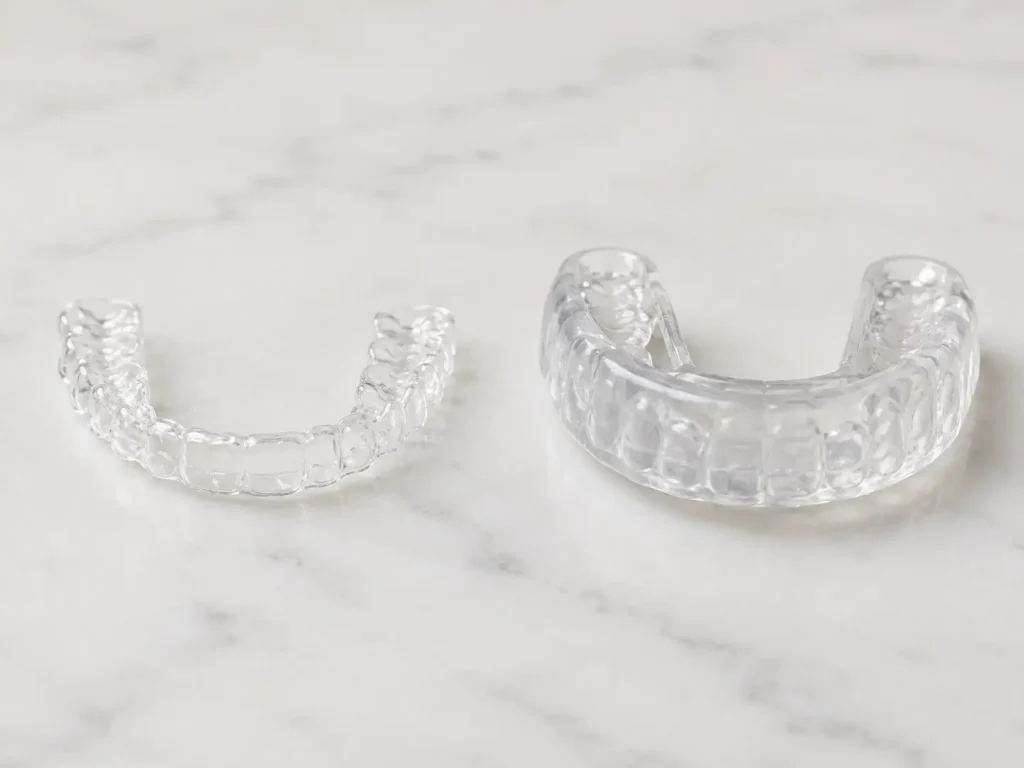
The Core Difference: They Protect Against Different Things
Start here, because everything else follows from it. A retainer and a night guard solve two completely different problems.
A retainer has one job: to hold your teeth in the position your braces or aligners worked so hard to achieve. Teeth naturally drift back toward where they started, sometimes within months of treatment, so a retainer keeps them put. A night guard does something entirely different. It cushions and separates your upper and lower teeth so the force of grinding or clenching, a condition called bruxism, gets absorbed by the appliance instead of your enamel.
One preserves position. The other absorbs force. Once you see it that way, the reason they cannot swap jobs becomes obvious, and it comes down to how each one is built.
What a Retainer Does
A retainer is the final, essential step of orthodontic treatment. After your braces come off or your last aligner comes out, your teeth are in their new positions but not yet stable, because the bone around them is still settling. Without something holding them, they drift. This is the whole reason teeth shift back after braces when a retainer is not worn, and it is why most orthodontists, along with the American Association of Orthodontists, recommend wearing one nightly for life.
To do that job, a retainer is designed to be thin, snug, and precise. A clear retainer is only about 0.76 millimeters thick, roughly the thickness of a credit card. That slim profile is a feature, not a flaw: it lets the retainer grip each tooth exactly and control its position without being bulky or noticeable. What it is not built to do is absorb heavy, repeated force. And that single fact is the crux of this whole article.
What a Night Guard Does
A night guard exists to protect your teeth from you. Bruxism, the clinical term for grinding and clenching, often happens during sleep, when you have no conscious control over the force your jaw generates. And that force is considerable. Left unchecked, it wears down enamel, cracks teeth, damages dental work, and leaves many people waking with sore jaws and headaches.
A night guard solves this by acting as a durable barrier between your upper and lower teeth. Instead of grinding enamel against enamel, you grind against the guard, which absorbs and distributes the pressure. To survive that punishment night after night, night guards are built thick and tough, ranging from about 1.5 to 5 millimeters depending on how severe the grinding is. Compare that to a retainer’s 0.76 millimeters and you can see the difference at a glance. A night guard is engineered to take a beating. A retainer is engineered to be invisible.
Can a Retainer Double as a Night Guard, or Vice Versa?
This is the question everyone actually came here to ask, so let me answer it directly for each direction.
Using a retainer as a night guard: usually a bad idea
If you grind your teeth while wearing a thin retainer, you are asking a credit-card-thin piece of plastic to absorb forces it was never designed for. Two things tend to happen. First, you crack, wear down, or puncture the retainer quickly, and replacing it repeatedly gets expensive. Second, and more concerning, grinding on a retainer can apply uneven pressure that actually shifts your teeth, the exact opposite of what a retainer is supposed to do. In effect, you turn your alignment tool into another hard surface to grind against, and you can damage your bite in the process.
There is one narrow exception worth being honest about. If your grinding is very mild and occasional, and you have a thicker style of retainer, it may offer short-term, limited protection. But that is a temporary bridge, not a solution. For anything beyond occasional light clenching, a retainer is the wrong tool.
Using a night guard as a retainer: also a problem
Going the other way fails too. Night guards are built thicker and generally fit more loosely than a retainer, because their job is to cushion, not to precisely control tooth position. Wear a night guard instead of your retainer and your teeth can drift out of alignment, undoing the orthodontic work you paid for. A night guard protects enamel. It does not hold teeth in place.
So the plain answer is no, in almost all cases. One appliance cannot reliably do both jobs, because the two jobs demand opposite designs: thin and precise versus thick and shock-absorbing.
If You Grind and Just Finished Braces: Your Best Option
This is the situation that genuinely confuses people, and it is more common than you might think. You need a retainer to protect your alignment, and you need protection from grinding. What do you do?
You have a few good options, and the right one depends on your grinding severity. Here is how I generally think about it:
• A dual-purpose appliance. In some cases, an orthodontist can design a single appliance thick enough to both retain your teeth and withstand grinding. This works best for mild to moderate bruxism and has to be professionally made and fitted, not improvised from a standard retainer.
• Two separate appliances. For moderate to heavy grinding, the safest approach is often a proper night guard for sleep plus a retainer worn at other times, or a bonded retainer behind the teeth that holds alignment while the night guard handles grinding.
• A bonded retainer plus a night guard. A permanent retainer bonded behind your front teeth quietly maintains alignment around the clock, while a night guard protects everything from grinding. For many grinders, this pairing is the cleanest solution.
The point is that this is exactly the kind of case where a professional evaluation pays off. Grinding combined with retention is a real clinical puzzle, and the answer depends on how hard you grind, which teeth are affected, and what type of retention your case needs. It is not something to guess at with an over-the-counter product.
How to Know if You Grind Your Teeth
Many people grind and have no idea, because it happens while they sleep. If you are deciding whether you need grinding protection on top of a retainer, watch for these common signs of bruxism:
• Waking up with a sore jaw, facial muscle tenderness, or a dull headache, especially in the morning.
• Teeth that look flattened, chipped, or worn down, or increased tooth sensitivity.
• A partner who hears grinding sounds at night.
• Jaw clicking, tightness, or pain, which can overlap with jaw and TMJ issues and is worth mentioning to your orthodontist.
If several of these sound familiar, bring it up before you assume your retainer alone has you covered. Catching grinding early protects both your enamel and your new alignment.
Caring for Both Appliances
If you end up with a retainer and a night guard, the good news is that caring for them follows the same simple rules, so it is not double the work. Rinse each one in lukewarm water when you take it out, brush it gently with mild dish soap rather than abrasive toothpaste, and store it dry in a ventilated case. Never use hot water on either, since heat warps the plastic and ruins the fit.
One practical tip: keep them in clearly labeled or differently colored cases so you do not mix them up, since they can look similar at a glance. And because a night guard takes real grinding force, inspect it regularly for worn spots or thinning, and replace it before it wears through. A guard with a hole in it is no longer protecting anything.
Why Do People Grind Their Teeth in the First Place?
Understanding what drives bruxism helps you address the root of the problem, not just protect against its damage. A night guard shields your teeth, but it does not stop the grinding itself, so it is worth knowing what is behind it.
Several factors are commonly linked to grinding and clenching:
• Stress and anxiety. This is one of the most common triggers. Tension often expresses itself through a clenched jaw, especially during sleep when you cannot consciously relax it.
• Sleep disorders. Bruxism frequently travels with conditions like sleep apnea, and the two can feed each other, which is one reason persistent grinding is worth investigating.
• Bite issues. When teeth do not fit together properly, the jaw may grind in search of a comfortable resting position, which is one place orthodontic treatment can genuinely help.
• Lifestyle factors. Caffeine, alcohol, and certain medications can increase grinding activity, particularly close to bedtime.
Here is the useful takeaway. Because a corrected bite can reduce the grinding that stems from misalignment, orthodontic treatment sometimes addresses part of the underlying cause, not just the symptom. That said, a night guard is still the frontline protection while any bite issues are being corrected and while stress or other triggers are managed. Think of the guard as protecting your teeth today while you work on the reasons behind the grinding for tomorrow.
Finding the Right Fit at Freedman & Haas
Retainers and night guards look like twins, but they are built for opposite jobs: one holds your teeth in place, the other shields them from the force of grinding. Using the wrong one, or asking one to do both without professional guidance, usually ends in a damaged appliance, shifted teeth, or worn enamel. The good news is that the right combination is straightforward once someone looks at your specific situation.
At Freedman & Haas Orthodontics, our board-certified team can assess whether you grind, what kind of retention your smile needs, and design a plan that protects both your alignment and your enamel, whether that is a single dual-purpose appliance or the right pairing of two. We have guided more than 30,000 patients across West Palm Beach and Wellington to lasting smiles. If you grind your teeth, have questions about your retainer, or wake up with jaw pain, schedule a visit and we will get you the right protection.
Frequently Asked Questions
Can I use my retainer as a night guard?
Usually not. A clear retainer is only about 0.76 millimeters thick and is not built to absorb grinding forces. Grinding on it can crack or wear it out quickly and even shift your teeth through uneven pressure. Only very mild, occasional clenching might be tolerated by a thicker retainer as a short-term measure, but ongoing grinding calls for a proper night guard.
Can a night guard replace my retainer?
No. Night guards are thicker and fit more loosely because they are designed to cushion, not to hold teeth in place. Wearing one instead of your retainer can let your teeth drift out of alignment. If you need both, you need an appliance or combination designed for both jobs, not one substituting for the other.
What is the difference between a retainer and a night guard?
A retainer holds your teeth in their corrected position after orthodontic treatment and is thin and snug, around 0.76 millimeters. A night guard protects your teeth from grinding and clenching and is thicker, roughly 1.5 to 5 millimeters, to absorb force. One preserves alignment, the other absorbs pressure, and they are built very differently to do so.
I grind my teeth and just got my braces off. What should I do?
Tell your orthodontist, because this needs a professional plan. Depending on how heavily you grind, options include a single dual-purpose appliance built to both retain and protect, a night guard paired with a separate retainer, or a bonded retainer behind your teeth combined with a night guard. The right choice depends on your grinding severity and retention needs.
How long do night guards and retainers last?
A night guard typically lasts about 5 to 10 years, though heavy grinders may wear through one faster. Retainer lifespan varies by type, with clear retainers generally lasting a few years and sturdier Hawley retainers lasting longer. Both should be replaced promptly if they crack, warp, or stop fitting correctly.