
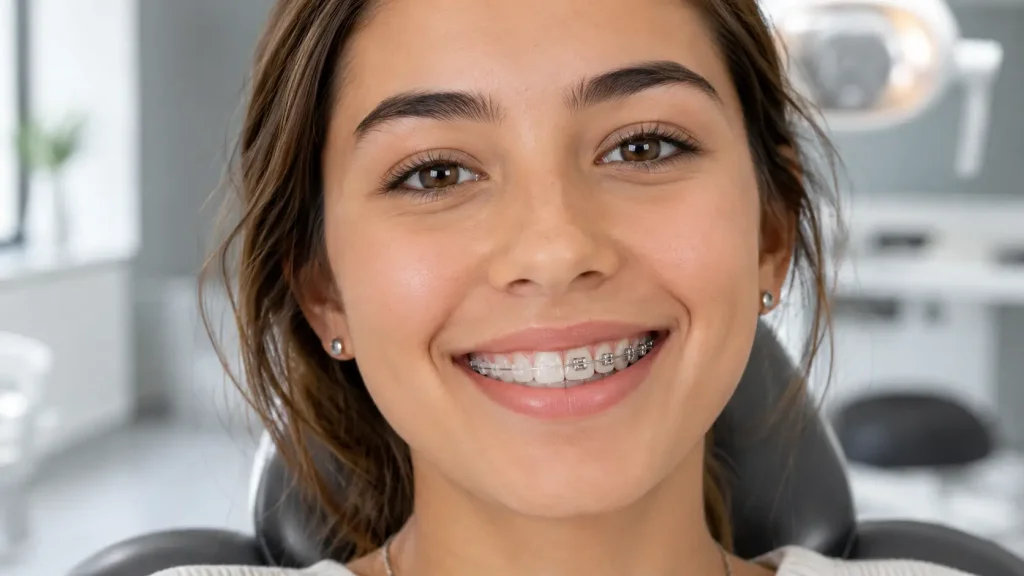
You have made the big decision, you are getting braces. Then, just when you thought the hard part was over, your orthodontist asks a question you weren’t prepared for: “Would you like metal or clear?” Suddenly you are weighing appearance against budget, durability against discretion, and wondering whether one option will quietly cost you months of extra treatment.
Here is the good news: there is no wrong answer, only the answer that fits your case, your lifestyle, and your priorities. In this guide, we compare clear and metal braces head-to-head across the six factors that matter, explain who each option serves best, and answer the questions patients ask us most often in our West Palm Beach and Wellington offices. By the end, you will know exactly which column you belong in.
How Do Clear (Ceramic) Braces Work?
Clear braces, often called ceramic braces, work exactly like traditional braces: brackets bonded to each tooth, connected by an archwire that applies gentle, continuous pressure. The difference is purely in the materials. Instead of stainless steel, the brackets are made from a polycrystalline ceramic that is either tooth-colored or translucent, allowing them to blend into your natural smile. Pair them with a frosted or tooth-colored wire, and from a few feet away most people simply won’t notice them. The underlying biology, however, is identical, if you want the full picture of the forces at play, our article on how orthodontics work to shift teeth explains it step by step.
How Do Metal Braces Work?
Metal braces are the time-tested original: high-grade stainless-steel brackets and wires that have straightened more smiles than every other appliance combined. And if your mental image of metal braces comes from the 1990s, prepare to be surprised. Today’s brackets are dramatically smaller, smoother, and more comfortable than the ones many parents remember, and modern heat-activated wires move teeth more efficiently with less discomfort. For a broader look at every appliance category, our guide to different types of braces covers the full landscape.
Clear vs. Metal Braces: The Key Differences
Both options will get you to the same destination, a healthy, straight smile. The differences lie in the journey. Here is how they compare across the factors patients care about most:
| Factor | Clear (ceramic) braces | Metal braces |
| Appearance | Tooth-colored or translucent brackets that blend in; hard to spot in photos and conversation | Visible stainless steel; colorful elastic ties can make them fun for kids and teens |
| Effectiveness | Treats the same conditions; certain complex movements may progress slightly slower | The gold standard for every case type, including the most severe |
| Durability | Ceramic is strong but more brittle; brackets can chip or fracture and need replacing | Stainless steel is nearly indestructible in everyday use |
| Staining | Brackets resist stains, but the clear elastic ties can discolor with coffee, tea, or curry between visits | No visible staining concerns |
| Cost | Typically, a modest premium over metal due to materials | Usually, the most affordable fixed option |
| Comfort | Smooth, rounded brackets; many patients find them gentler on lips and cheeks | Very comfortable with modern low-profile brackets; occasional irritation possible |
Let’s unpack the three differences that tend to tip the decision one way or the other.
Appearance
This is, without question, the main reason patients choose clear braces. For working professionals, college students, and image-conscious teens, ceramic brackets offer the reassurance of orthodontic treatment without a metallic smile in every meeting, presentation, or photo. On the other hand, plenty of younger patients actually prefer metal precisely because of the colorful elastic ties they get to choose at every visit.
Durability and Maintenance
Stainless steel takes whatever daily life throws at it. Ceramic, while strong, is more brittle, biting into something hard at the wrong angle can chip or fracture a bracket, which means an extra repair visit and, occasionally, a small delay in treatment. Clear braces also ask slightly more of your habits: the brackets themselves resist staining, but the clear elastic ties around them can discolor if you are a devoted coffee, tea, or red-wine drinker. The fix is simple, those ties are replaced at every adjustment, but between visits, rinsing after dark drinks keeps everything looking invisible.
Cost
Because of their specialized materials, clear braces usually carry a modest premium over metal. How much depends on the length and complexity of your treatment, which is why we always quote both options side by side at your consultation. For a realistic look at total figures, insurance, and monthly payment plans in our area, see our complete breakdown of orthodontic treatment costs in West Palm Beach.
Who Is the Best Candidate for Clear Braces?
Clear braces tend to be the right call if you recognize yourself in most of these statements:
- You are an adult or older teen who wants effective treatment without a noticeable metallic look.
- Your work or social life puts you in front of people, clients, cameras, classrooms, every day.
- You want fixed appliances rather than removable aligners, so results never depend on remembering to wear anything.
- You are willing to be slightly more careful with hard foods and dark drinks.
Clear braces are also a popular middle path for patients who were told they are not ideal candidates for aligners but still want discretion, and for adults returning to treatment later in life, a group we wrote about in orthodontic treatment for adults over 40.
Who Is the Best Candidate for Metal Braces?
Metal remains the workhorse of orthodontics for good reason. It is likely your best fit if:
- Your case involves significant crowding, rotations, or bite correction where maximum durability helps.
- You are choosing for a child or younger teen, metal stands up better to lunchrooms, sports, and forgotten rules. Our article on braces for kids covers what parents should expect at each age.
- Budget is a deciding factor and you want the most cost-effective fixed option.
- You simply want the most battle-tested appliance and don’t mind the look, or you actively enjoy customizing your colors.
Speaking of colors: choosing bands is half the fun for many patients. We collected the most popular combinations in our guide to the best colors for braces.
Can Clear Braces Handle Complex Cases?
This is where an honest answer matters more than a sales pitch. Yes, modern ceramic braces can treat nearly everything metal braces treat, including significant crowding and bite problems. Because they are fixed to your teeth and use the same wires, they are mechanically far closer to metal braces than to removable aligners.
That said, in a small number of severe cases, our doctors may recommend metal for specific teeth or treatment phases, for example, when heavy forces or certain auxiliary attachments are needed, or when a deep bite would cause lower brackets to take repeated impact. Sometimes the smartest plan is a hybrid: ceramic brackets on the visible upper front teeth and metal everywhere else, giving you discretion where it counts and durability where it matters. This is exactly the kind of judgment call that benefits from a board-certified orthodontist’s experience rather than a one-size-fits-all answer.
What About Invisalign? Where Does It Fit?
Many patients researching clear braces are really weighing three options, not two. Invisalign and other clear aligners remove the brackets-and-wires question entirely, using a series of transparent removable trays instead. Aligners win on invisibility and food freedom; fixed braces win on around-the-clock reliability and certain complex movements. If your priority is discretion, it is worth comparing both paths before deciding, our article on choosing between braces and aligners through that decision, and you can also compare timelines in does Invisalign work faster than braces. In short: clear braces are the sweet spot for patients who want discretion plus the set-it-and-forget-it reliability of a fixed appliance.
How We Help You Decide at Freedman & Haas
After more than 30 years and 30,000+ smiles across West Palm Beach and Wellington, we have learned that the “best” appliance on paper means nothing if it doesn’t fit the patient in the chair. That is why your consultation with us never starts with a product, it starts with your diagnosis, your goals, and your daily life.
Our board-certified orthodontists will examine your case, show you exactly how each option would perform for your specific teeth, and quote both side by side with no pressure in either direction. Sometimes we will tell you the premium for ceramic isn’t worth it for your case; sometimes we will tell you it absolutely is. Honest guidance is the whole job.
Frequently Asked Questions
Do clear braces stain easily?
The ceramic brackets themselves do not stain. The clear elastic ties holding the wire can pick up color from coffee, tea, red wine, and strongly pigmented foods, but they are swapped for fresh ones at every adjustment visit. Rinsing with water after dark drinks keeps them clear between appointments.
Are clear braces worth the extra cost?
That depends entirely on how much visibility matters to you. If a discreet appearance will make you more confident at work or school for the next 18 months, most patients say the modest premium was easily worth it. If you are choosing for a 12-year-old who wants neon green bands anyway, metal is the smarter spend.
Do clear braces take longer than metal braces?
For most cases, treatment time is essentially the same. In certain complex movements, ceramic brackets may progress slightly slower, and a fractured bracket can add a repair visit. The far bigger drivers of your timeline are case complexity and how well you follow instructions, factors we explore in how often braces are tightened.
Can I get clear braces on just my top teeth?
Yes, and it is one of our most popular requests. Because upper teeth are far more visible than lower ones, many patients choose ceramic brackets on top and metal on the bottom, getting most of the aesthetic benefit at a lower cost.
Ready to See Which Option Fits Your Smile?
Clear or metal, the destination is the same: a smile you love and a bite that works the way it should. The only question is which road suits you, and that is a conversation, not a quiz.
Schedule your consultation at Freedman & Haas Orthodontics today. Our board-certified team will evaluate your case at our West Palm Beach or Wellington office, show you both options on your own smile, and help you make the choice with total confidence. Your future smile won’t care which braces built it, but the next 18 months of your life just might.