
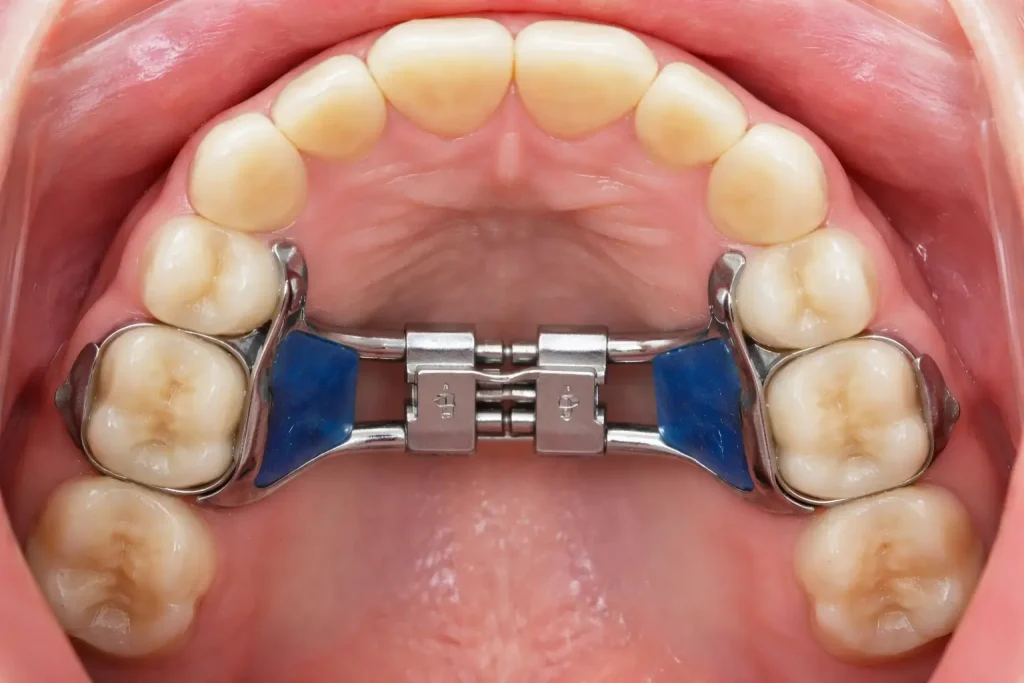
You’re sitting in the orthodontist’s office, and the doctor mentions that your child needs a palatal expander. For most parents, this is the first time they’ve heard the term, and it immediately raises a dozen questions. What is it exactly? Does it hurt? How long does it stay in? Will it affect eating and talking?
These are completely reasonable questions, and the answers are more reassuring than most parents expect. A palatal expander is one of the most predictable and well-established tools in orthodontics, and when used at the right time, it can correct jaw width problems that would otherwise require surgical intervention later in life.
At Freedman & Haas Orthodontics, we walk every family through what to expect before, during, and after palatal expander treatment. This guide covers everything you need to know, from how the appliance actually works to how to turn the key at home.
What Is a Palatal Expander and How Does It Work?
A palatal expander is a fixed orthodontic appliance that fits in the roof of the mouth and is attached to the upper back molars. Its job is to gradually widen the upper jaw, the maxilla, by applying gentle, consistent pressure to the two halves of the palate.
Here’s the part that surprises most people: the roof of your mouth is actually made up of two separate bones that meet in the middle at a growth plate called the midpalatal suture. In children and young teens, this suture hasn’t yet fused, it’s still flexible and responsive to pressure. A palatal expander takes advantage of this by slowly separating the two halves, stimulating new bone to form in the widening gap.
The result is a permanently wider upper jaw. Once the expansion is complete and the new bone has filled in, the result is stable, there’s no tendency for the jaw to narrow back down.
How the Upper Jaw Expands During Childhood
The midpalatal suture begins fusing in the mid-teen years for most patients, typically between ages 14 and 17 in girls and slightly later in boys. Before that fusion is complete, the suture is soft and responsive, allowing gradual widening without surgical intervention.
After the suture fuses, the same expansion is still possible, but it requires a different, more invasive approach called MARPE (Micro-implant Assisted Rapid Palatal Expansion) or, in more complex cases, surgical jaw expansion. This is why orthodontists strongly prefer to address palatal width issues while the suture is still open and the process is simple.
The takeaway for parents: if your child has been recommended for a palatal expander, doing it now, while the window is open, is almost always easier, faster, and less costly than addressing the same problem in adulthood.
Why Would My Child Need a Palatal Expander?
Palatal expanders are recommended for specific reasons, not as a routine part of every child’s orthodontic treatment. The three most common indications are crossbites, crowding, and breathing or airway issues.
Correcting a Crossbite
A posterior crossbite, where one or more upper back teeth bite inside the lower teeth, is the most common reason for palatal expansion. This happens when the upper jaw is narrower than the lower jaw, causing the back teeth to fit together incorrectly.
Crossbites aren’t just an aesthetic issue. Over time, an uncorrected crossbite can cause the lower jaw to shift sideways during biting, which leads to uneven jaw growth and facial asymmetry. The longer a crossbite goes uncorrected, the more that compensatory shift becomes habitual, and eventually structural. Early expansion eliminates the cause before the jaw adapts to it.
Making Room for Crowded Teeth
When the upper arch is too narrow for all the permanent teeth to erupt properly, widening the arch creates additional space without removing teeth. This is one of the ways Phase 1 treatment can prevent the need for permanent tooth extractions later.
A palatal expander doesn’t add teeth, it makes the arch wide enough so that the existing teeth have room to fit. Combined with careful monitoring of eruption timing, expansion during the right developmental window can significantly reduce the crowding that would otherwise require more extensive treatment.
Improving Nasal Breathing and Airway Health
The floor of the nasal cavity sits directly above the roof of the mouth. When the palate is widened, the nasal passage widens with it, which can meaningfully improve nasal airflow in children who breathe primarily through their mouths.
For children who snore, suffer from chronic congestion, or have been identified as mouth breathers, palatal expansion is sometimes recommended in coordination with an ENT or pediatric physician. Improved nasal breathing has downstream benefits for sleep quality, oxygen intake, and even facial development.
Types of Palatal Expanders Used in Orthodontics
Not all palatal expanders are the same. The right type depends on your child’s specific situation, age, and what’s being corrected.
Rapid Palatal Expander (RPE)
The most common type is the Rapid Palatal Expander, or RPE. Despite the name, “rapid” is relative, it typically refers to the expansion phase taking weeks rather than months. The RPE is a fixed appliance cemented to the upper molars. It has a central screw mechanism that a parent activates by inserting a small key and turning it a quarter turn, usually once a day or every other day as prescribed.
Each turn moves the two sides of the expander apart by a fraction of a millimeter, gradually widening the palate. The expansion phase typically lasts three to six months, followed by a retention phase where the expander stays in place (but is no longer being turned) for several more months to allow new bone to consolidate.
Removable Expanders
For very mild expansion needs, or in cases where the patient is highly compliant, a removable expander may be appropriate. These look similar to retainers and can be taken out for eating and cleaning, which many patients prefer.
The downside is that removable expanders only work when they’re being worn. This makes them more sensitive to compliance issues, if a child forgets to wear it, treatment slows or stalls. For cases that require more predictable, consistent force, a fixed RPE is usually the better choice.
MARPE: Skeletal Expanders for Teens and Adults
For older teens whose midpalatal suture has partially or fully fused, standard palatal expanders may not be sufficient to achieve skeletal expansion. MARPE (Micro-implant Assisted Rapid Palatal Expansion) uses small temporary implants placed in the palate to provide more direct force to the bone, bypassing the teeth.
MARPE allows palatal expansion in patients who are too old for conventional expanders but who still want to avoid surgical intervention. It’s more involved than a standard RPE, but it extends the non-surgical window for expansion into the late teens and sometimes early twenties.
In the most complex cases, typically adults with fully fused sutures and severe jaw width discrepancies, surgical-assisted palatal expansion (SARPE) may be the appropriate path. Your orthodontist will discuss which approach is right based on the patient’s specific anatomy and age.
What to Expect: The Palatal Expander Timeline
One of the most helpful things a parent can understand before treatment begins is the timeline, not just the expansion phase, but everything that follows. Here’s a realistic picture of what the process looks like from start to finish.
The appliance is placed during a routine appointment, usually 45 to 60 minutes. A few days of adjustment discomfort are normal as the mouth gets used to the presence of the appliance. Speech may be slightly affected for the first week or two, a mild lisp or difficulty with certain sounds is common and resolves on its own as the tongue adapts.
The active expansion phase, during which you or your child turns the key daily, typically lasts 3 to 6 months. After that, the expander stays in place for an additional 6 to 12 months as a retainer, allowing new bone to fully consolidate before the appliance is removed.
Total time with the expander in place is generally 9 to 18 months. After removal, the orthodontist will assess whether additional orthodontic treatment is needed and plan the next phase accordingly.
How to Turn the Expander Key
Turning the key is something parents often feel anxious about, but it’s straightforward once you’ve done it a few times. Your orthodontist will show you exactly how to do it at the placement appointment and will provide written instructions to take home.
The basic process: have your child tilt their head back, open their mouth wide, and keep their tongue down and out of the way. Insert the key into the hole in the center of the expander, push it firmly in the direction your orthodontist indicated, and rotate until you see the next hole. Then remove the key. The whole process takes about 30 seconds.
It’s completely normal to notice mild pressure or a slightly sore feeling in the upper teeth and the roof of the mouth immediately after turning. This typically resolves within an hour or two. If you’re unsure whether you’ve turned the key correctly, or if you miss a day and aren’t sure whether to double-turn, call the office, we’re always happy to clarify.
Is the Gap Between Front Teeth Normal?
Yes, and this one surprises nearly every parent. As the palate widens, the two upper front teeth (central incisors) often develop a visible gap between them. This gap can look quite dramatic and may seem alarming.
It’s completely expected and temporary. The gap appears because the two halves of the upper jaw are moving apart, and the central incisors are attached to those bones. Once expansion is complete and the expander is no longer being turned, the gap typically closes on its own within a few months as the surrounding teeth drift back together. Any remaining spacing is addressed during Phase 2 comprehensive treatment.
If you notice this gap and haven’t been warned about it, don’t panic, call the office and we’ll confirm that everything is proceeding as planned.
Does a Palatal Expander Hurt?
This is the question every child asks, and the honest answer is: it’s more uncomfortable than painful, and the discomfort is manageable. The initial placement feels awkward and pressured rather than sharp or severe. Most children describe the turning process as a feeling of pressure in the upper teeth, cheeks, or nose, sensations that feel odd but aren’t acutely painful.
Over-the-counter pain relievers like ibuprofen or acetaminophen are typically sufficient on the days when discomfort is noticeable, particularly during the first week of the expansion phase. After the first few days, most children adjust and stop noticing the expander as a source of discomfort.
Eating soft foods for the first few days after placement is usually a good idea. Soups, yogurt, mashed potatoes, and pasta are all good choices. Within a week, most children are back to eating normally, with the exception of the hard and sticky foods that should be avoided throughout treatment.
How to Care for a Palatal Expander
Good hygiene around a palatal expander is important because the appliance creates areas where food can accumulate near the gum tissue and molars. A few simple habits make a big difference.
Foods to Avoid and Cleaning Tips
The main foods to avoid are sticky and chewy items (caramel, gummies, taffy), hard foods that could bend or dislodge the appliance (ice, hard candy, nuts, popcorn), and foods that could get trapped in the expander (chewing gum, stringy foods).
For cleaning, brushing after every meal is ideal. A water flosser or oral irrigator is particularly helpful for flushing food particles out of the area around the expander. Standard flossing is more difficult with the appliance in place, but threading floss under the wire is possible with a floss threader. Your orthodontist will show you the technique at the placement appointment.
Regular orthodontic check-up appointments (every 4 to 8 weeks during the expansion phase) allow the team to clean around the appliance professionally and ensure everything is progressing on track. If the expander feels loose, a wire is poking, or something just doesn’t feel right, call the office, don’t wait for the next scheduled visit.
Palatal Expander Treatment in West Palm Beach and Wellington
At Freedman & Haas Orthodontics, our board-certified orthodontists have decades of experience placing and monitoring palatal expanders for children and teens across Palm Beach County. We see patients at our West Palm Beach and Wellington offices, and we customize every treatment plan to the individual child’s anatomy and developmental stage.
If your child has been told they may need a palatal expander, or if you’ve noticed signs of a narrow jaw, crossbite, or mouth breathing, a professional evaluation is the right next step. We offer free consultations and will explain clearly whether expansion is recommended, when the best time to start is, and what the full treatment path looks like.
Conclusion
A palatal expander is not something to fear, it’s one of the most reliable and well-established tools in orthodontics. When used at the right time and for the right reasons, it corrects jaw width problems that would otherwise require much more complex interventions later, prevents tooth extractions, and in some cases even improves breathing.
The most important thing is to have the evaluation early enough that the option exists. Once the midpalatal suture fuses, the simple non-surgical approach is no longer available. If your child is between ages 6 and 14 and has not yet had an orthodontic evaluation, now is the time.