
It is a worry we hear more often than you might expect. A patient is a few weeks into treatment, enjoying how discreet their aligners are, and then a quiet thought creeps in. If these trays sit snugly over my teeth for most of the day, am I sealing in whatever is on them? Could Invisalign actually be giving me cavities?
It is a fair question, and it deserves a straight answer rather than reassurance for its own sake. The short version is that Invisalign does not cause cavities on its own, and the research actually hands aligners a slight edge over braces on this very front. The longer version, which is the one worth reading, explains the single situation where aligners genuinely can raise your risk, why it happens, and the handful of simple habits that keep it from ever becoming a problem. Let us walk through all of it.
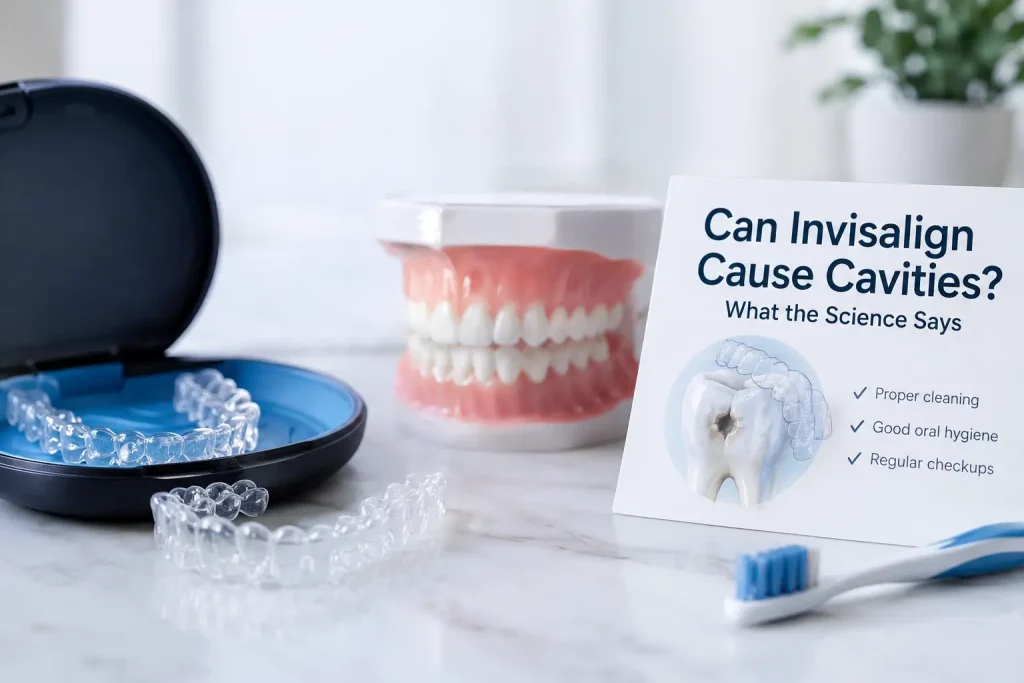
The Honest Answer
Let us start with the reassuring part, because it rests on solid evidence rather than wishful thinking. Clear aligners do not inherently cause tooth decay. If anything, when researchers line up aligner wearers against patients in fixed braces, the aligner group tends to come out ahead on nearly every measure that predicts cavities.
The reason is mechanical and almost obvious once you picture it. Braces bond brackets and wires onto the surface of every tooth, and all of that hardware creates countless little nooks where plaque gathers and a toothbrush struggles to reach. Aligners carry none of that baggage. You take them out, brush and floss exactly as you always have, and slip them back in. Fewer places for plaque to hide means fewer of the conditions that quietly lead to decay in the first place.
What the Research Actually Shows
The numbers tell the same story. A 2023 systematic review and meta-analysis that pooled multiple clinical studies found significantly less plaque accumulation among aligner wearers than among patients in fixed braces, a difference that held steady at three months, six months, and a full year into treatment. In one twelve-month comparison the braces group carried several times the plaque of the aligner group, a striking gap for something as simple as being able to remove the appliance to clean. Several studies within that same review also measured the cariogenic bacteria living in saliva, the microbes most closely tied to decay, and consistently counted fewer of them in the aligner groups.
The most striking figures come from white spot lesions, the chalky early signs of enamel breaking down before a true cavity forms. One retrospective study recorded new lesions in just 0.8 percent of aligner patients, against nearly 19 percent of those in braces on the upper teeth. That is not a narrow margin. It reflects how much easier teeth are to keep clean when nothing is cemented to them. If you have ever noticed the chalky white marks that can linger after braces come off, that is precisely the problem aligners tend to sidestep, and it is one more reason many patients weigh how aligners compare with braces across the factors that matter before deciding.
It is worth adding the one honest asterisk the researchers themselves raised. The very same review that favored aligners also noted that a tray worn close to 22 hours a day can trap plaque against the teeth and blunt saliva’s cleansing effect. In other words, the protective edge aligners hold is real, but it is not automatic. It depends on how they are worn, which brings us to the part that actually matters for your teeth.
A Quick Primer on How Cavities Form
To see why the trays matter at all, it helps to understand what actually causes a cavity, because decay is not a single event so much as a slow tug of war. Every time you eat or drink something containing sugar or starch, the bacteria living in your mouth feed on it and release acid. That acid draws minerals out of your enamel in a process called demineralization, and once the acidity at the tooth surface crosses a certain threshold, the enamel starts to dissolve on a microscopic level. The reassuring part is that this is reversible. Between meals, saliva steps in to neutralize the acid, rinse away the sugar, and ferry calcium and phosphate back into the enamel, a repair process known as remineralization.
A healthy mouth spends all day swinging gently between those two states, and as long as repair keeps pace with damage, no cavity ever forms. A cavity appears only when the balance tips, when acid attacks grow long or frequent enough that saliva simply cannot keep up with the repairs. This is precisely where an aligner can push the scales the wrong way. By sealing the teeth and holding sugar or acid against them while shutting saliva out of the equation, a tray can stretch a brief, survivable dip in acidity into a long one that never gets neutralized. The plastic itself does nothing harmful. It just quietly removes your mouth’s natural ability to recover between exposures.
So Where Does the Risk Actually Come From?
Here is the honest caveat, and it is the whole reason this question is worth asking at all. Although the aligner itself is harmless, the way some people wear it can create a real cavity risk. The culprit is never the plastic. It is what gets trapped underneath it.
Think about what an aligner does while it is in your mouth. It forms a tight, custom seal around every tooth for roughly 22 hours a day. Under normal conditions your saliva bathes your teeth constantly, rinsing away food debris and neutralizing the acids that erode enamel. When a tray caps your teeth, it blocks much of that natural cleansing. Now picture sipping a sweet coffee or a soda with the trays still in place. The sugar and acid seep under the aligner, pool against the enamel, and simply stay there, held against the tooth by the very tray meant to protect your smile. What would have been a brief exposure that saliva washes away instead becomes a prolonged acid bath. That is the mechanism behind every cavity ever blamed on Invisalign.
Eating or drinking anything but water with the trays in
This is the single biggest risk, and happily the easiest one to avoid. Anything other than plain water belongs in your mouth only after the trays come out. That covers coffee, sweetened tea, soda, juice, sports drinks, and even many flavored waters that are far more acidic than they taste.
Putting the trays back without cleaning your teeth
After a meal, food particles and sugar linger on and between your teeth. Seal an aligner over all of that and you have trapped it against the enamel for hours at a stretch. A quick brush, or at the very least a thorough rinse with water, before the trays go back in makes a genuine difference to your risk.
A dry mouth and reduced saliva flow
Because the trays limit how far saliva can reach, anyone who already runs toward a dry mouth, whether from medication, habitual mouth breathing, or simply not drinking enough, starts at a small disadvantage. Saliva is your enamel’s best natural defense, so staying well hydrated matters more during aligner treatment than most people stop to realize.
How to Wear Invisalign Without Getting Cavities

None of this is complicated, and once the habits settle in they turn into second nature. A short set of straightforward rules keeps your risk firmly in the braces-beating territory where it belongs.
• Drink only water while your trays are in. Everything else goes in after they come out.
• Brush, or at minimum rinse thoroughly with water, before putting the trays back after you eat.
• Keep flossing once a day, which is far simpler with no brackets or wires in the way.
• Clean the aligners themselves regularly so they do not turn into a reservoir for bacteria, much the way you would keep a retainer clean.
• Stay hydrated through the day to support the saliva that defends your enamel.
• Keep up with your routine dental checkups, and stay mindful of protecting your gums throughout treatment, since early changes are caught long before they ever become cavities.
Can You Start Invisalign If You Already Have Cavities?
A natural follow-up is whether existing decay rules aligners out. It usually does not, but any active cavities should be treated before or early in your treatment. A new filling can slightly change the shape of a tooth, which in turn affects how precisely the trays fit, so the sequencing matters. This is one more reason treatment should begin with a proper exam rather than a kit mailed to your door, where no one ever looks for the decay in the first place.
The Bottom Line
So, can Invisalign cause cavities? Not on its own. Worn with a little care, aligners are actually one of the cleaner ways to straighten teeth, with research showing less plaque, fewer harmful bacteria, and dramatically fewer white spots than braces. The only real risk comes from eating and drinking with the trays in and skipping the brush afterward, and both of those sit entirely within your control.
At Freedman & Haas Orthodontics, our board-certified team has guided more than 30,000 patients across West Palm Beach and Wellington toward straighter, healthier smiles, and we make sure every aligner patient leaves knowing exactly how to protect their enamel along the way. If you want an honest read on whether Invisalign fits your teeth and your habits, schedule your consultation today and let us talk it through.
Frequently Asked Questions
Does Invisalign cause more cavities than braces?
No. Research consistently shows the opposite. Aligner wearers tend to accumulate less plaque, carry fewer cavity-causing bacteria, and develop far fewer white spot lesions than patients in fixed braces, mainly because the trays come out for brushing and flossing. The cavity risk with aligners comes from how they are worn, not from the aligners themselves.
Can I drink coffee or soda with my aligners in?
You should not. Only plain water belongs in your mouth while the trays are in. Coffee, soda, juice, and sweetened or acidic drinks seep under the aligner and sit against your enamel without saliva to wash them away, which is exactly the situation that leads to decay. Take the trays out, enjoy your drink, then rinse or brush before putting them back.
What happens if I forget to brush before putting my aligners back?
Once in a while it is not a catastrophe, but making a habit of it is where trouble starts. Food and sugar left on the teeth get sealed against the enamel for hours. If you cannot brush after a meal, a thorough rinse with water is a reasonable fallback until you can, and it is far better than nothing.
Can I get Invisalign if I already have a cavity?
Usually yes, but the cavity should be treated before or early in your orthodontic plan. A filling can slightly alter the shape of the tooth and affect how the trays fit, so it is best handled first. This is one reason starting with a full exam matters, since it catches decay a mail-order aligner service would miss entirely.
How do I know if I am getting a cavity during treatment?
Watch for new sensitivity to hot, cold, or sweet, chalky white or discolored spots on the enamel, or any persistent ache. Many early cavities cause no symptoms at all, which is why keeping your regular dental checkups during aligner treatment is the surest way to catch a problem while it is still easy to fix.