
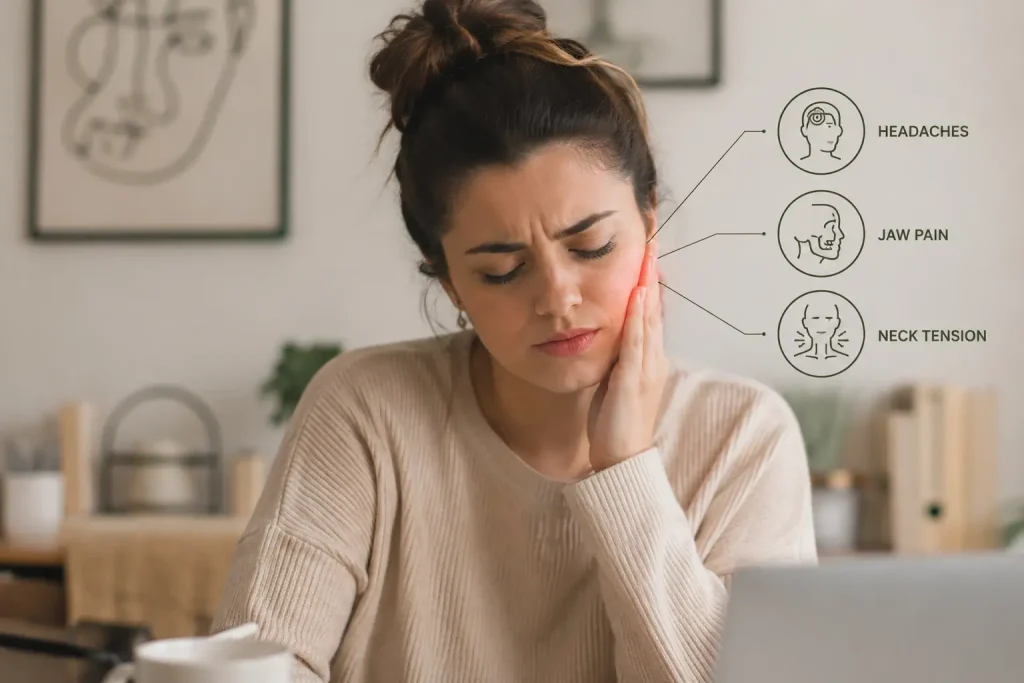
Jaw clicking that keeps you up at night. A dull ache behind your ears every morning. Headaches that start at your temples and work inward. These are the kinds of symptoms that send people to chiropractors, neurologists, and pain specialists, only to eventually hear a referral back to a dentist or orthodontist.
The connection between your bite and your jaw joint is real and well-documented. For a significant subset of people with TMJ disorder, a malocclusion, a bite that does not fit together properly, is at least a contributing factor to their symptoms. And for those patients, correcting the bite through orthodontic treatment can produce genuine, lasting relief. This article explains what TMJ disorder actually is, how bite problems contribute to it, which malocclusion patterns carry the highest risk, when braces or Invisalign can help, and what orthodontic treatment cannot accomplish, so you can approach a consultation at Freedman & Haas Orthodontics with clear, realistic expectations.
What Is TMJ Disorder (TMD), and Why It Happens
TMJ stands for temporomandibular joint, the hinge joint that connects your lower jaw to your skull. You have two of them, one on each side, just in front of your ears. These joints are among the most complex in the human body: they allow the jaw to hinge open and closed, slide forward and back, and move side to side, all in coordinated motion that happens hundreds of times a day during talking, eating, and swallowing.
TMJ disorder, or TMD, is an umbrella term for pain and dysfunction involving these joints, the surrounding muscles, and the structures that connect the jaw to the skull. It is common, affecting a significant portion of the adult population to some degree at some point in their lives, and it is frequently underdiagnosed because the symptoms often appear far from the jaw itself.
Common Symptoms: Clicking, Locking, Pain, and Tension Headaches
TMD presents differently from person to person. The most common symptoms include:
- Clicking, popping, or grating sounds when opening or closing the jaw
- Jaw pain or soreness, especially in the morning or after eating
- Limited range of motion, or difficulty opening the mouth fully
- Jaw locking in an open or closed position
- Earache or a feeling of fullness in the ear without an actual ear infection
- Tension headaches, particularly in the temples, behind the eyes, or at the back of the head
The headache component surprises many patients. The muscles that power jaw movement, including the masseter, temporalis, and pterygoid muscles, are closely connected to the muscles and fascia of the head and neck. When these muscles are chronically overworked or held in abnormal tension by a poor bite, that strain radiates outward and can produce headache patterns that feel entirely disconnected from the jaw.
What Causes TMD: Bite vs. Stress vs. Trauma vs. Grinding
TMD is rarely caused by a single factor. The most common contributing causes include:
- Bite problems (malocclusion) that force the jaw joint into an unnatural position during closure
- Bruxism (teeth grinding and clenching), which places enormous repetitive stress on the joint and surrounding muscles
- Psychological stress, which increases muscle tension throughout the body including the jaw
- Trauma to the jaw or head, even from incidents that happened years earlier
- Structural problems within the joint itself, such as disc displacement
Understanding what is driving a patient’s TMD is essential before any treatment, orthodontic or otherwise, is recommended. At Freedman & Haas, a thorough evaluation looks at the bite, the range of jaw motion, muscle tenderness, and joint sounds before drawing any conclusions about whether orthodontic treatment is appropriate for a given patient.
The Link Between Your Bite and Your Jaw Joint
The jaw joint is designed to function in a specific relationship with the teeth. When the upper and lower teeth come together, they guide the jaw into a position, and the joints accommodate that position. When the teeth do not fit together correctly, when there is a significant malocclusion, the jaw has to shift, compensate, or strain to achieve closure. Over time, that compensatory strain affects the joint, the discs within it, and the muscles that control jaw movement.
How Malocclusion Forces the Jaw Out of Position
Think of it this way: if your upper and lower teeth do not meet symmetrically, your jaw unconsciously shifts to find the most comfortable biting position. That shift might be slight, a millimeter or two, but it is happening dozens of times a minute, all day long, every day. The cumulative load on the joint and muscles is significant, and over months and years, it can lead to the inflammation, disc displacement, and muscle fatigue that produce TMD symptoms.
This is why correcting the bite, bringing the upper and lower teeth into proper alignment so the jaw can close in a balanced, symmetrical position, can reduce or eliminate the compensatory strain that is driving symptoms.
Open Bite, Crossbite, and Deep Bite: The Highest-Risk Patterns
Not all malocclusions carry equal TMD risk. The bite problems most commonly associated with jaw joint stress are:
- Deep bites: The upper front teeth significantly overlap the lower front teeth vertically, forcing the lower jaw backward and loading the joint in a way it was not designed to sustain long-term. Understanding can braces correct overbites and underbites explains why correcting this pattern is often central to TMD relief
- Open bites: The front teeth do not meet at all, which forces excessive load onto the back teeth and fundamentally alters how the jaw mechanics function during chewing. A detailed breakdown of how to fix an open bite covers the orthodontic approaches available for this specific pattern
- Crossbites: Particularly posterior crossbites, which cause the lower jaw to shift laterally during closure, creating asymmetrical loading on one joint over the other
If you have one of these bite patterns and are experiencing TMD symptoms, the connection is worth investigating carefully in a professional evaluation. In practice, many patients come into our offices having lived with one of these patterns for years without realizing the relationship between their bite and their chronic jaw discomfort.
Can Braces Actually Cure TMJ?
“Cure” is too strong a word, and any orthodontist who promises to cure your TMJ with braces is overstating what orthodontic treatment can deliver. What braces can do is correct the underlying bite problem that may be contributing to your symptoms, which in many patients produces significant and lasting relief.
The distinction matters. Orthodontic treatment addresses the dental and skeletal factors that affect how the jaw closes and where it positions itself during function. When a malocclusion is contributing to joint strain, correcting it removes a significant source of that strain. But if the patient’s TMD also involves disc displacement, arthritic changes in the joint, or psychological stress-driven clenching, those components require separate management.
The honest clinical picture is that orthodontic treatment, whether braces or Invisalign, is one important piece of a TMD management plan for appropriate patients. It works best when combined with a complete evaluation and, in many cases, coordination with the patient’s dentist and other providers. Patients who come to us after years of jaw pain often describe the evaluation itself as clarifying, because for many of them it is the first time anyone has connected their bite pattern to their symptoms in a clear and specific way.
Can Invisalign Help With Jaw Pain?
Yes, for many patients. Invisalign corrects the same bite problems that braces correct, including overbites, crossbites, open bites, and crowding that affects how the teeth come together. Furthermore, because Invisalign acts as a mild bite splint while the aligners are being worn, covering the biting surfaces of the teeth, some patients notice temporary relief from clenching symptoms during treatment, separate from any permanent bite correction being achieved.
For adult TMD patients who are good Invisalign candidates, meaning motivated, compliant, and with appropriate case complexity, Invisalign can be an effective way to address the orthodontic component of their TMD management. For a deeper look at what adults need to know about Invisalign in the context of more complex treatment goals, that resource covers the key considerations for adult patients approaching orthodontic treatment with specific clinical concerns.
Braces vs. Invisalign for TMJ: Which One Is Better for You?
The answer depends entirely on your specific case. There is no universal winner. What matters is which treatment is better suited to the particular bite problem contributing to your symptoms. A good starting point for that decision is how do I decide if braces or aligners are best for me, which covers the general clinical factors that guide that choice, including the bite-specific considerations most relevant to TMD patients.
When Invisalign Is the Better Option
Invisalign tends to be effective for TMD-related cases involving moderate overbites, mild-to-moderate crowding affecting bite balance, and spacing issues that alter how the teeth come together. It is often preferred by adult patients who need to manage professionally while in treatment, and for patients whose TMD symptoms are mild to moderate and whose bite correction needs fall within Invisalign’s clinical range, it is a strong and practical option.
When Traditional Braces Are More Effective
For more significant bite corrections, including severe overbites, underbites requiring substantial movement, and complex cases involving multiple planes of correction simultaneously, traditional braces typically offer more control and precision. Braces exert continuous force and allow the orthodontist to manage three-dimensional tooth movement in ways that are more difficult to achieve with removable aligners alone. In cases where the source of TMD symptoms requires precise vertical control or significant bite repositioning, the additional control of fixed appliances is often clinically appropriate.
What Orthodontic Treatment Won’t Fix
Being clear about this is important. Orthodontic treatment will not repair structural damage already done to the TMJ itself. Disc displacement, arthritic changes, and joint degeneration require management through other means, including bite splints, physical therapy, anti-inflammatory therapy, or in severe cases, surgical intervention.
Orthodontics also will not eliminate TMD symptoms caused primarily by stress-driven bruxism. If the main driver of your jaw pain is clenching and grinding under psychological stress, a night guard is the appropriate first line of management, not braces. That said, many patients need both bite correction and bruxism management, addressed in the right sequence, and an experienced orthodontist will help you understand which component to address first.
Will I Need a Night Guard or Bite Splint Too?
Possibly, and this is a common part of TMD management that complements orthodontic treatment rather than replacing it. Night guards protect the teeth and joint from the forces of nocturnal grinding, reducing the muscle fatigue and joint load that contribute to morning pain and headaches. Bite splints, which are more precisely fabricated, can also be used to trial an ideal jaw position before committing to permanent orthodontic correction, giving both the patient and the treating provider a clearer picture of what symptom improvement is achievable.
At Freedman & Haas, we coordinate with patients’ dental teams throughout treatment to ensure that orthodontic and restorative components of TMD management are sequenced appropriately and working toward the same outcome.
What to Expect at a TMJ-Focused Orthodontic Evaluation in West Palm Beach
A TMJ-focused orthodontic evaluation at Freedman & Haas goes beyond standard new-patient records. In addition to digital scans, X-rays, and photos, the evaluation includes a hands-on assessment of jaw range of motion, palpation of the jaw muscles and joint areas for tenderness, analysis of how the teeth come together across multiple jaw positions, and a detailed conversation about symptom history, duration, and triggers.
The goal is to determine whether an orthodontic component exists in your TMD picture, and if so, what kind of bite correction is most likely to help. We will be direct about what we can address, what falls outside orthodontic scope, and what other providers you may need to involve in your care. For patients who have never had a thorough bite evaluation before, this appointment often provides meaningful clarity about why symptoms have persisted despite other treatments. Your first orthodontic consultation walks through what to expect during the visit, with the addition of the TMJ-specific components described above.
Does Insurance Cover TMJ Orthodontic Treatment?
Whether insurance covers orthodontic treatment intended to address TMD depends significantly on how the claim is coded and what your specific plan covers. Standard orthodontic benefits, typically a lifetime maximum of $1,000 to $2,000 under dental insurance, apply to the orthodontic treatment itself regardless of the clinical indication.
Medical insurance may cover some TMD-related treatments such as bite splints or physical therapy under medical benefits, but orthodontic tooth movement is generally classified as dental rather than medical. At Freedman & Haas, we verify your benefits before you begin treatment and help you understand clearly what coverage applies to your specific situation, including flexible 0% interest payment options for out-of-pocket costs.
Conclusion
Braces and Invisalign will not resolve TMJ disorder in every patient, but for patients whose symptoms are driven at least in part by a bite problem, orthodontic treatment can be a meaningful and lasting part of the solution. The key points to take away: TMD is almost always multifactorial, so a thorough evaluation matters before any treatment decision; deep bites, open bites, and crossbites are the patterns most commonly linked to joint strain; correcting the bite removes a significant mechanical source of that strain, but it does not address disc damage or stress-driven grinding separately; and Invisalign and traditional braces each have appropriate cases, with the choice depending on the specific bite problem at hand.
If your bite is contributing to your jaw pain, an honest evaluation will tell you so, along with a clear explanation of what orthodontic treatment can realistically accomplish for your case. Book a free consultation at our West Palm Beach or Wellington office and we will give you a complete picture of what is driving your symptoms and what options exist to address them. Schedule your free consultation here.