
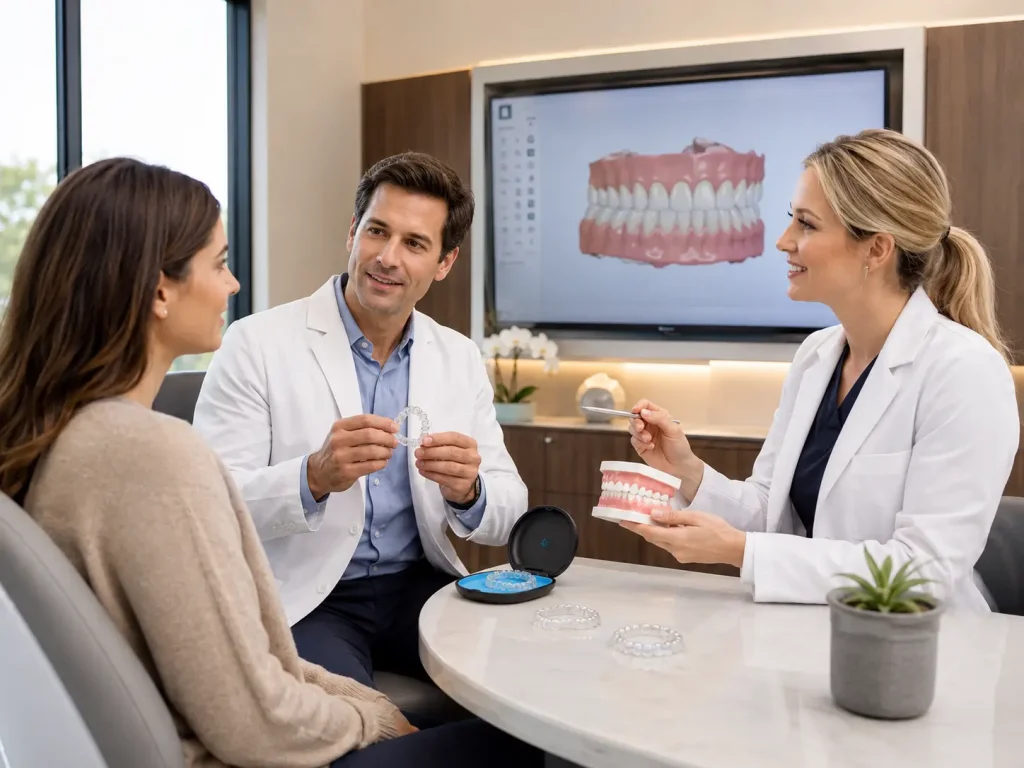
Walk into almost any general dental office in Palm Beach County today and you will find Invisalign on the menu. That is a fairly recent development, and one that has created a lot of confusion for patients who assume that if two providers offer the same product, the results will be similar. They often are not.
The question of whether to see an orthodontist or a general dentist for Invisalign is worth taking seriously. In this article, we will cover exactly what separates an orthodontist from a general dentist, why that difference directly affects your Invisalign outcome, when it matters most, what questions to ask any provider before you commit, and why patients across West Palm Beach and Wellington choose Freedman & Haas Orthodontics when they want the most experienced hands guiding their smile. By the end, you will have a clear picture of what kind of care your case actually requires.
What’s the Real Difference Between a Dentist and an Orthodontist?
Both dentists and orthodontists hold dental degrees, and both are licensed to treat patients. The path diverges significantly after dental school: orthodontists complete an additional two to three years of full-time residency training in orthodontics, a specialty program focused exclusively on the diagnosis, prevention, and treatment of dental and facial irregularities, including malocclusion, tooth alignment, and jaw development.
General dentists do not complete this residency. Their training is designed to produce broad-based practitioners who can handle a wide range of dental needs, including cleanings, fillings, crowns, and extractions. Orthodontics is not their specialty, and the exposure they receive in dental school, while useful, is not equivalent to the depth of a dedicated residency.
That distinction matters more than it might seem on the surface, especially when the treatment involves moving teeth and correcting a bite.
Years of Education and Training Compared
| General Dentist | Board-Certified Orthodontist | |
| Dental school | 4 years | 4 years |
| Orthodontic residency | None | 2 to 3 years, full-time specialty program |
| Board certification | Not applicable | Written and clinical examination by the American Board of Orthodontics |
| Clinical focus | Broad-based dentistry | Tooth movement, bite mechanics, jaw development |
That residency is not a formality. It involves intensive hands-on training in treating hundreds of cases under supervision, with a focused curriculum on how teeth move, how the bite functions, how the jaws grow and develop, and how to plan complex treatment sequences from start to finish. It is the foundation of everything an orthodontist does in clinical practice.
What “Board-Certified Orthodontist” Actually Means
Board certification takes the residency one step further. To understand the importance of seeing a board-certified orthodontist, it helps to know what the process involves: an orthodontist must present a series of completed cases to the American Board of Orthodontics for evaluation, demonstrating that their treatment outcomes consistently meet the highest clinical standards. It is a voluntary but rigorous process that only a fraction of orthodontists pursue.
Dr. Freedman and Dr. Haas both achieved board certification in 2012, presenting complex treated cases before the American Board of Orthodontics in Dallas, Texas. That experience of being evaluated on actual patient outcomes, not just theoretical knowledge, shapes how they approach every new case that comes through the door.
Can a General Dentist Do Invisalign?
Yes, legally and technically. Invisalign’s manufacturer, Align Technology, offers the product to any licensed dentist or orthodontist who completes a training program. That program is relatively brief and focuses primarily on the mechanics of the Invisalign system itself, not on the underlying orthodontic principles that determine whether a treatment plan will actually produce good results.
In practice, this means that a general dentist who offers Invisalign has learned how to use the Align software and submit cases, but may not have deep clinical experience in diagnosing bite problems, managing tooth movements in complex cases, or recognizing when Invisalign is not the right tool at all. The appliance is the same regardless of who prescribes it. The expertise behind the treatment plan is not.
Why Orthodontists Get Better Invisalign Results
Understanding how aligners straighten teeth is only the starting point. The quality of Invisalign treatment depends less on the aligners themselves, which are manufactured by Align Technology to the same standard for every provider, and more on the clinical judgment behind the treatment plan. Who diagnoses the problem, how tooth movements are sequenced, how the bite is managed throughout treatment, and how refinements are handled all determine whether the final result is excellent or merely acceptable.
Diagnosing the Bite, Not Just the Teeth
One of the most important distinctions between an orthodontist’s evaluation and a general dentist’s evaluation is scope. Orthodontists are trained to analyze the bite, specifically the relationship between the upper and lower jaws, alongside the individual positions of teeth. A treatment plan that addresses only tooth alignment while ignoring how the teeth bite together can produce a straighter smile that does not function well, wears unevenly, or creates problems that were not present before treatment.
At Freedman & Haas, every Invisalign evaluation includes a full bite analysis using iTero digital scanning and 3D imaging. What this means in practice is that before any treatment planning begins, the doctors have a complete, three-dimensional picture of how the teeth and jaws relate to each other. That level of diagnostic detail is not universal across all Invisalign providers, and it is directly tied to the standard of care that orthodontic training produces.
Handling Complex Cases: Crowding, Overbites, Underbites
Invisalign is a highly versatile system, but it performs best in the hands of someone who understands its limitations as well as its capabilities. Not every bite problem is well-suited to clear aligners. Certain severe overbites, significant skeletal discrepancies, and cases requiring precise vertical control may be better managed with traditional braces or a combination approach. Knowing the difference is what separates a good outcome from a compromised one.
Knowing which cases to treat with Invisalign, which to treat differently, and how to sequence complex movements requires exactly the kind of expertise that orthodontic training develops over years of supervised clinical work. The 5 keys to creating beautiful smiles with aligners come down to planning, sequencing, and knowing when to course-correct, all of which are skills developed through years of treating real cases, not a weekend certification.
Knowing When Invisalign Is Not the Right Tool
An experienced orthodontist will tell you honestly when Invisalign is the right choice, when it is not, and what the alternatives are. A general dentist offering Invisalign may have a narrower range of case complexity they are comfortable treating, and may offer aligners to patients whose cases fall outside that range without fully disclosing the limitations. That kind of honest assessment, grounded in deep clinical knowledge, is one of the most valuable things a specialist can offer.
When a Dentist Might Be Enough for Invisalign
It is worth being fair here. For genuinely simple cases involving very mild crowding, minor spacing, or minimal tooth movement needed, a skilled general dentist with significant Invisalign experience may produce a perfectly good result. Not every Invisalign case is complex, and not every patient with a straightforward alignment issue needs to see an orthodontic specialist.
That said, the challenge is that patients typically cannot assess their own case complexity accurately. What looks like mild crowding to a patient may involve bite factors, root positions, or eruption issues that make the case considerably more involved than it appears on the surface. The only reliable way to know what level of care your case actually requires is to have it evaluated by someone with the training to see the full picture.
When You Should Absolutely See an Orthodontist
There are categories of cases where seeing a board-certified orthodontist rather than a general dentist for Invisalign is strongly advisable:
- Any case involving a significant overbite, underbite, or crossbite
- Cases with severe crowding or spacing that requires careful movement sequencing
- Treatment for teens or children, where growth factors directly affect how teeth should be moved
- Cases involving bite shifting or jaw asymmetry
- Any situation where a previous Invisalign course did not produce the expected result
In all of these situations, the depth of orthodontic training, including the bite analysis, the growth assessment, and the treatment sequencing expertise, is what separates an adequate outcome from an excellent one. These are not edge cases. In a busy orthodontic practice like Freedman & Haas, cases in several of these categories arrive every week, and the complexity is almost never visible from a simple photo or a quick visual exam.
Does Going to an Orthodontist Cost More?
Not necessarily. Orthodontists and general dentists price Invisalign using broadly similar structures, and in many cases an orthodontist’s Invisalign fee is comparable to what a dental office charges. The Florida range for how much Invisalign costs in Florida, typically between $3,000 and $8,000 depending on case complexity, applies across both provider types.
What you are comparing is not just price but value. A lower fee from a less experienced provider that results in incomplete correction, poor bite function, or the need for retreatment is not a better deal in any meaningful sense. At Freedman & Haas, flexible 0% interest payment plans are available, and the practice accepts more insurance plans than any other orthodontist in the West Palm Beach area, making specialist-level care accessible without a cost premium that puts it out of reach.
What Goes Wrong When Invisalign Is Done by the Wrong Provider
The most common issues that arise when Invisalign is managed by an inexperienced provider include:
- Teeth that are visually straighter but do not bite together properly
- Cases that stall and require extensive refinements because movements were not sequenced correctly from the start
- Teeth that tip rather than translate, meaning only the crown moves while the root position stays incorrect
- Bite problems that were not present before treatment began
- Results that look acceptable initially but relapse because retainer protocols were not appropriate for the specific case
These are not hypothetical risks. At Freedman & Haas, the doctors regularly see patients who come in for a second opinion or retreatment after an unsatisfactory first course elsewhere. The costs in time, money, and frustration are real and avoidable. They are also the direct result of the gap between general dental training and specialist orthodontic training.
Questions to Ask Before Starting Invisalign Anywhere
Whether you are evaluating Freedman & Haas or another provider, these questions are worth asking before you commit to treatment:
- Are you a board-certified orthodontist or a general dentist?
- How many Invisalign cases do you complete each year?
- What additional Invisalign training have you completed beyond the basic Align certification?
- If my treatment needs refinements, are those included in the original fee?
- Can you show me before-and-after results from cases similar to mine?
A provider who welcomes these questions and answers them with specifics is a provider worth trusting. Vague answers or deflection around case volume and additional training are worth noting.
Why Patients in West Palm Beach Choose Freedman & Haas for Invisalign
At Freedman & Haas Orthodontics, Invisalign is treated as what it is: a sophisticated orthodontic tool that requires specialist expertise to use well. Both Dr. Freedman and Dr. Haas are board-certified orthodontists with decades of combined clinical experience, and they treat Invisalign cases at the full range of complexity, from straightforward alignment corrections to involved bite corrections that require careful staging and ongoing monitoring.
Dr. Freedman’s participation in the Dayan Invisalign Masterclass Series, one of the most advanced continuing education programs focused specifically on complex Invisalign cases, reflects a commitment to staying at the leading edge of what the system can do. That kind of ongoing clinical education is what allows the practice to take on cases that other providers would refer out or, worse, attempt without the necessary preparation.
Every evaluation at the West Palm Beach and Wellington offices includes a full bite analysis, digital 3D scanning with iTero, and a direct conversation about whether Invisalign is the right choice for the case at hand. For adult patients in particular, what adults need to know about Invisalign often goes beyond what a quick consultation at a general dental office covers, and that difference in depth tends to show in the final result.
Conclusion
The core question in this article comes down to training, experience, and the depth of care behind a treatment plan. Both orthodontists and general dentists can legally offer Invisalign in Florida, but the expertise they bring to diagnosing your case, sequencing your movements, and managing your bite throughout treatment is meaningfully different. For straightforward cases, an experienced general dentist may be sufficient. For anything more involved, and most cases are more involved than they appear, the depth of specialist orthodontic training is what protects your result.
The most important takeaways: board certification matters because it reflects real clinical outcomes, not just credentials; bite analysis is not optional in good Invisalign care; the cost difference between providers is often smaller than patients expect; and the cost of retreatment after a poor first result is always higher. If you are weighing your options for Invisalign in West Palm Beach or Wellington, a free consultation at Freedman & Haas gives you an honest evaluation from specialists who will tell you exactly what your case involves and what approach will serve you best. Book your free consultation here.