
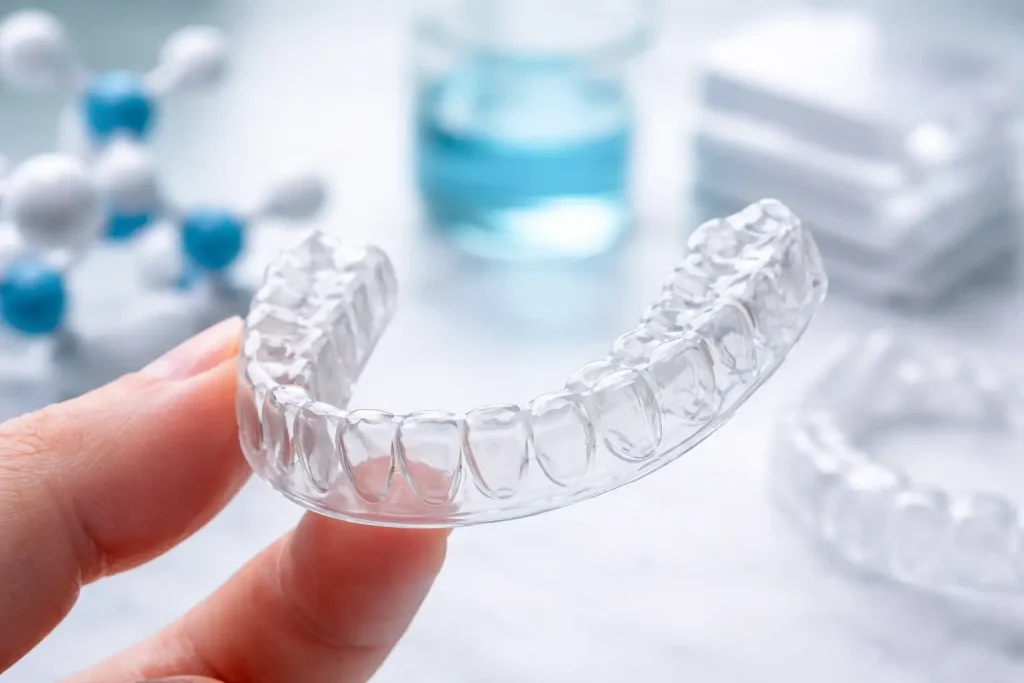
If you’re considering Invisalign in West Palm Beach, Wellington, or Indiantown, one of the smartest questions you can ask (especially if you’re a parent or a “read every ingredient label” kind of person) is: what exactly are these clear aligners made of?
We love this question at Freedman & Haas Orthodontics because it shows you’re thinking like a proactive patient. Invisalign trays sit in your mouth for 20–22 hours a day during active treatment, so it’s completely reasonable to want real, specific answers, not hand-wavy “it’s plastic” explanations.
Here’s the headline: Invisalign clear aligners are made from Invisalign’s proprietary material called SmartTrack, which Align Technology describes as a medical-grade, high molecular weight, thermoplastic polymer. In Align Technology’s own materials/testing documentation, SmartTrack aligners are described as thermoplastic polyurethane/co-polyester.
Now let’s dive deeper into what that means, why the material matters for comfort and results, how the aligners are manufactured, and who tends to be a great Invisalign candidate here in Florida.
What Material Are Invisalign Clear Aligners Made Of?
Invisalign aligners are made from a proprietary, custom-engineered material called SmartTrack. Invisalign’s published FAQ materials describe SmartTrack as a medical-grade thermoplastic polymer designed for elasticity, a snug fit, and consistent force delivery.
If you’re thinking, “Okay… but what kind of thermoplastic polymer?”, great. Align Technology’s materials sheet gets more specific: SmartTrack aligners are made of Thermoplastic Polyurethane/Co-polyester.
Why should you care about the exact material? Because the material influences:
- Comfort: A material with better elasticity and fit can feel smoother and less “sharp” on the gums.
- Predictability: Aligners work by applying controlled forces. A material engineered to deliver gentle, steady force helps keep movements on track.
- Durability and clarity: The better the material performs in the mouth, the less likely it is to warp, crack, or get overly cloudy between changes.
Things we hear all the time: “My aligners feel tight and I’m worried something’s wrong.”
Here’s the solution: a new tray should feel snug, especially in the first day or two. Use aligner chewies for 5–10 minutes a couple times a day to seat them fully (this improves comfort and tracking). If you want safe pain relief, Tylenol (acetaminophen) as directed is typically our go-to recommendation. And if the pain is sharp, one-sided, or getting worse after 48 hours, call us, because that’s not a “push through it” situation.
Another common problem: “The edges are rubbing my tongue or cheeks.”
Here’s the solution: first, make sure the tray is fully seated (chewies help). If you still feel a rough spot, you can gently smooth the edge with a clean nail file/emery board. For temporary relief, a small amount of orthodontic wax on the irritating edge can be magic. If it’s persistent, bring the aligner in and we’ll adjust it properly.
Do Invisalign clear aligners contain Bisphenol A (BPA)?
This is the question behind the question for many families, and we appreciate the directness.
According to Align Technology’s Materials and Testing FAQs, Invisalign aligners are not made with latex, parabens, phthalates, glutaraldehyde, epoxy, or Bisphenol A (BPA).
Additionally, an Invisalign/Align FAQ document states they are not aware of BPA (and also references BPS) being present in their aligners or retainers based on their knowledge and testing.
You might also wonder, “Okay, but what about BPA leaching?” A peer-reviewed in-vitro study comparing multiple clear aligner systems reported no detectable BPA leaching in the systems tested, including Invisalign.
We talk it through with you, case by case. We can share what the manufacturer states about materials, discuss what the research says (and what it doesn’t), and make sure you feel comfortable before you commit. You deserve to feel confident, not rushed.
How Invisalign aligners are made
One of the coolest parts of Invisalign is that it’s not just a “tray.” It’s a whole digital-and-manufacturing workflow that turns your smile into a custom sequence of tiny, planned movements.
In practical terms, here’s how it works:
We start with a detailed digital scan (or impressions in some situations, but scanning is the modern standard). That scan creates a 3D model of your teeth and bite. From there, we design a treatment plan that maps out tooth movement step-by-step, think of it like GPS directions for your smile.
Once the plan is approved, aligners are manufactured so that each tray represents a specific stage. Many descriptions of aligner manufacturing explain that aligners are formed over 3D-printed molds/models for each stage, using a process where the clear material is heated and pressure-formed (thermoformed) to match the mold precisely.
That’s why your trays look nearly identical… but aren’t. Each one is subtly different, and those tiny differences add up to big changes over time.
Issue 1: “I opened a new tray and it doesn’t ‘click’ on easily.”
Here’s the solution: don’t force it like you’re trying to snap a phone case on. Seat it gently, use chewies, and give it a few minutes. If it still won’t fully seat, especially around one tooth, call us. Sometimes it’s a tracking issue, sometimes it’s a tray defect, and sometimes we just need to guide the next step.
Issue 2: “I lost an aligner (or my teen lost one). What now?”
Here’s the solution: don’t panic, and don’t guess. Call our office. Depending on where you are in the series, we may recommend going back to the previous aligner, moving forward to the next one, or ordering a replacement. And yes, this is why the aligner case is non-negotiable. If it’s not in your mouth, it lives in the case. Napkins are the #1 accidental aligner graveyard.
Issue 3: “My aligners are getting cloudy and gross.”
Here’s the solution: brush them gently with a soft toothbrush and clear, mild soap. Avoid hot water (heat can warp thermoplastics). And use retainer/aligner cleaning crystals or tablets as directed a few times a week to reduce odor and buildup. If you drink coffee or tea, remove aligners first, hot beverages + aligners can be a recipe for staining and warping.
Furthermore, if attachments are part of your plan (those small tooth-colored bumps), expect a short adjustment period. Attachments help the aligners grip and move teeth more effectively. They’re one of the reasons Invisalign can treat more complex cases than it used to. The tradeoff is that attachments can feel “bumpy” at first.
Issue 4: “Attachments are shredding my cheeks.”
Here’s the solution: wax for the first week, warm salt-water rinses for irritated tissue, and give your mouth a little time, most patients adapt quickly. If irritation persists, we can polish a rough edge.
Eligibility for Invisalign
Now that you know what Invisalign is made of and how it’s produced, the next big question is: Am I (or my teen) a good candidate?
The honest answer is: many people are, but not everyone should be treated with aligners, and we’ll always tell you the truth, even if it means recommending braces.
Invisalign can be a great fit for mild to complex cases depending on tooth movement needs, bite issues, and patient compliance. Invisalign’s own materials describe usage across a range of cases, but emphasize that suitability and treatment time depend on case complexity and doctor evaluation.
Here’s how we think about candidacy in real life for patients across West Palm Beach, Wellington, and Indiantown:
Invisalign tends to work best when…
You’ll actually wear it. This sounds obvious, but it’s the make-or-break factor. Aligners are removable, which is amazing… and also a responsibility. If you’re wearing them 20–22 hours a day, we can do excellent work. If they’re “in most of the time,” treatment becomes unpredictable and can drag on.
Issue 5: “I snack all day. Invisalign seems impossible.”
Here’s the solution: structure snack times. Instead of grazing, try two snack windows, then brush/rinse and get trays back in. Also, drink water with aligners in, water is safe. For everything else (especially sugary drinks), take them out.
Your goals match what aligners do well. Invisalign is fantastic for many alignment and spacing problems. It’s also great for certain bite corrections when planned properly with attachments and elastics. However, some situations still respond more efficiently to braces, especially when we need heavy-duty control of tooth roots, significant vertical changes, or very complex bite mechanics.
Your gum and bone health are stable. If gums are inflamed or there’s active periodontal disease, we want that addressed first. Moving teeth in an unhealthy foundation is never the right move.
Issue 5: “My gums bleed when I brush. Can I still do Invisalign?”
Here’s the solution: we coordinate with your dentist to get inflammation under control first. Meanwhile, upgrade your home care: use an electric toothbrush, floss daily, and if flossing is hard, use a Waterpik plus floss threaders. Consistent hygiene makes everything, treatment, comfort, results, better.
Teens and Invisalign
Invisalign for teens can be amazing, especially for self-conscious kids who want a less noticeable option. But we’ll be real: teens are busy, hungry, and sometimes forgetful.
Issue 6: “My teen will lose aligners.”
Here’s the solution: build a system. One case that stays in the backpack. One backup case at home. And a rule: aligners never go on lunch trays, never go in pockets, and never get wrapped in napkins.
On the other hand, if your teen is unlikely to wear aligners consistently, braces may be a better choice because they don’t rely on compliance the same way. Our job is to pick the option that will actually succeed for your child.
Adults and Invisalign
Adults often love Invisalign because it blends into professional life. We treat plenty of adults in Florida who are on Zoom all day, meeting clients, or simply want a discreet approach.
Issue 7: “I’m worried Invisalign will make me lisp.”
Here’s the solution: you may have a slight lisp for a few days while your tongue adapts. Read out loud for 10 minutes a day, keep aligners in consistently (taking them out repeatedly slows adaptation), and give it a week. If it’s still significant after two weeks, we’ll evaluate tray fit and thickness and help troubleshoot.
Invisalign vs. braces: the cost reality in Florida
Cost always comes up, and we never want you guessing. Here are the real baseline ranges we discuss with families:
In Florida, traditional braces typically range from $3,000 to $7,000, and Invisalign usually falls between $3,500 and $8,000, depending on case complexity.
What drives where you land in those ranges? Complexity, expected treatment length, how many aligners you need, whether bite correction requires elastics or additional mechanics, and whether refinements are likely.
Issue 8: “I want Invisalign, but I’m afraid it’ll be out of budget.”
Here’s the solution: come in for a complimentary consultation. We’ll show you options, explain what you actually need (not what’s trendy), and map out a payment plan that fits your household.
The “DIY aligners” question (and why material matters)
We also want to say this clearly because we care about your health: not all clear aligners are created equal. Invisalign’s SmartTrack material is engineered specifically for orthodontic tooth movement and backed by extensive manufacturing controls and clinical oversight.
When aligner treatment is done without proper diagnosis, bite planning, and monitoring, the risk isn’t just “it doesn’t work.” The risk is that it changes your bite in ways that create discomfort, uneven tooth wear, or instability.
Issue 9: “I tried a cheaper aligner option and my bite feels weird now.”
Here’s the solution: we evaluate your bite, check for unwanted shifts, and build a plan to stabilize and correct what’s happening. Early intervention matters, don’t wait months hoping it settles.
Conclusion
So, what is Invisalign made of? Invisalign aligners are made from SmartTrack, Invisalign’s proprietary medical-grade, high molecular weight thermoplastic polymer, specifically described in Align Technology documentation as thermoplastic polyurethane/co-polyester. And if you’re wondering about BPA, Align’s published materials state Invisalign aligners are not made with BPA, and independent research has reported no detectable BPA leaching in tested aligner systems, including Invisalign.
Just as importantly, Invisalign isn’t only about material, it’s about the plan. The aligners are created through a digital workflow (scan → staged treatment plan → custom manufacturing), often using 3D-printed molds and thermoforming to shape each stage precisely.
We’d love to help you figure out whether Invisalign is the best fit for your smile and your lifestyle. And when budget comes up (it always does), remember: In Florida, traditional braces typically range from $3,000 to $7,000, and Invisalign usually falls between $3,500 and $8,000, depending on case complexity. At Freedman & Haas, we offer flexible 0% interest financing and low monthly payment plans to make this affordable for families.
Ready for real answers and a clear plan? Schedule a complimentary consultation with us at Freedman & Haas Orthodontics in West Palm Beach, Wellington, or Indiantown, and we’ll walk you through every step, from materials to outcomes, with zero pressure and lots of clarity.